
Cost of Installing Solar Panels in Navi Mumbai Societies (2026 Subsidy Guide)
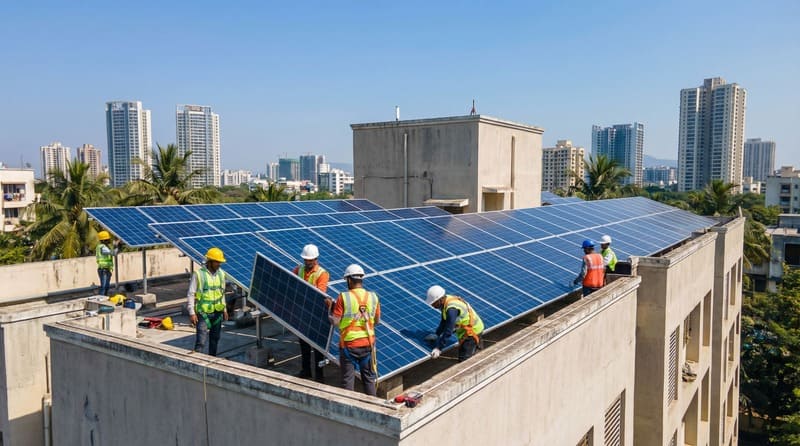
In 2026, the cost of installing a rooftop solar system for housing societies in Navi Mumbai ranges from ₹40,000 to ₹49,000 per kW for premium installations before subsidies. Under the PM Surya Ghar Muft Bijli Yojana, Group Housing Societies (GHS) receive a subsidy of ₹18,000 per kW (capped at 500 kW). Additionally, the Navi Mumbai Municipal Corporation (NMMC) offers a 5% property tax rebate for eco-friendly societies. With Virtual Net Metering now mandatory, the payback period for a typical 50 kW society plant has dropped to just 3.5–5 years.
Let’s face it: the electricity bill for your society’s common areas—lifts, water pumps, and corridor lighting—is likely the single biggest line item in your monthly maintenance budget. If you live in a high-rise in Kharghar or a gated community in Seawoods, you’ve probably noticed these costs inching up every year. But here is the good news: 2026 is arguably the best year in history to switch to solar in Navi Mumbai.
Why? Because panel prices have crashed to ₹22 per watt, government subsidies are being credited directly to bank accounts, and for the first time, you don’t need a massive roof to make it work.
Whether you are a Society Chairman trying to reduce the sinking fund burden or a resident tired of rising maintenance charges, this guide covers everything—from the real installation costs in Vashi to the “Virtual Net Metering” magic that is changing the game for skyscrapers.
1. The 2026 Cost Paradigm: What Are You Actually Paying?
Gone are the days when solar was a luxury experiment for bungalows. In 2026, it is a standardized, fiscal necessity. The cost of solar photovoltaic (PV) modules has dropped significantly, largely due to domestic manufacturing and the government’s ALMM (Approved List of Models and Manufacturers) policy.
Breaking Down the Price Tag
For a housing society, cost isn’t just about the panels. It’s about the entire “System Balance.” Here is what a typical quotation looks like in 2026 for a high-quality installation:
- Solar PV Modules (60% of cost): The heart of the system. Prices hover around ₹22 per watt.
- Inverter (20% of cost): The brain that converts DC to AC.
- Mounting Structure (8% of cost): Crucial in Navi Mumbai due to high wind speeds.
- Cabling & Installation (9-12% of cost): Wiring and labor.
Estimated Pre-Subsidy Costs for Societies:
- Small System (10-20 kW): ₹5.5 Lakhs – ₹10 Lakhs
- Medium System (50 kW): ₹20 Lakhs – ₹25 Lakhs
- Large System (100 kW+): ₹40 Lakhs+
Note: A standard 3 kW system for an individual household now costs approximately ₹1,35,000 before subsidy.
Brand Matters: Premium vs. Value
In Navi Mumbai, you generally have three tiers of equipment to choose from:
- Domestic Premium (Tata Power, Adani): ~₹47k–₹49k per kW. Best for societies wanting 25-year warranty security.
- Domestic Value (Waaree, Vikram): ~₹45k–₹47k per kW. High performance, lower price.
- Global Premium (Panasonic, SunPower): ~₹60k–₹70k per kW. Highest efficiency, but often ineligible for government subsidies due to Domestic Content Requirements (DCR).
2. The Subsidy Bonanza: PM Surya Ghar & NMMC Incentives
The financial viability of solar in 2026 hinges on two major pillars: Central Government subsidies and Local Municipal rebates.
PM Surya Ghar Muft Bijli Yojana
This central scheme has revolutionized funding by using Direct Benefit Transfer (DBT). The money doesn’t go to the vendor; it comes straight to your society’s bank account after commissioning.
- For Individual Homeowners:
- First 2 kW: Subsidy of ₹30,000 per kW (Total ₹60k).
- Additional Capacity (up to 3 kW): Subsidy of ₹18,000 per kW.
- Result: A 3 kW system costing ₹1.35 Lakhs gets a ₹78,000 subsidy, slashing your investment by nearly 60%.
- For Group Housing Societies (GHS):
- Subsidy Rate: Fixed at ₹18,000 per kW.
- Capacity Limit: Up to 500 kW per society (calculated at 3 kW per flat).
- Example: If your society installs a 50 kW plant costing ₹22 Lakhs, you receive a flat subsidy of ₹9,00,000. Your net cost drops to ₹13 Lakhs immediately.
NMMC Property Tax Rebate: The Cherry on Top
The Navi Mumbai Municipal Corporation (NMMC) is aggressive about its “Eco-City” status. Societies that implement green initiatives like Solar Power, Rainwater Harvesting, and Waste Composting can claim a Property Tax Rebate of up to 5%.
- For a large complex in Seawoods paying ₹20 Lakhs in annual property tax, a 5% saving equals ₹1 Lakh per year—forever. This savings alone can cover the annual maintenance of the solar plant.
3. Virtual Net Metering: The High-Rise Solution
Historically, skyscrapers in places like Belapur or Vashi faced a problem: “We have 100 flats but only enough roof space for 20 kW.”
Enter Virtual Net Metering (VNM). Mandated by the Maharashtra Electricity Regulatory Commission (MERC) in 2026, VNM allows a society to install a solar plant elsewhere (or on a common roof) and “digitally distribute” the generated credits to individual bills.
- How it works: If your common solar plant generates 5,000 units, you can allocate 3,000 units to the society office and split the remaining 2,000 units among residents.
- The Impact: Residents get lower personal electricity bills without needing panels on their specific balcony or window.
4. Engineering for the Coast: The Salinity Factor
Navi Mumbai isn’t Pune or Nashik. We are coastal. The air in nodes like Vashi, Nerul, and Ulwe carries heavy salt moisture from the creek. This is kryptonite for standard electronics.
If your committee chooses the cheapest vendor, you risk system failure within 3 years due to corrosion. Here is what your “Technical Specs” document must include:
- Structure Protection: Demand Hot-Dip Galvanized Iron (>80 microns) or Anodized Aluminum. Standard painted iron will rust in Vashi’s humidity.
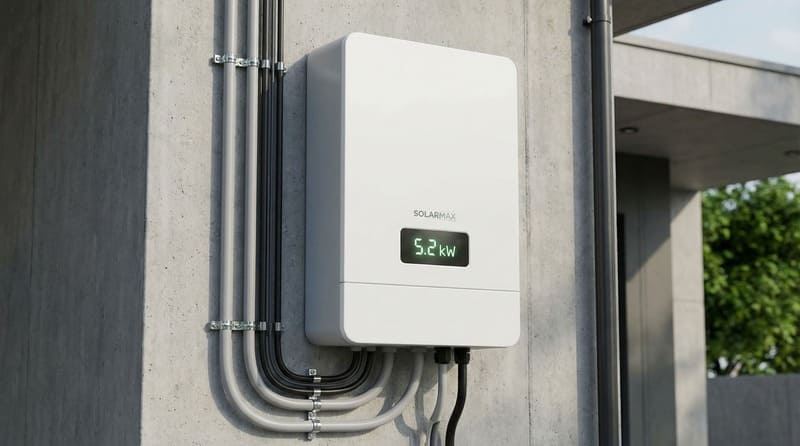
- Inverter Safety: Ensure the inverter has an IP65 rating (water and dust proof) and conformal coating on PCBs to resist salt corrosion.
- Cable Management: Use UV-resistant conduits. Exposed wires will crack under the relentless Navi Mumbai sun and salt spray.
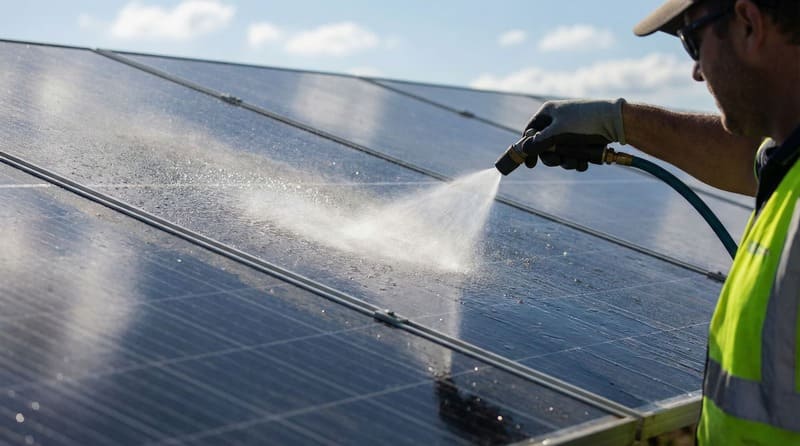
Pro Tip: Cleaning is critical. In dusty areas near the Sion-Panvel Highway, panels should be cleaned every 15 days during non-monsoon months to maintain efficiency. Dust can drop generation by 25%.
5. ROI Analysis: Does it Actually Save Money?
Let’s look at the math for a typical medium-sized society in Kharghar.
Case Study: 50 kW Common Area System
- Total Project Cost: ₹22,00,000
- Less: PM Surya Ghar Subsidy: ₹9,00,000
- Net Cost to Society: ₹13,00,000
- Monthly Savings (at ₹12/unit): ₹78,000
- Annual Savings: ~₹9.36 Lakhs
- Payback Period: ~1.4 to 2 Years (Aggressive estimate); Realistic is 3.5 Years.
After 3.5 years, the electricity generated is essentially free for the next 20+ years. The ROI beats any Fixed Deposit your society holds.
6. How to Finance It: Green Loans
If your society doesn’t want to break its Fixed Deposits, banks are lining up to lend.
- SBI Surya Shakti: Offers loans at interest rates as low as 7% – 9.15%.
- HDFC Bank: Covers up to 80% of the project cost.
This means you can pay the loan EMI using the savings from your electricity bill. It’s a cash-neutral transaction from Day 1.
7. Step-by-Step Guide to Installation
Ready to propose this in your next AGM? Here is your roadmap:
- Feasibility Study: Hire a consultant to check roof strength and shadow analysis.
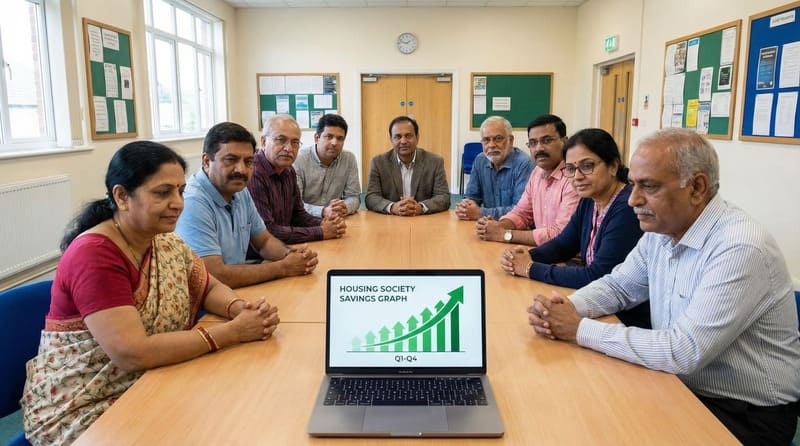
- AGM Approval: You need a 2/3rd majority vote. Present the ROI calculation.
- Vendor Selection: Choose only Empanelled Vendors from the National Portal to ensure subsidy eligibility.
- TFR (Technical Feasibility Report): Apply to MSEDCL. They check transformer capacity (usually approved in 15 days now).
- Installation & Inspection: Install DCR modules. Get the Joint Inspection Report (JIR) signed.
- Subsidy Claim: Upload photos and JIR to the portal. Money hits the bank in 30-90 days.
FAQs
Q1: What is the cost of a 50kW solar system for a housing society in Navi Mumbai? A: In 2026, a 50kW on-grid solar system costs approximately ₹20 Lakhs to ₹25 Lakhs before subsidy. After applying the PM Surya Ghar subsidy of ₹18,000/kW, the net cost to the society comes down to roughly ₹13 Lakhs to ₹16 Lakhs.
Q2: Is the NMMC property tax rebate applicable for existing buildings? A: Yes. Existing housing societies in Navi Mumbai can claim the Eco-Rebate (up to 5%) on property tax if they implement solar power, rainwater harvesting, and waste composting. You must apply to the NMMC ward office with proof of installation.
Q3: Can we install solar panels if our society roof has shadow issues? A: Partial shadow can severely impact generation. However, using Micro-inverters or Power Optimizers can mitigate this by ensuring one shaded panel doesn’t drag down the entire string. Alternatively, under Virtual Net Metering, you might be able to install the system on a different, sunnier structure within the same premises.
Q4: How much subsidy does a homeowner get for a 3kW solar system? A: An individual homeowner in Navi Mumbai gets a total central subsidy of ₹78,000 for a 3kW system under the PM Surya Ghar Yojana. This includes ₹30,000/kW for the first 2kW and ₹18,000 for the third kW.
Q5: What maintenance do solar panels need in coastal areas like Vashi? A: Coastal areas require more frequent cleaning (every 15 days) to remove salt and dust. An annual structural audit is also recommended to check for corrosion on mounting structures and to ensure earthing connections are intact.
The Future is Bright (and Cheap)
The transition to solar energy in Navi Mumbai has moved beyond “saving the planet”—it is now about saving your society’s bank balance. With the convergence of low panel prices, the PM Surya Ghar subsidy, and NMMC tax rebates, the financial argument is irrefutable.
By investing in solar in 2026, your society isn’t just buying power; you are buying independence from future tariff hikes. The sun shining on your terrace is an asset. It’s time to plug it in.