Navi Mumbai Metro Route Map & Fare Guide 2026: The Ultimate Commuter & Investor Playbook
Traffic jams on the Sion-Panvel highway used to dictate the daily schedule of a Navi Mumbaikar. Today, you can glide over the congestion in an air-conditioned coach while enjoying panoramic views of the Kharghar hills. The Navi Mumbai Metro has officially transitioned from a highly anticipated infrastructure dream into the daily lifeline of the city.
Whether you are a daily commuter trying to figure out the fastest route from Taloja to Belapur, or a real estate investor tracking where property values will spike next, understanding the metro network is critical. This comprehensive 2026 guide breaks down the operational routes, the recently slashed fare structures, digital ticketing hacks, and the massive impact this network is having on the local housing market.
Navi Mumbai Metro 2026 at a Glance
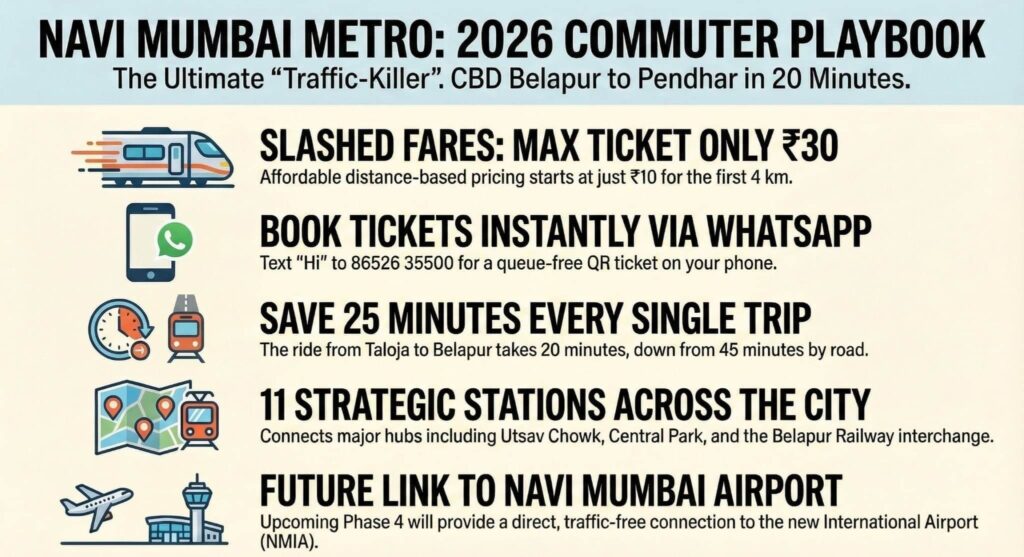
- Operational Route (Line 1, Phase 1): CBD Belapur to Pendhar (11.10 km).
- Total Stations: 11 fully operational elevated stations.
- Revised Fares (2026): Highly affordable, ranging from a minimum of ₹10 to a maximum of ₹30.
- Timings: 6:00 AM to 10:00 PM daily.
- Frequency: Every 10 minutes during peak hours; every 15 minutes during non-peak hours.
- Future Expansions: Direct connectivity to the upcoming Navi Mumbai International Airport (NMIA) via Phase 4.
The Operational Lifeline: Line 1 (CBD Belapur to Pendhar)
The foundation stone for the Navi Mumbai Metro project was laid back on May 1, 2011. After years of anticipation, Phase 1 of Line 1 officially opened its doors to the public on November 17, 2023. Today, in 2026, it operates flawlessly as the backbone of Navi Mumbai’s internal transit.
Executed and funded primarily by the City and Industrial Development Corporation (CIDCO), Line 1 is a completely elevated corridor spanning 11.10 kilometres. It seamlessly connects the bustling commercial hub of CBD Belapur to the rapidly developing residential and industrial node of Pendhar (Taloja).
This specific corridor was designed to ease the extreme vehicular pressure on the internal roads of Kharghar and the Sion-Panvel Highway. By doing so, it has effectively bridged the gap between Navi Mumbai’s established commercial centers and its emerging, affordable residential suburbs.
Station-by-Station Route Map (Phase 1)
The operational stretch consists of 11 strategically placed stations. Here is the sequence if you are traveling from Belapur towards Pendhar:
- CBD Belapur (Belapur Terminal): The starting point and a massive commercial hub. It offers a direct interchange with the CBD Belapur suburban railway station (Harbour Line), making it a crucial transit point for those traveling from Mumbai or Panvel.
- Sector 7 (Belapur): Serves the dense residential and commercial micro-markets of Belapur’s inner sectors.
- CIDCO Science Park: Located strategically to serve students, families, and researchers visiting the park.
- Utsav Chowk (Kharghar): A landmark station in the heart of Kharghar, surrounded by premium eateries, residential towers, and retail outlets. It is heavily utilized by students of nearby educational institutions.
- Sector 11 (Kharghar): Serves the premium residential pockets of central Kharghar.
- Sector 14 (Kharghar): Connects commuters to local markets and mid-segment housing complexes.
- Central Park (Kharghar): A major weekend destination. Families across Navi Mumbai use this station to visit the massive Central Park and the nearby ISKCON temple without worrying about parking.
- Pethpada: Serves the growing residential communities on the outer fringes of Kharghar.
- Sector 34 (Kharghar): Connects to the newer, premium high-rises developing towards the Taloja border.
- Panchanand (Pethali-Taloja): A critical interchange point for industrial workers and residents of the Taloja area.
- Pendhar (Terminal): The current terminus. This station is a game-changer for Taloja residents, cutting their commute to Belapur from a grueling 45-minute road journey to a breezy 20-minute metro ride.
Navi Mumbai Metro Fare Guide 2026: Slashed Prices
One of the most significant updates for commuters happened recently when CIDCO realized the need to aggressively boost ridership. In September 2024, CIDCO slashed the Metro ticket fares by up to 33%, making it one of the most affordable rapid transit systems in India.
Previously, the maximum fare for the full 11 km stretch was ₹40, but the revised structure has capped the maximum fare at just ₹30. This distance-based fare structure is designed to benefit both short-distance hoppers and end-to-end commuters.
Current Fare Structure (Line 1)
| Distance Travelled | Metro Fare |
| 0 – 4 km | ₹10 |
| 4 – 8 km | ₹20 |
| 8 – 11+ km | ₹30 |
Note: There are currently no specific concessions for senior citizens or students, but the highly subsidized base fares make it economical for all demographics.
How to Buy Tickets: The Digital Shift
CIDCO has aggressively pushed for a “queue-free” commuting experience. The traditional plastic token system has been largely phased out in favor of eco-friendly, fast, and digital alternatives.
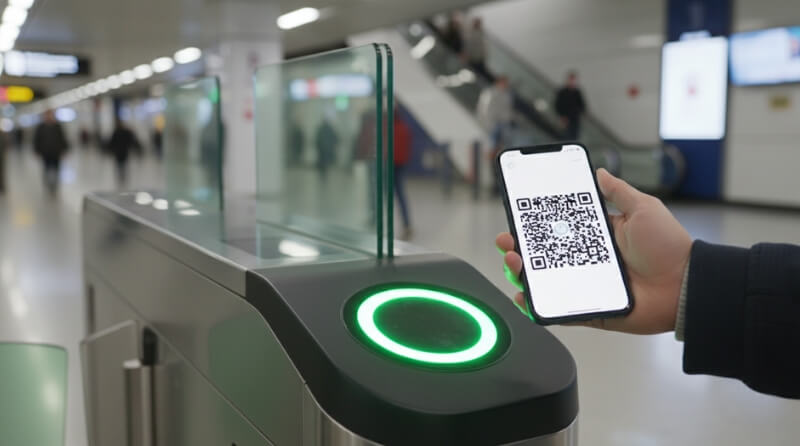
- WhatsApp Ticketing (The Fastest Method): You can book tickets instantly without downloading any app. Simply send a ‘Hi’ to the official metro WhatsApp number (86526 35500), select ‘Buy Ticket’, choose your source and destination, and pay via UPI. You will receive a QR code directly in your chat, which you scan at the AFC (Automated Fare Collection) gates.
- QR Code Paper Tickets: For those who prefer paying by cash, ticket counters now issue thermal-printed paper tickets with a QR code, replacing the old plastic tokens. This system went live to reduce wait times at counters.
- Ticket Vending Machines (TVMs): Automated touch-screen machines are available at all concourse levels. You can select your destination, insert cash, and collect your QR ticket.
- Navi Mumbai Metro Smart Cards: If you are a daily commuter, purchasing a rechargeable Smart Card is the best choice. You can top it up online or at the station, allowing you to bypass ticketing queues entirely.
Mobile App Booking: Passengers can use the dedicated mobile application (like the Mumbai 1 app) to book tickets via credit card, debit card, or UPI, generating a digital QR code on their screen.
Metro Timings & Frequency (2026 Schedule)
To cater to the growing ridership—which surpassed 12,000 riders per day early on and continues to climb—the operator maintains a strict and reliable schedule.
- Operational Hours: The metro runs seven days a week, starting at 6:00 AM and closing at 10:00 PM.
- Peak Hour Frequency (Every 10 Minutes): To handle the office rush, trains run every 10 minutes. This peak frequency applies roughly from 7:00 AM to 10:00 AM, and again from 5:00 PM to 8:00 PM.
- Non-Peak Hour Frequency (Every 15 Minutes): During mid-day and late evening hours, trains run at a comfortable 15-minute interval.
With a top speed of 80 km/h and an average travel time of around 20-25 minutes from Belapur to Pendhar, the metro guarantees that you arrive at your destination entirely free from the unpredictability of road traffic.
The Grand Vision: Upcoming Phases and the Airport Link
While Phase 1 is a massive success, it is only a fraction of the total planned 106.4 km network. The Navi Mumbai Metro Line 1 is being executed in four distinct phases to eventually connect the existing city infrastructure directly to the new aviation hub.
Phase 2: Taloja MIDC to Khandeshwar
Phase 2 aims to capture the massive industrial workforce traveling to Taloja MIDC and the residential populations of Kalamboli and Kamothe.
- Length: 7.12 km.
- Stations (8 Planned): MIDC Station 2, MIDC Station 1, Kasadi, Sector 7 E (Kalamboli), Sector 13 (Kalamboli), Sector 2 E (Kalamboli), Sector 10 (Kamothe), and Khandeshwar.
- Impact: This will provide rapid transit for factory workers and connect Kalamboli—a major highway node—to the broader metro grid.
Phase 3: The Interlink (Pendhar to MIDC)
A short but critical 3.87 km elevated stretch with one station that will physically connect the operational Phase 1 (Pendhar) to the upcoming Phase 2 (MIDC).
Phase 4: Khandeshwar to Navi Mumbai International Airport (NMIA)
This is the phase investors are watching closely. Spanning 4.17 km, this extension will take the metro from Khandeshwar directly into the terminals of the Navi Mumbai International Airport (NMIA). This will give residents of Belapur, Kharghar, and Taloja a direct, traffic-free ride to catch their flights.
The “Gold Line” (Mumbai Airport to Navi Mumbai Airport)
Looking slightly further ahead to 2029, a new 35-km express metro line called the Gold Line (Line 8) is proposed to connect Chhatrapati Shivaji Maharaj International Airport (CSIA) in Mumbai directly to NMIA. Partially underground and partially elevated along the Sion-Panvel Highway, this 20,000-crore project will feature massive interchange hubs at Vashi, Nerul, and Mankhurd, effectively merging the Mumbai and Navi Mumbai transit networks into a single, seamless ecosystem.
Real Estate Impact: Where to Invest Near the Metro?
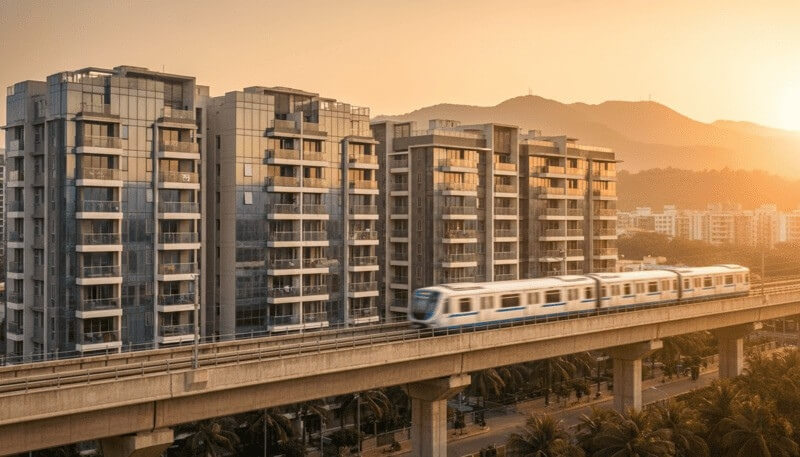
Infrastructure drives real estate. It is the golden rule of property investment. By connecting strategic nodes, the Navi Mumbai Metro is unlocking entirely new opportunity corridors citywide. The “Metro Effect” is actively pushing up property prices, making proximity to a station a major premium.
If you are looking to buy a home or invest in 2026, here is how the metro is reshaping the micro-markets.
1. Taloja (The Affordable Goldmine)
Before the metro, Taloja was considered a distant, disconnected industrial fringe. Today, Pendhar and Panchanand stations have pulled Taloja right into the mainstream.
- The Vibe: High-density, affordable housing with massive township projects.
- Property Prices: A 1 BHK in Taloja typically starts around ₹45 Lakhs, while spacious 2 BHKs range between ₹60 Lakhs to ₹85 Lakhs.
- The Verdict: With Phase 2 set to connect Taloja further down to Khandeshwar, capital appreciation here is expected to remain in the double digits for the next 3-5 years. It is currently the best market for first-time homebuyers on a budget.
2. Kharghar (The Premium Lifestyle Hub)
Kharghar has always been Navi Mumbai’s most well-planned node, but traffic bottlenecks were its Achilles’ heel. With 6 metro stations (from Utsav Chowk to Sector 34) cutting right through its heart, Kharghar has achieved peak transit-oriented development.
- The Vibe: Cosmopolitan, green (Central Park, Golf Course), and education-centric.
- Property Prices: Kharghar is a premium market. A good 2 BHK starts at ₹1 Crore, while luxury 3 BHKs near the hills or Central Park easily command ₹1.8 Crores to ₹2.5 Crores.
- The Verdict: Ideal for end-users seeking a high quality of life. The rental yield here is strong, driven by corporate professionals who now use the metro to commute to Belapur.
3. CBD Belapur (The Commercial Anchor)
As the terminal station that links the Metro to the Harbour Railway Line, CBD Belapur is witnessing a commercial renaissance. Companies are setting up offices here knowing their workforce can commute easily from both Mumbai (via train) and Taloja (via metro).
- The Vibe: Bustling business district by day, vibrant pub and restaurant culture by night.
- The Verdict: Investing in commercial real estate (office spaces, retail shops) near the Belapur Terminal station is highly lucrative, as footfalls have multiplied exponentially.
Pro-Tips for Daily Commuters
If you are just starting to use the Navi Mumbai Metro, keep these 2026 hacks in mind to optimize your travel:
- Park & Ride: If you live in areas like Panvel or Kamothe that aren’t on the metro line yet, drive your two-wheeler to Belapur or Pendhar. Both terminal stations have ample nearby parking. You can bypass the highway traffic entirely.
- Central Park Weekends: Avoid the nightmare of finding parking near Central Park on a Sunday evening. Park your car at Utsav Chowk or Sector 11, take a ₹10 metro ride, and get off right at the park gates.
- Ditch the Tokens: Never stand in line. Use the WhatsApp ticketing feature (86526 35500) while you are walking up the stairs to the station. By the time you reach the security check, your ticket is on your screen.
Riding Towards a Global City
The Navi Mumbai Metro is not just a train; it is a catalyst. It has physically united the commercial might of Belapur, the premium lifestyle of Kharghar, and the affordable housing density of Taloja into one cohesive, accessible urban stretch. As Phase 4 pushes closer to the Navi Mumbai International Airport, the region is bracing for a massive economic upgrade.
Whether you are saving ₹5,000 a month on fuel by commuting via the metro, or earning a 12% ROI on an apartment purchased near Pendhar station, the transit system is paying dividends to everyone.
FAQs
Q1: What are the current Navi Mumbai Metro timings in 2026?
A: The Navi Mumbai Metro operates daily from 6:00 AM to 10:00 PM. During peak hours (7:00 AM–10:00 AM and 5:00 PM–8:00 PM), trains run every 10 minutes. During non-peak hours, the frequency is every 15 minutes.
Q2: What is the maximum fare for the Navi Mumbai Metro?
A: Following a massive 33% fare reduction by CIDCO, the maximum ticket price for a one-way journey on Line 1 (Belapur to Pendhar) is capped at just ₹30. The minimum fare for traveling 0 to 4 kilometers is ₹10.
Q3: Is the Navi Mumbai Metro connected to the local train network?
A: Yes, there is a seamless interchange available. The CBD Belapur Metro Station (Belapur Terminal) is located right next to the CBD Belapur suburban railway station, allowing passengers to easily transfer between the Metro and the Harbour Line (CSMT to Panvel network).
Q4: Which metro stations are closest to the upcoming Navi Mumbai Airport?
A: Currently, there is no direct operational station at the airport. However, under Phase 4 of the Metro Line 1 expansion, the network will be extended from Khandeshwar directly into the Navi Mumbai International Airport (NMIA) with a dedicated terminal station.
Q5: How has the metro impacted property prices in Taloja and Kharghar?
A: The metro has triggered massive real estate growth. Areas near Pendhar and Panchanand stations in Taloja have seen significant capital appreciation, as commute times to Belapur were slashed by half. Properties within a 1-kilometer radius of Kharghar metro stations are commanding higher rental yields due to intense demand from corporate professionals.
Q6: Can I buy a Navi Mumbai Metro ticket online?
A: Absolutely. You can buy tickets online using the Mumbai 1 Mobile App or via WhatsApp by sending a ‘Hi’ to 86526 35500. You make the payment via UPI or card and receive a digital QR code, which you simply scan at the entry gates, completely avoiding the ticket counter queues.