

LPG Gas Price Hike March 2026: Why It Happened and 7 Cheaper Alternatives to Cook Without a Gas Cylinder
The LPG gas price hike 2026 has shaken Indian households across the country. LPG cylinder prices in India jumped by Rs 60 in March 2026, pushing the price of a 14.2 kg domestic cylinder to Rs 912 in Mumbai and Navi Mumbai. Consequently, this marks a significant spike in cooking costs for millions of Indian households. Furthermore, the primary culprit behind this LPG gas price hike 2026 is the Strait of Hormuz crisis affecting 90% of India’s LPG imports, compounded by geopolitical tensions and the Government of India invoking the Essential Commodities Act to manage the shortage. Therefore, if you are a Navi Mumbai resident struggling with rising cylinder costs, this guide explores 7 proven, affordable alternatives to cook without LPG — complete with setup costs, monthly expenses, and practical comparisons.
Current LPG Prices Across Indian Cities (March 2026)
As expected, LPG prices vary across major Indian metros due to transportation costs and local taxes. Below is the snapshot after the March 2026 LPG gas price hike:
| City | 14.2 kg Cylinder Price (Rs) | Price Change | Monthly Impact (3 cylinders) |
|---|---|---|---|
| Delhi | 899 | +60 | +180 |
| Mumbai | 912 | +60 | +180 |
| Navi Mumbai | 912 | +60 | +180 |
| Bangalore | 895 | +60 | +180 |
| Chennai | 905 | +60 | +180 |
| Kolkata | 889 | +60 | +180 |
| Hyderabad | 903 | +60 | +180 |
| Pune | 908 | +60 | +180 |
Why the LPG Gas Price Hike 2026 Is Happening
1. Geopolitical Tensions in the Middle East
Escalating tensions between Iran, the United States, and Israel have created an unstable environment in the world’s most critical oil and gas region. As a result, these tensions directly impact global LPG supplies and drive up international prices, which then translate to higher domestic cylinder costs in India.
2. Strait of Hormuz Blockade and LPG Gas Price Hike
Specifically, the Strait of Hormuz, through which 90% of India’s LPG imports pass, is facing shipping disruptions due to geopolitical conflicts. Consequently, this critical chokepoint in global energy logistics has restricted supply flows, forcing India to source LPG from alternative, more expensive markets. Ultimately, every day of blockade pushes domestic prices higher.
3. High Import Dependency (Over 60%)
India imports over 60% of its LPG requirements from countries like Saudi Arabia, Qatar, the United Arab Emirates, and Australia. Therefore, this heavy dependence on imports makes Indian consumers vulnerable to global price swings. Moreover, unlike countries with domestic LPG production, Hence, India cannot insulate itself from international market volatility.
4. Global Crude Oil Prices and Subsidy Reduction
LPG prices are directly pegged to global crude oil prices. Consequently, rising crude costs, combined with the government’s gradual reduction in LPG subsidies mean households now bear more of the true market cost.However, the Essential Commodities Act has been invoked to regulate pricing, but it does not prevent genuine cost increases from global factors.
7 Cheaper Alternatives to Beat the LPG Gas Price Hike 2026: Complete Cost Breakdown
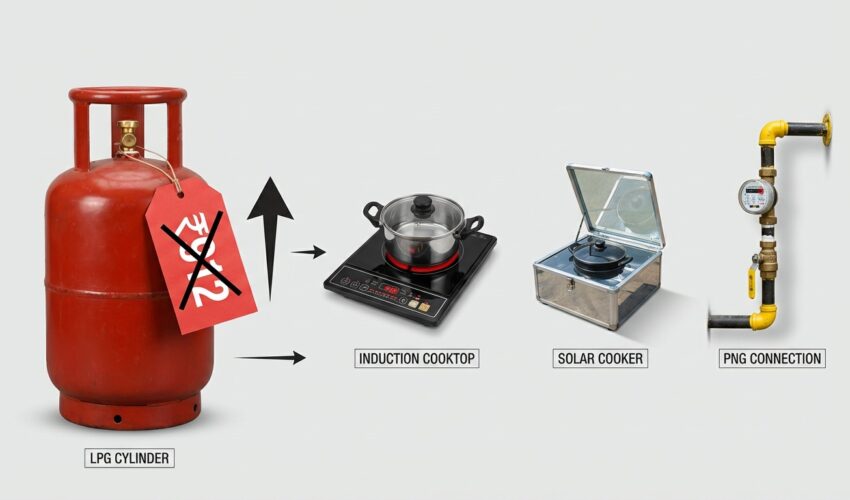
1. Induction Cooktop — Best Alternative to the LPG Gas Price Hike 2026
Specifically, induction cooking uses electromagnetic waves to heat cookware directly, bypassing the need for an open flame. As a result, it is one of the fastest and most energy-efficient cooking methods available today.
Setup Cost: Rs 2,500 to Rs 8,000
Monthly Running Cost: Rs 300 to Rs 500
Lifespan: 10-15 years
Power Required: 2000W
How It Works: Place magnetic cookware on the induction plate. Thus, the appliance creates a magnetic field that heats the cookware rapidly. In fact, heat is generated inside the pan, not the cooktop surface, making it safer and faster.
Pros:
- 90% more energy-efficient than LPG (save Rs 1,500-2,000 monthly)
- Heats water 40% faster than gas.
- Safe: only heats cookware, not the surface.
- Additionally, there are no open flames, reducing fire risk.
- Moreover, it requires low maintenance and lasts 10-15 years.
- Also, it is easy to clean.
Cons:
- Requires induction-compatible cookware (costs Rs 2,000-5,000 more)
- Additionally, it needs stable electricity supply.
- Furthermore, it cannot be used during power cuts.
- Additionally, traditional aluminum or copper pans cannot be used.
Best For: Overall, best for urban households with stable electricity, families of 4-5, daily cooking needs in apartments and flats.
2. Piped Natural Gas (PNG) — Save 25-30% After the LPG Gas Price Hike 2026
Notably, PNG is delivered directly to your home via underground pipes from a centralized distribution network. Indeed, in Navi Mumbai and Mumbai, Mahanagar Gas Ltd (MGL) is the primary distributor.
Setup Cost: Rs 8,000 to Rs 15,000 (connection + meter)
Monthly Running Cost: Rs 400 to Rs 700
Lifespan: Indefinite (infrastructure)
Price per Unit: Rs 25-30 per cubic meter
How It Works: A dedicated gas pipe runs from the municipal distribution network into your home. Notably, you cook directly on gas burners, similar to LPG, but with no cylinder refills needed.
Pros:
- 20-30% cheaper than LPG cylinders monthly.
- Never worry about empty cylinders.
- Continuous, uninterrupted supply.
- No storage space required.
- Safe: no cylinder handling or delivery risks.
- Furthermore, it features automatic metering and billing.
Cons:
- However, it is only available in metro areas (not all neighborhoods in Navi Mumbai have coverage).
- High upfront connection cost.
- However, it is dependent on MGL infrastructure and service quality.
- Also, it cannot be relocated easily.
Best For:Overall, ideal for permanent residents in urban areas with PNG network coverage, Families wanting hassle-free cooking, those tired of managing cylinder deliveries.Learn how to apply for PNG connection in Navi Mumbai.
3. Electric Pressure Cooker: Smart Choice During LPG Gas Price Hike
Remarkably, an electric pressure cooker combines heating and pressure cooking in one sealed chamber. Therefore, it eliminates the need for stovetop cooking altogether.
Setup Cost: Rs 4,000 to Rs 10,000
Monthly Running Cost: Rs 200 to Rs 400
Lifespan: 8-10 years
Capacity: 3-8 liters
How It Works: Fill the cooker with ingredients, set the timer, and the electric element heats water to create steam pressure. Significantly, cooking happens entirely in an enclosed environment, reducing energy waste.
Pros:
- 30-40% cheaper than LPG for daily cooking.
- Completely hands-off cooking (set and forget)
- Energy-efficient: insulated walls prevent heat loss.
- Ideal for dal, rice, meat, and curries.
- Moreover, it is very safe: sealed chamber, no pressure risks if used correctly.
- Fits perfectly on any kitchen surface.
Cons:
- Cannot fry or sauté (requires separate cookware)
- However, it has fixed cooking times (not ideal for quick recipes).
- Requires electricity (useless during power cuts)
- Furthermore, it has limited capacity (not suitable for large families or guests).
Best For: Overall, best for small to medium families focusing on curries, dal, rice, and soups. For example, ideal for apartment dwellers wanting to minimize gas usage.
4. Solar Cooker: Zero Running Cost Despite LPG Gas Price Hike
Interestingly, a solar cooker harnesses free solar energy to heat and cook food. For instance, it requires no fuel, electricity, or complex setup.
Setup Cost: Rs 3,000 to Rs 8,000
Monthly Running Cost: Rs 0 (free solar energy)
Lifespan: 15-20 years
Cooking Time: 2-4 hours (depends on sunlight)
How It Works: A polished reflective surface concentrates sunlight into an insulated cooking chamber. Specifically, the temperature can reach 150C, sufficient for boiling, steaming, and slow cooking.
Pros:
- Zero monthly running cost (completely free cooking)
- Additionally, it is environmentally friendly with zero emissions.
- No dependency on electricity or gas.
- Minimal maintenance.
- Great for Indian households with abundant sunshine.
- Furthermore, it is eligible for government subsidies (up to 50% cost covered).
Cons:
- Only works during daylight (not suitable for breakfast or evening cooking)
- Dependent on weather (rainy days are not viable)
- However, it has slower cooking (2-4 hours for a meal).
- Furthermore, it requires outdoor space and consistent sunlight.
- Additionally, it cannot achieve high-heat cooking (frying, roasting).
Best For: Overall, ideal for families with outdoor space, those wanting zero cooking costs, semi-urban and rural areas with consistent sunshine. In particular, perfect as a supplementary cooker for dal, rice, and vegetables.
5. Microwave Oven
Importantly, a microwave uses electromagnetic radiation to agitate water molecules inside food, generating heat from within.
Setup Cost: Rs 3,000 to Rs 6,000
Monthly Running Cost: Rs 250 to Rs 450
Lifespan: 8-12 years
Power: 700W to 1000W
How It Works: Place food in a microwave-safe container inside the chamber. Additionally, the machine emits radiation at a frequency that excites water molecules, thereby heating the food quickly from the inside out.
Pros:
- Fastest cooking method (5-10 minutes for most meals)
- Energy-efficient for small portions.
- Furthermore, it is perfect for reheating, defrosting, and quick cooking.
- Space-saving for compact kitchens.
- Costs Rs 300-400 monthly for daily use.
Cons:
- Cannot fry, sauté, or achieve cooking texture variety.
- Furthermore, it is not ideal for preparing traditional Indian curries.
- Only suitable for small family portions.
- However, some have health concerns (though largely debunked, many still hesitant).
- Additionally, it requires electricity constantly.
Best For: Overall, best for individuals, working professionals, those needing quick reheating and simple meals. Moreover, not suitable for traditional cooking.
6. Air Fryer
Notably, an air fryer circulates hot air at high speed to cook food. As a result, it mimics the texture of deep-fried items with minimal oil and energy.
Setup Cost: Rs 4,000 to Rs 12,000
Monthly Running Cost: Rs 200 to Rs 400
Lifespan: 8-10 years
Power: 1200W to 1600W
How It Works: Hot air circulates rapidly inside an enclosed chamber at 180-200C. Furthermore, food placed in a basket gets cooked from all angles, creating a crispy exterior without submerging in oil.
Pros:
- 30% energy-efficient compared to regular oven.
- Cooks food 20% faster than traditional methods.
- Importantly, it is healthier, using 80% less oil than deep frying.
- Versatile: fry, bake, roast, reheat all in one appliance.
- Also, it offers easy cleanup with no oil splatter.
Cons:
- Small cooking capacity (unsuitable for large family meals)
- Not ideal for curries or wet dishes.
- However, it has a high upfront cost.
- Requires electricity.
- However, it cannot replicate traditional cooking textures.
Best For: Overall, ideal for families wanting healthier frying options, those with limited time for cooking, snack preparation and quick meals.
7. Biomass / Biogas Cooker (Rural and Semi-Urban)
Interestingly, a biogas cooker burns methane gas produced from decomposing agricultural waste and animal manure. Specifically, it uses renewable cooking fuel.
Setup Cost: Rs 15,000 to Rs 40,000
Monthly Running Cost: Rs 0 to Rs 200 (minimal feedstock cost)
Lifespan: 15-20 years
Daily Feedstock: 20-30 kg agricultural waste
How It Works: Organic matter (cow dung, crop residue, food waste) is fed into an anaerobic digester. Similarly, bacteria decompose the material, producing methane gas. Likewise, this gas flows through a pipe to a kitchen burner, just like LPG.
Pros:
- Near-zero monthly cooking cost (uses waste materials)
- Produces organic fertilizer as a byproduct (saves Rs 3,000-5,000 annually)
- Moreover, it is sustainable and environmentally friendly.
- Government subsidies available (up to 90% cost covered)
- Works just like LPG, familiar cooking experience.
Cons:
- Very high upfront cost (even with subsidies)
- Furthermore, it requires continuous feedstock (daily maintenance).
- Additionally, it needs livestock or access to agricultural waste.
- Moreover, it is not viable for urban apartments or city flats.
- Additionally, it produces odor and needs proper ventilation.
- Also, there are seasonal variations in gas production.
Best For: Overall, ideal for agricultural communities, rural households, families with cattle or livestock, those with access to abundant organic waste.
Cost Comparison: LPG Gas Price Hike 2026 vs 7 Alternative Cooking Methods
| Cooking Method | Setup Cost (Rs) | Monthly Cost (Rs) | Annual Cost (Rs) | Cooking Speed | Availability |
|---|---|---|---|---|---|
| LPG Cylinder | 0 (existing) | 2,700-3,600 | 32,400-43,200 | Medium | All areas |
| Induction Cooktop | 2,500-8,000 | 300-500 | 3,600-6,000 | Very Fast | Urban + Electricity |
| PNG Connection | 8,000-15,000 | 400-700 | 4,800-8,400 | Medium | Metro areas only |
| Electric Pressure Cooker | 4,000-10,000 | 200-400 | 2,400-4,800 | Slow | All + Electricity |
| Solar Cooker | 3,000-8,000 | 0 | 0 | Very Slow | Sunny areas |
| Microwave Oven | 3,000-6,000 | 250-450 | 3,000-5,400 | Very Fast | All + Electricity |
| Air Fryer | 4,000-12,000 | 200-400 | 2,400-4,800 | Fast | All + Electricity |
| Biogas Cooker | 15,000-40,000 | 0-200 | 0-2,400 | Medium | Rural + Waste |
Key Insight: Importantly, a family switching from LPG to induction cooking can save Rs 28,000-38,000 annually. Besides, even accounting for higher electricity bills, induction remains 60% cheaper than LPG over a 5-year period. Moreover, PNG offers 25-30% savings and eliminates cylinder management hassles.
How to Apply for PNG After the LPG Gas Price Hike 2026: Mumbai & Navi Mumbai Guide
Step-by-Step Process with Mahanagar Gas Ltd (MGL)
Eligibility Check: First, verify if your address is in MGL’s service area. Visit mglonline.com or call MGL customer service at 1860-425-4425 to confirm coverage.
Document Preparation: Gather the following documents:
- Property ownership proof (sale deed, rent agreement, or lease)
- Address proof (electricity bill, water bill, or property tax receipt)
- Identity proof (Aadhar, PAN, voter ID, or passport)
- Proof of kitchen location (utility bills showing kitchen address)
Online Application: Visit mglonline.com and click on “New Connection”. In contrast, fill in your details, upload scanned documents, and submit. Nevertheless, you will receive a reference number and an estimated quote.
Payment and Survey: Pay the connection deposit (typically Rs 5,000-10,000 depending on property type). Meanwhile, an MGL surveyor will visit your home within 5-7 days to inspect the kitchen. Additionally, they will identify the pipe routing, and confirm feasibility.Installation: After survey approval, MGL arranges for pipe laying, meter installation, and safety testing. Consequently, the entire process takes 15-30 days depending on your location and any complications in routing.
Final Inspection and Activation: An MGL inspector conducts a final safety check. Therefore, once cleared, your PNG connection is activated. As a result, you will receive a customer ID and are ready to use PNG immediately.
Timeline: Overall, the total process takes 30-45 days from application to activation.
Cost Breakdown: Notably, the connection fee (Rs 8,000-15,000), refundable security deposit (Rs 5,000-10,000), Monthly charges starting from Rs 25 per cubic meter.
Government Subsidies and Schemes for Cooking Alternatives
1. Ujjwala 2.0 Scheme
Notably, the Prime Minister Ujjwala Yojana 2.0 provides free LPG connections to below-the-poverty-line households. While primarily an LPG scheme, it demonstrates government commitment to reducing cooking fuel burden. Thus, check your eligibility at pmuy.gov.in.
2. PM Surya Ghar Yojana
Furthermore, this scheme offers subsidies of up to Rs 78,000 for installing rooftop solar panels. Though primarily for electricity generation, solar panels can also power induction cooktops, effectively making your cooking free after the initial investment.
3. National Biogas and Manure Management Program
Additionally, families in rural and semi-urban areas can receive subsidies covering up to 90% of biogas cooker installation costs. Indeed, contact your state’s agricultural department or visit mnre.gov.in for details.
4. State-Specific Cooking Equipment Subsidies
Similarly, Maharashtra offers subsidies for solar cookers and electric pressure cookers under various renewable energy schemes. Importantly, check with your local municipal corporation (Navi Mumbai Corporation) for current programs and eligibility.
FAQ: LPG Gas Price Hike 2026 — Your Alternatives Answered
Q1: Is induction cooking safe for daily use?
Absolutely, induction cooking is completely safe for daily use. Significantly, it only heats the cookware, not the cooktop surface, reducing burn risks. For example, the electromagnetic field is non-ionizing and poses no health threat. In fact, millions of households worldwide use induction safely every day.
Q2: Can I use my existing cookware with an induction cooktop?
However, only if your cookware is made of iron, stainless steel, or has a magnetic base. For instance, aluminum, copper, and glass cookware will not work. Specifically, you can check if a pan is induction-compatible by placing a magnet on its bottom. Therefore, if the magnet sticks, it will work on induction.
Q3: What is the electricity cost of running induction and electric cookers daily?
Induction cooktops consume 2-3 units of electricity per day (at Rs 5-8 per unit). This results in Rs 300-500 monthly. In particular, this is 70% cheaper than the current Rs 2,700-3,600 LPG cylinder cost for the same cooking.
Q4: How long does it take for PNG connection approval in Navi Mumbai?
Generally, from application submission to final activation, the process typically takes 30-45 days. Additionally, delays may occur if your address is at the edge of the service area or if pipe routing requires extra work. Moreover, you can track your application status on mglonline.com.
Q5: Are solar cookers practical for Indian weather?
Yes, absolutely. Furthermore, India receives 4-6 peak sun hours daily for most of the year. In addition, solar cookers work best in clear skies and are ideal for cooking lunch (11 AM to 3 PM). However, they are less practical during monsoon but perfectly viable in summer and winter. Therefore, consider them as supplementary to your primary cooking method.
Q6: Which alternative is best for families that cook multiple meals daily?
For families cooking 2-3 meals daily, a combination approach works best: induction for breakfast and quick meals (fastest, cheapest), electric pressure cooker for lunch (dal, rice, curries). Furthermore, PNG or biogas serves as primary evening fuel. Consequently, this hybrid approach reduces dependency on any single sourceSimilarly, this hybrid approach reduces dependency on any single source and minimizes monthly costs to Rs 800-1,200 compared to Rs 3,000 for LPG alone.
Conclusion: Beat the LPG Gas Price Hike 2026 — Take Action Today
The LPG gas price hike 2026 is a wake-up call for every Indian household. Indeed, at Rs 912 per cylinder, families cannot afford to remain dependent on a single, volatile fuel source. In fact, the 7 alternatives outlined in this guide are not just cheaper — they are also practical and accessible to everyone, from urban Navi Mumbai to rural areas.
To begin, your first step should be simple: if you have reliable electricity and live in an urban area, seriously evaluate induction cooking. Notably, a one-time investment of Rs 5,000-8,000 will save you Rs 25,000-30,000 annually. Additionally, for those in MGL service areas, apply for a PNG connection today and eliminate cylinder anxiety forever. Furthermore, for rural families, biogas cookers paired with government subsidies offer near-zero cooking costs.
Above all, do not wait for prices to rise further. Therefore, start your transition now. Ultimately, your family’s wallet and the environment will thank you.