
How much does a family actually need each month to live in Navi Mumbai? There isn’t one reliable number. Rent, school choice, commute, flat size and whether you own or rent can change the household budget by tens of thousands of rupees. This guide builds a practical family budget category by category so you can substitute your own costs instead of relying on a single citywide estimate.
Navi Mumbai Family Budget: Quick Answer
For a family, housing is usually the largest variable. Citywide benchmark data suggests a family budget can vary substantially depending on rent, schooling, transport and lifestyle — there is no single reliable figure. Rather than using one headline number, calculate your budget as:
Housing + groceries + utilities + transport + education + healthcare + discretionary spending + savings/contingency.
A family renting privately and paying school fees should expect a materially different budget from a family that owns its home or uses lower-cost schooling. See the three scenarios further below for how this plays out in practice.
What Actually Determines a Navi Mumbai Family Budget?
Two families of the same size, in the same city, can spend very differently. The variables that move the total most are: which node you live in, whether you rent or own, the school route you choose, how many household members commute, and how much you spend on discretionary items. Get the first three right and the rest of the budget becomes far more predictable.
Housing: Start With Your Actual Rent or EMI
Rent varies substantially by node, building, age, furnishing and proximity to transport — a single citywide 1BHK figure hides more than it reveals. Use our Navi Mumbai Cost of Living guide for current housing benchmarks, then insert your actual shortlisted rent (or EMI, if you own) into the budget below rather than a generic node-wise number.
Housing costs can be lower in some developing or more distant locations than in established nodes such as Vashi or Nerul, but the trade-off may be commute time, transport options or project-specific factors. Compare actual shortlisted homes rather than choosing a node solely on its reputation for affordability — our guide to the best areas in Navi Mumbai compares nodes side by side.
A 2BHK does not add a fixed percentage over a 1BHK in the same node — the actual premium varies enormously by project, micro-market, age and size. Compare specific listings rather than applying a formula.
Build Your Monthly Household Budget
Once housing is fixed, build the rest of the budget category by category rather than assuming one standard household amount. The categories below are the ones that matter most for a Navi Mumbai family — use the guidance in each to fill in your own numbers rather than a citywide average.
Groceries & Household Essentials
Grocery spending varies significantly with household size, diet, branded vs. local purchases, online ordering and how often the family eats outside the home. Citywide cost-of-living datasets are better used as benchmarks than as a fixed family grocery allowance — track one month of actual grocery purchases to establish your own baseline, then compare the same basket across neighbourhood stores, supermarkets and online grocery services rather than assuming one channel is always cheaper.
Utilities, Internet & Mobile
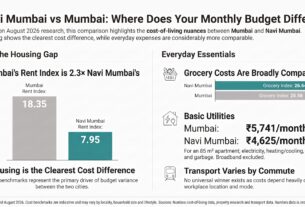
Citywide benchmark data puts basic utilities (electricity, water, gas and garbage) for an approximately 85 sq. m apartment at roughly ₹4,600 a month, before broadband or mobile — actual electricity use can vary substantially with AC usage, apartment size and season. Broadband typically runs around ₹700 a month on top of that. Don’t mix mobile, broadband, gas and electricity into one arbitrary figure — budget each separately so you can see where the money actually goes.
Society maintenance varies by building, facilities, expenditure and the charge heads used under the applicable society framework — there is no universal Navi Mumbai per-square-foot rate. If maintenance isn’t included in your rent, use your actual society bill rather than a citywide assumption; see our Society Maintenance Charges guide for how these charges are typically structured.
Education: Calculate It Per Child
For families with children, school fees can rival rent — and they should be calculated per child rather than treated as one household line item. School fees vary enormously by school, curriculum and grade: published 2026–27 fee schedules at individual Navi Mumbai schools can range from well below ₹1 lakh annually to several lakhs at higher-fee and international schools. Always budget using the specific school’s current fee schedule rather than a citywide average — municipal, state-board and aided schools cost a fraction of private CBSE/ICSE and international fees, and are how many local families keep the budget in check.
Budget for the extras beyond tuition too: admission/one-time fees, school transport, books, uniforms, activities, meals where applicable, and after-school classes. See our guide to the best schools in Navi Mumbai and the international school fees guide for current, school-specific numbers rather than a single citywide figure.
Transport: Calculate It Per Commuter
Budget commuting separately for each working or studying household member rather than for a single earner — a two-commute household can look very different from a one-commute household on paper. Public transport can keep costs relatively low, but the actual monthly cost depends on route and mode. Use the current Local Train guide, Metro fare guide and NMMT bus fare guide for current fares rather than a static figure here, and add car/fuel or cab costs separately if the household uses one.
Healthcare & Insurance
Healthcare is irregular rather than evenly monthly for many households. Budget for health insurance premiums, routine medicines and consultations, and a separate emergency provision — don’t assume healthcare costs zero in a normal month just because nothing came up. Beyond health cover, also budget for vehicle insurance, term/life insurance and home insurance where applicable, using your actual household premiums rather than a generic citywide average.
Domestic Help & Childcare
For many Navi Mumbai families, domestic help or childcare is a material monthly line item — cook, cleaning help, a nanny or after-school care, for example. Costs here depend heavily on hours, frequency and the specific arrangement, so budget using your own actual or expected cost rather than a single citywide wage.
Where a Family Budget Can Flex
Not every category can be trimmed equally. Grouping expenses this way makes it clearer where a family actually has room to adjust:
- Fixed or difficult to change quickly: rent or EMI, school fees, insurance premiums.
- Semi-variable: groceries, electricity, commute, domestic help.
- Discretionary: dining out, subscriptions, entertainment, shopping.
When money is tight, the discretionary category is the one to work on first — the fixed and semi-variable categories usually need a bigger decision (a different node, a different school, fewer commuters) to move meaningfully.
Three Family Budget Scenarios
There is no single “family monthly cost” for Navi Mumbai. A household that owns its home, uses public transport and has low education costs can spend dramatically less than a family renting a larger apartment, paying private-school fees and running a car. Rather than one number, here’s how three different households might approach the same categories:
- Scenario A — Lean household: lower-cost or more distant node, controlled groceries, public transport for all commuters, limited dining out, municipal/state-board or aided schooling (or no school-age children yet).
- Scenario B — Moderate family: a typical rented 1–2BHK in a mid-range node, mixed public/private transport, private-school fees where applicable, broadband and mobile for the household, occasional dining and entertainment.
- Scenario C — Higher-cost family: an established or premium node, a larger home, car or regular cab use, higher-fee or international schooling, domestic help, and more discretionary spending.
Rather than attaching a single fabricated total to each scenario, use the worksheet below to build your own total from your actual category costs — that number will be far more useful than any citywide average.
Annual & Irregular Expenses
Some of the biggest costs in a family’s year don’t show up in a “monthly” budget unless you plan for them. Convert annual and quarterly expenses into monthly provisions: divide annual school fees, insurance premiums, vehicle servicing and other predictable yearly costs by 12, and set that amount aside every month even when the actual bill arrives quarterly or once a year.
Keep a separate provision for irregular expenses too — medical bills, repairs, school activities, festivals, travel and appliance replacement all tend to arrive unevenly rather than as a steady monthly amount.
Renting vs. Owning Changes the Budget Completely
The categories above assume a household with a monthly rent line — but owning changes the shape of the budget substantially.
For renters: rent is the main monthly housing cost; the security deposit is a move-in cash outlay rather than a recurring expense; maintenance may or may not be included in the rent, so confirm this with the landlord.
For owners: the EMI (where applicable) replaces rent; society maintenance and property tax are paid directly; home insurance and repairs are the owner’s responsibility rather than the landlord’s.
Family Monthly Budget Worksheet
This is the feature the old version of this guide was missing: an actual worksheet. Fill in your own amount for each category rather than relying on one citywide number.
| Category | Your Monthly Amount |
|---|---|
| Rent / EMI | ₹_____ |
| Society maintenance | ₹_____ |
| Groceries | ₹_____ |
| Electricity | ₹_____ |
| Cooking gas | ₹_____ |
| Internet + mobile | ₹_____ |
| School tuition (per child) | ₹_____ |
| School transport | ₹_____ |
| Other education (books, uniforms, activities) | ₹_____ |
| Work/school commute (per member) | ₹_____ |
| Car / fuel / cabs | ₹_____ |
| Healthcare / medicines | ₹_____ |
| Domestic help / childcare | ₹_____ |
| Insurance (health, vehicle, life, home) | ₹_____ |
| Dining / entertainment | ₹_____ |
| Shopping / personal care | ₹_____ |
| Emergency / irregular expenses (monthly provision) | ₹_____ |
| Savings / investments | ₹_____ |
| TOTAL | ₹_____ |
Where a Family Budget Can Realistically Flex
Compare neighbourhood markets, supermarkets and online grocery services based on your actual weekly basket rather than assuming one channel is always cheaper. Many parks, promenades and outdoor public spaces around Navi Mumbai have little or no entry cost, although parking and specific activity charges can vary — our guide to free things to do in Navi Mumbai is a good place to plan weekends that don’t dent the budget.
A Realistic Bottom Line
There is no credible single monthly budget for a Navi Mumbai family. A household that owns its home, uses public transport and has low education costs can spend dramatically less than a family renting a larger apartment, paying private-school fees and running a car. The most useful approach is to build the budget from your actual housing, education and commute costs first, then add groceries, utilities, healthcare and discretionary spending using the worksheet above. The levers that move the total most are the node you live in, whether you rent or own, and the school route you pick — get those right and the rest is manageable.
Frequently Asked Questions
What does a budget family month cost in Navi Mumbai?
There is no reliable single amount. Rent, school fees, household size, commute and vehicle ownership can change the monthly budget substantially. Build the total from your actual housing and education costs first, then add groceries, utilities, transport, healthcare and discretionary spending using the worksheet above.
Which Navi Mumbai nodes are most affordable for families?
Housing costs can be lower in some developing or more distant nodes than in established locations such as Vashi or Nerul, but affordability should be evaluated against commute costs and the actual property available. Compare current listings rather than relying on a fixed locality ranking — our Cost of Living guide has current housing benchmarks.
How much are school fees in Navi Mumbai?
School fees vary significantly by institution, board and grade. Published 2026–27 fee schedules at individual Navi Mumbai schools range widely — some run well below ₹1 lakh a year, others run into several lakhs at higher-fee and international schools. Use the specific school’s current official fee structure, and budget transport, books, uniforms and one-time charges separately from tuition.
How can families keep grocery costs down?
Start by tracking one month of actual grocery spending. Compare the same basket across neighbourhood stores, supermarkets and online grocery services, plan meals before shopping, and separate essential groceries from convenience purchases.
Are there free things to do with family in Navi Mumbai?
Many parks, promenades and outdoor public spaces have little or no entry cost, although access, parking and specific activity charges can vary. See our guide to free things to do in Navi Mumbai for selected outing ideas and the costs to check.
What is the biggest expense for a family in Navi Mumbai?
For renting households, housing is often one of the largest fixed costs. For families using private schools, education can also become a major expense — sometimes rivalling rent. The relative weight depends on your locality, school choice and household decisions, which is why the worksheet above asks you to fill in your own numbers rather than rely on a fixed ranking.
How should annual school fees be budgeted monthly?
Add up tuition, transport and other predictable annual school costs, subtract any one-time charges that don’t recur every year, then divide the annual recurring total by 12. Set that amount aside monthly, even though fees are usually billed quarterly or term-wise, so the payment doesn’t come as a shock.
Is Navi Mumbai cheaper for families than Mumbai?
Housing can make Navi Mumbai materially cheaper in some comparisons, but the result depends on the exact localities, commute and household being compared. See our dedicated Navi Mumbai vs Mumbai Cost of Living guide for the full comparison.
Sources & Methodology
There is no single official “family cost of living” figure for Navi Mumbai. Household spending varies substantially by locality, housing, school choice, commute, family size and lifestyle. This guide therefore uses citywide benchmark data only where appropriate, and encourages readers to substitute their actual housing, education and transport costs using the worksheet above.
Cost-of-living benchmarks (utilities, broadband) were cross-checked against current Numbeo and Wise Navi Mumbai datasets — Numbeo’s dataset is built from contributor-submitted prices, so treat these as broad benchmarks rather than hard household budgets. School costs should be checked against each school’s official 2026–27 fee schedule rather than a citywide average. Transport fares should be verified through the relevant operator or this site’s dedicated, currently-audited fare guides. Society maintenance should be based on your actual society bill rather than a citywide per-square-foot assumption.
Last verified: 27 August 2026.