
For many older housing societies in Navi Mumbai, ageing buildings, structural concerns and changing development regulations are prompting a hard look at redevelopment. But redevelopment isn’t simply about finding a developer and agreeing on a bigger flat: it can involve the society, CIDCO, the relevant planning authority, structural professionals, legal advisers, developers and, where applicable, MahaRERA, and the specifics of land tenure and consent can materially affect what’s actually possible.
This guide walks through that process from a flat owner’s perspective and flags the checks to make before any major decision.
Important: Redevelopment requirements can vary according to land tenure, planning authority, building condition, applicable development regulations and the circumstances of an individual society. This guide is for general information and should not replace verification with CIDCO/NMMC, qualified structural professionals or independent legal advisers.
Quick Answer: How Does Society Redevelopment Work in Navi Mumbai?
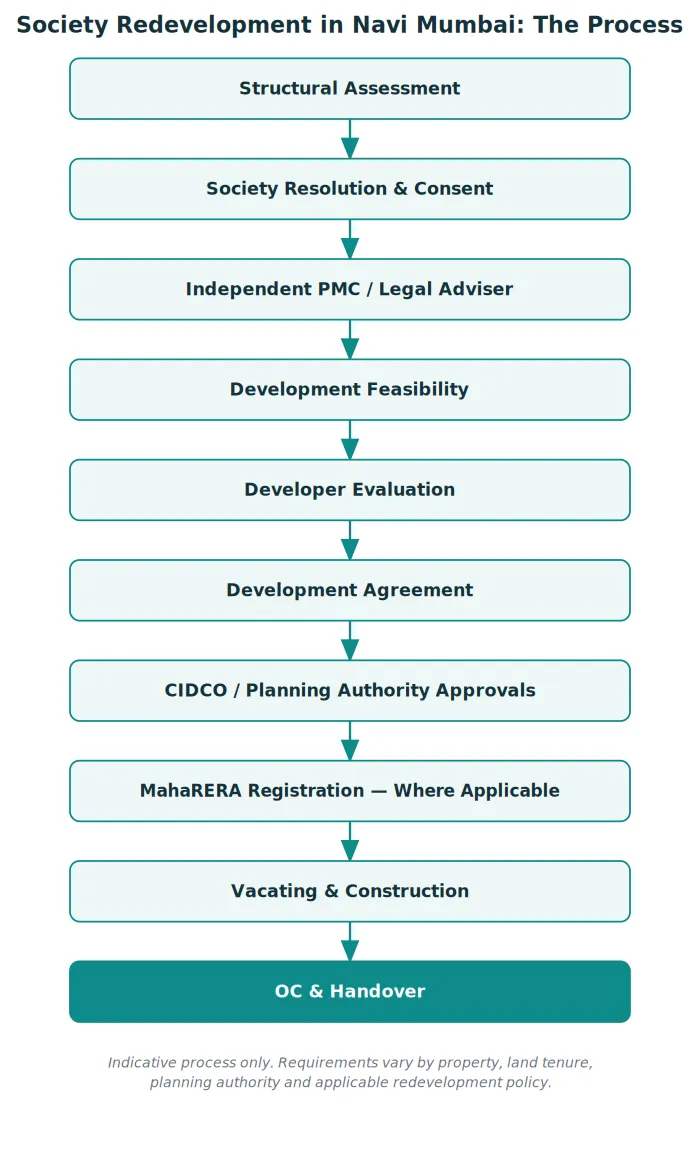
A typical redevelopment process may involve:
Structural assessment → Society decision and member consent → Appointment of professional advisers → Developer evaluation → Development agreement → Statutory approvals → MahaRERA registration where applicable → Vacating the building → Construction → Occupancy Certificate and handover
The exact sequence can differ from society to society, and CIDCO allotted or leasehold land can bring additional permissions and lease conditions into play.
1. How Society Redevelopment Works
There is no single redevelopment rule that applies identically to every property in Navi Mumbai. Depending on the location, CIDCO, the Navi Mumbai Municipal Corporation, other applicable planning authorities, the Maharashtra Government and, where relevant, MahaRERA can all be involved. So the first question isn’t “how much extra area will we receive,” it’s “which authority and land conditions actually apply to our property.”
Before approaching developers, establish your society’s land and building status:
- Who owns the underlying land, and is it freehold or leasehold?
- Was the land allotted by CIDCO, and what lease conditions apply?
- Which planning authority currently governs development permission, and which regulations apply to the plot?
- Is the title clear, with no encumbrances, disputes or unauthorised additions?
Obtain and review your society’s actual allotment, lease, conveyance and property documents rather than assuming your tenure matches a neighbouring society’s.
2. Who Decides? Member Consent and the Society’s Decision
For co-operative housing societies, this is set out in directions issued under Section 79A of the Maharashtra Co-operative Societies Act, 1960 (directive No. SGY-2018/PK-85/14-S, dated 4 July 2019). A Special General Body Meeting called specifically for redevelopment must satisfy:
- Quorum of at least two-thirds of the society’s total membership, not two-thirds of whoever attends.
- Approval from not less than 51% of total membership, measured against total membership, not just members present or voting.
- Absent members’ written or oral opinions are not counted toward that 51%.
- Written consent letters are then obtained from the members who voted in favour.
Example: a 100 member society needs at least 67 members present for quorum, and at least 51 of the total 100, not 51 of those present, to approve. A meeting where 70 attend and only 45 vote in favour meets quorum but fails the 51% threshold.
51% is necessary but not automatically sufficient: the society must still follow the prescribed notice, minutes and consent procedure, separate CIDCO permissions can apply on top of it, and this Section 79A process shouldn’t be confused with MHADA’s separate redevelopment framework for cessed buildings, which is a different regime entirely.
A member who is present and votes against a resolution that otherwise meets these thresholds can still face genuinely complex questions about their own position and rights under the eventual agreement. This is worth independent legal advice specific to that member’s situation rather than assuming a default outcome either way.
3. Structural Assessment and Independent Advisers
A qualified structural professional, appointed independently by the society rather than relying on a developer’s own opinion, should assess the building’s condition and repair needs. This helps establish:
- current structural condition and any immediate safety concerns
- the extent of repairs required, and whether major rehabilitation is needed
- whether a structural audit, dangerous building classification or repair notice already applies to the building under your local authority’s current rules
A structural assessment on its own is not automatic approval for redevelopment; planning eligibility still needs to be established separately.
Depending on the project’s complexity, the society should also appoint:
- An Architect or Project Management Consultant (PMC), for feasibility, tendering, technical comparison, specifications and monitoring.
- An independent property lawyer, to review title, CIDCO conditions, tender documents, the Development Agreement, powers of attorney, security and default/dispute clauses.
Know who appoints and pays each adviser, and whether they have any commercial relationship with a developer bidding for the project. Any conflict of interest should be disclosed before their recommendations are relied on.
4. Understanding Development Potential
“Every CIDCO society gets 2.5 FSI” is not a rule. What’s actually permissible depends on the regulations, plot and approvals applicable to that specific property, covering base FSI, any additional development potential, plot area, deductions and setbacks, the existing authorised built-up area (what’s sanctioned on record, not just what’s built), premiums and charges, and whether any incentive the feasibility relies on genuinely applies to this plot and redevelopment category.
Have this independently calculated. A developer’s commercial proposal should be a starting point for negotiation, not the society’s source for its own entitlement. Height is a separate check from FSI, and our building height limits guide explains the fire, road width and airport rules that can apply to a taller rebuilt building. Parking is also calculated again for the new building, as our parking requirements guide explains. The margins around the new building are set separately, and our setbacks and margins guide explains them. For how FSI is set and what counts towards it, see our FSI limits guide. TDR is one source of that FSI, and our TDR guide explains how it works.
5. Selecting a Developer
Don’t choose a developer solely because they promise the largest flat or biggest financial package. Before voting on a developer, verify:
- completed redevelopment projects and any currently under construction
- MahaRERA project history, delays and disputes on previous projects
- litigation relevant to redevelopment, and financial capability
- proposed transit rent security and bank guarantee
- references from previous societies: was rent paid on time, was possession on time, were specifications honoured, how were disputes handled
A blank, side by side worksheet then forces a like for like comparison across proposals, on your society’s own terms rather than each developer’s pitch.
| Item | Developer A | Developer B | Developer C |
|---|---|---|---|
| Replacement carpet area | [to fill in] | [to fill in] | [to fill in] |
| Transit accommodation (rent) | [to fill in] | [to fill in] | [to fill in] |
| Corpus/consideration | [to fill in] | [to fill in] | [to fill in] |
| Completion timeline | [to fill in] | [to fill in] | [to fill in] |
| Security/bank guarantee | [to fill in] | [to fill in] | [to fill in] |
| MahaRERA project history | [to fill in] | [to fill in] | [to fill in] |
| Completed redevelopment references | [to fill in] | [to fill in] | [to fill in] |
| Litigation checked | Yes/No | Yes/No | Yes/No |
| Financial capability reviewed | Yes/No | Yes/No | Yes/No |
Leave the cells blank until your PMC and lawyer verify each figure directly with each developer, and always check the developer’s actual registered projects on MahaRERA individually: projects are registered, not developers, so “RERA registered developer” is not a substitute for checking each project.
6. What Members May Negotiate
Depending on the project and negotiated agreement, this typically covers:
- Replacement flat: existing entitlement plus any agreed additional area, with the measurement basis stated unambiguously as carpet area, not left ambiguous as saleable, built-up or super built-up area.
- Transit arrangement: rent or alternative accommodation during construction, with the amount, start date, frequency, escalation, deposit/brokerage and duration all written down, and payments continuing until actual possession, not just an estimated date.
- Corpus or other consideration: only where negotiated and documented.
- Specifications, amenities and parking: defined contractually, not assumed.
There is no standard Navi Mumbai figure for additional area, corpus or transit rent. These depend on the property, development potential and the negotiated agreement, and should be verified for your project rather than benchmarked against another society’s.
7. Development Agreement and Member Agreements
The Development Agreement is a society level document. Members should understand it before the building is vacated or demolished. Important provisions typically include:
- project milestones, construction timeline and possession procedure
- bank guarantee/security, insurance and treatment of delays
- default and termination provisions, and dispute resolution
- developer’s and society’s respective rights and obligations, and taxes/statutory charges
Separately, each member should get independent legal advice on their own individual agreement, commonly a Permanent Alternate Accommodation Agreement or similar (the exact format can vary between projects), which records their personal entitlement and is distinct from the society level Development Agreement.
Treat the required bank guarantee or security as a matter for your lawyer to negotiate against the specific project, not a fixed percentage that applies everywhere.
8. CIDCO Redevelopment Issues in Navi Mumbai
Many older Navi Mumbai developments sit on CIDCO allotted land. Where a society occupies CIDCO leasehold/allotted land, prior written CIDCO permission can be required before demolishing an existing structure and constructing a new one, and lease conditions can also affect transfer conditions, premiums and development rights.
Because the exact instrument or process CIDCO applies can vary by property, this guide refers to “CIDCO permission, approval or NOC as applicable to the specific land and process,” rather than one universal “CIDCO NOC.” Have your lawyer or PMC confirm exactly which CIDCO process applies to your property.
Never assume your society owns the underlying land outright simply because members own their flats, and don’t assume every Navi Mumbai property is leasehold: check your society’s original land documents either way.
9. MahaRERA and Redevelopment
Not every redevelopment project needs MahaRERA registration. Under Section 3(2)(c) of the RERA Act, a project that doesn’t involve marketing, advertising, selling or new allotment can fall outside the requirement, which in practice typically covers the rehabilitation flats given back to existing members. Where the project also includes a sale component, that component needs registration. Have your lawyer confirm how this applies to your specific project.
Are existing members “allottees” under RERA? This is genuinely unsettled. Recent MahaRERA orders (January 2026, Girish Shrikant Lad and another v. Ashwamedh Spaces Pvt. Ltd.; July 2025, Murli Madhavan v. Shreedham Constructions Pvt. Ltd.) held that members receiving flats under a rehabilitation arrangement, without paying sale consideration, are not “allottees” under RERA, and that this component falls outside MahaRERA’s jurisdiction, unlike the position for buyers of a project’s separate sale component. Get independent legal advice specific to your project rather than assuming either way.
Where registration applies, verify directly on MahaRERA: the registration number, promoter(s), stated completion date, sanctioned plans, quarterly updates, extensions, complaints or orders, and whether registration has lapsed or been revoked, rather than relying on a developer’s own claim of being “RERA registered.”
10. What About Self-Redevelopment?
In self-redevelopment, the society takes on the developer’s role itself, engaging the architect, contractor and financing directly and retaining the eventual sale proceeds, instead of appointing a developer. This can mean more control and potentially better financial outcomes, but it also means the society takes on substantially greater financial, contractual and project management risk than a developer led redevelopment. Feasibility depends heavily on the society’s own capacity, access to financing and professional support, and needs its own dedicated legal, financial and technical advice. This guide focuses on developer led redevelopment; a dedicated self-redevelopment guide covering process, financing and risk in more depth is planned separately.
11. Before You Vacate Your Flat
Vacating for demolition is one of the most consequential and least reversible steps in the process. Don’t hand over possession simply because a developer was selected or a preliminary document signed. Confirm the redevelopment has reached the right stage, and that the protections below are actually documented, not just promised.
Documents
- Development Agreement executed and, where applicable, registered.
- Individual member agreement (PAAA or equivalent) executed and, where legally required, registered.
- Required approvals obtained, including CIDCO permissions or NOCs applicable to this property.
- MahaRERA registration verified directly on MahaRERA where required, not just claimed by the developer.
Financial protection
- Transit rent amount, frequency, start date and escalation written into the agreement.
- Security deposit, brokerage or shifting charges documented, if agreed.
- Developer security or bank guarantee provided and independently verified.
- Consequences of delayed rent or missed milestones recorded in the agreement.
Your existing flat
- Carpet area and replacement entitlement clearly recorded.
- Home loan or mortgage issues addressed with the lender where relevant, since the lender may hold an interest in the existing property and require its own documentation.
- Condition recorded through photographs, video and an inventory.
- Copies kept of all agreements, approvals and correspondence, plus developer and society representative contact details.
Future entitlement
- Additional area, if any, and the basis on which it is being provided, documented.
- Specifications and parking entitlement (if agreed) documented.
- Possession and completion mechanism, and the vacating date, understood.
Important: Do not treat this as a universal legal sequence. The documents, approvals and safeguards required before vacating can depend on the society, land tenure, redevelopment structure, development agreement and applicable approvals. Members should have the project documents reviewed by the society’s independent legal adviser before handing over possession.
The objective of this checklist is not to tell members when they are legally required to vacate. It is to give them a due diligence checklist so they do not surrender possession based only on verbal assurances, an appointment letter, marketing material or an incomplete redevelopment proposal.
12. During Construction
The society’s PMC or technical representative should monitor progress against sanctioned plans, agreed specifications, milestones, quality and the contractual schedule. For a MahaRERA registered project, check the original completion date against any approved extension and the current project status directly on MahaRERA, since an approved extension does not automatically excuse every contractual delay. Keep organised records of all communications, approvals and progress reports.
13. Before Taking Possession
Verify, ideally with your society’s own professionals:
- Occupancy Certificate, or its current status.
- Correct flat identification and actual carpet area measured against the entitlement on record.
- Consistency with approved plans and agreed specifications, including doors, windows, plumbing, electrical work, waterproofing and flooring.
- Common amenities, common areas, lifts, parking entitlement and utility connections.
- Defects or snags recorded in writing, and possession/handover documentation completed.
Don’t rely only on visual completion. The legal and statutory completion documents matter just as much as how finished the flat looks, and technical building certification itself should be left to your society’s qualified professionals.
Buying Into a Redeveloping Society
Buying into a society that is already discussing redevelopment needs extra diligence: confirm what stage it has actually reached, from informal discussion through to construction underway, and verify your specific entitlement through society records rather than a seller’s statement that “you’ll get a bigger flat.” Establish in writing who is entitled to any corpus, rent arrears or additional area tied to the flat, the seller or the purchaser, since this does not transfer automatically just because the flat has changed hands.
Also check for litigation involving the members, society, developer, title or CIDCO permissions, confirm the land tenure, and verify MahaRERA status directly where applicable. A redevelopment stage purchase carries different risks from buying a completed resale apartment, so get independent legal advice before completing the purchase.
What to read next
- TDR in Navi Mumbai: how transferable development rights work.
- FSI limits in Navi Mumbai: how much floor area a plot can carry.
- Housing Society Registration in Maharashtra: Requirements and Process
- Deemed Conveyance in Maharashtra: Process and Housing Society Checks
- MahaRERA Complaint: Filing, Status Checks, and Orders Explained
- Occupancy Certificate in Navi Mumbai: Authorities and Buyer Checks
Next step: The UDCPR guide explains which development rules apply to a plot, and the society maintenance charges guide covers how members’ monthly charges are set.
Frequently Asked Questions
Is society redevelopment mandatory?
Generally no. Redevelopment is normally a decision the society itself takes through its own consent process. In rare cases, a structural safety order or dangerous building classification from the local authority could compel action on a specific building, but that is a separate legal process from a society electively choosing to redevelop.
How much member consent is required?
For a co-operative housing society, Section 79A directions (4 July 2019) require a Special General Body Meeting with a quorum of two-thirds of total membership, and approval from not less than 51% of total membership, not just 51% of members present, with absent members’ opinions not counted. Written consent letters are then obtained from members who voted in favour.
Who is responsible for selecting the developer?
The society, through its appointed advisers and a structured comparison process, not any single office bearer or a developer’s own pitch. Use a like for like comparison across track record, financial capability, MahaRERA history and previous society references before deciding.
Is a structural audit required?
Building condition should be assessed by an independent structural professional regardless. Separately, check with NMMC or the applicable local authority whether a specific structural audit or dangerous building classification currently applies to your building under its own rules.
What should members check before selecting a developer?
Completed and ongoing projects, MahaRERA project history, delays, litigation, financial capability, proposed transit rent and security, construction timeline, and references from previous societies who worked with that developer.
Does a Navi Mumbai redevelopment project need CIDCO approval?
Where the society is on CIDCO allotted or leasehold land, prior written CIDCO permission can be required before demolition and reconstruction, along with other lease conditions. The exact process varies by property, so confirm which one applies with your lawyer or PMC rather than assuming a single universal “CIDCO NOC.”
Does redevelopment require MahaRERA registration?
Not automatically. Under Section 3(2)(c) of the RERA Act, a project that doesn’t involve marketing, advertising, selling or new allotment can fall outside the registration requirement, typically covering rehabilitation flats for existing members. Where the project also includes a sale component, that component needs registration.
What should I check before vacating my flat?
Work through the documents, financial protection, existing flat and future entitlement checklist above, and have your society’s independent lawyer confirm readiness before you hand over possession.
What happens if a member disagrees with redevelopment?
A member who votes against a resolution that otherwise meets the required consent threshold can still face complex questions about their own rights and position under the eventual agreement. This is genuinely case specific, so get independent legal advice rather than assuming a default outcome.
What happens to an existing home loan during redevelopment?
If a member’s existing flat is mortgaged, inform the lender and get its specific requirements before executing redevelopment related documents or surrendering possession, since the lender may hold an interest in the property and require its own documentation. Not every bank follows the same process, so check directly with your own lender.
Sources and Methodology
This guide draws on primary and official sources: the Section 79A directions issued under the Maharashtra Co-operative Societies Act (4 July 2019), MahaRERA’s orders and official project database, and CIDCO’s own building permission and leasehold materials, and independent legal reporting. Rules and requirements change, so confirm current details with the relevant authority before relying on them.
CIDCO
MahaRERA
Navi Mumbai Municipal Corporation
Last verified: September 2026