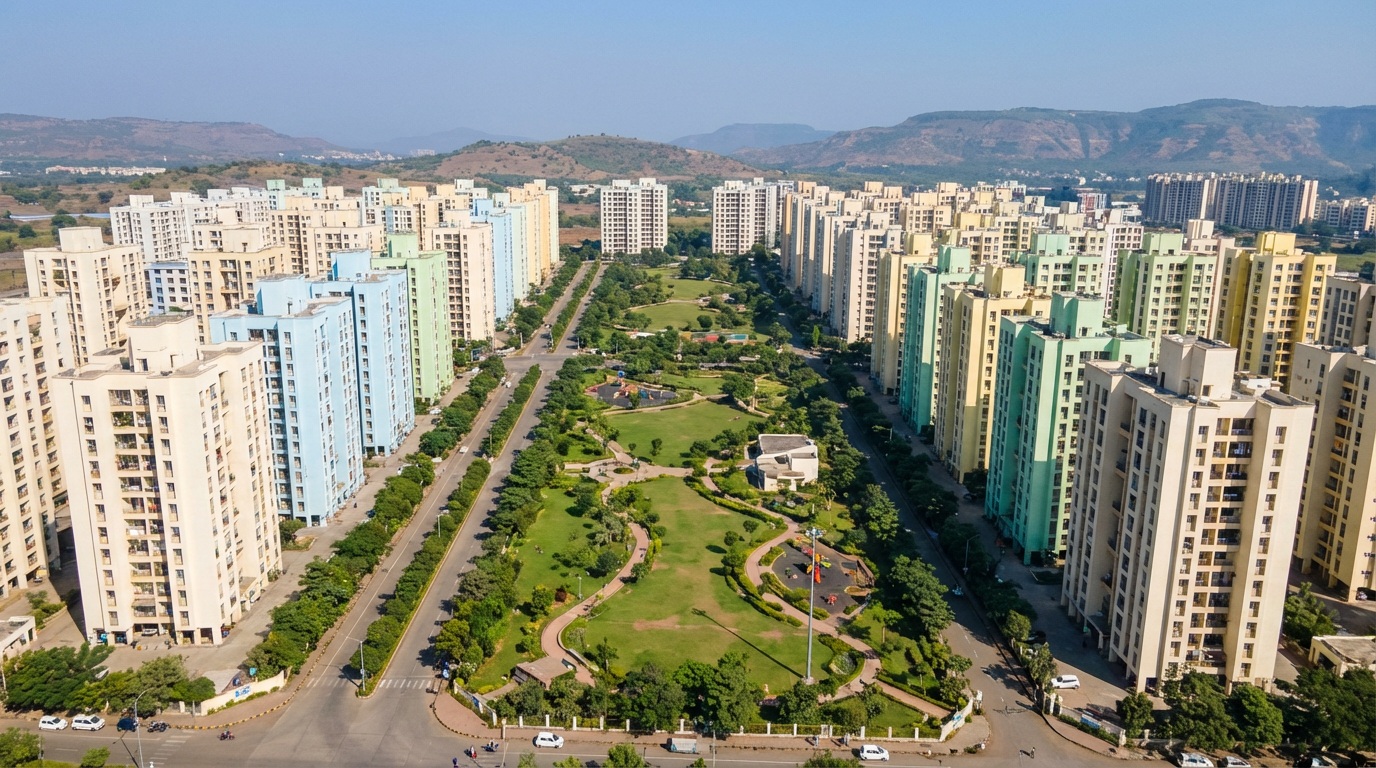
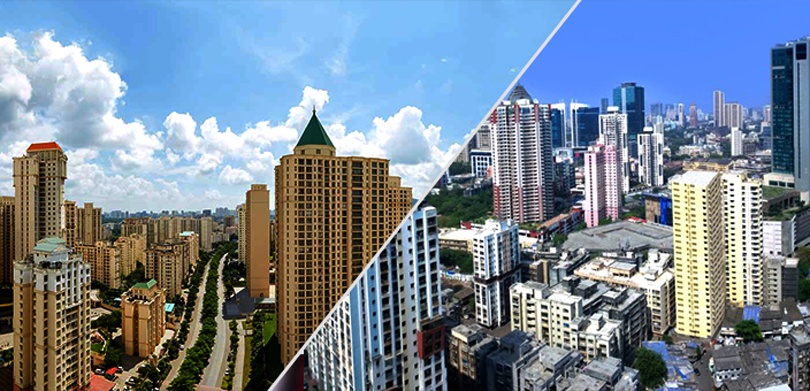
Choosing between Navi Mumbai and Thane is less about finding a universal winner and more about matching the city to your commute, housing budget and daily routine. Both are major residential markets within the Mumbai Metropolitan Region, but their urban form is very different: Navi Mumbai was developed as a planned city with sector-based nodes, while Thane has grown around an older and denser urban core.
This guide compares the two across housing costs, connectivity, schools, healthcare and lifestyle using current data where reliable comparisons are available. Property prices and rents vary substantially within both cities, so locality-level figures should be treated as market snapshots rather than fixed citywide rates.
The comparisons below are written for buyers comparing long-term property-market factors and for families and professionals weighing a relocation — not as a prediction of which city will deliver higher future returns.
Navi Mumbai vs Thane 2026: Quick Comparison
| Factor | Navi Mumbai | Thane |
|---|---|---|
| Urban form | Planned, node-based | Denser, established urban core |
| Property prices | Wide range by node | Wide range by micro-market |
| South Mumbai access | Stronger from selected nodes via Atal Setu/rail | Less direct |
| Central Mumbai access | Depends heavily on node | Strong via Central Line |
| Pune access | Strong from Panvel/Kalamboli corridor | Less direct |
| Schools | Broad CBSE/ICSE/international options | Broad CBSE/ICSE/international options |
| Healthcare | Major multispeciality hospitals | Major multispeciality hospitals |
| Airport access | Direct access to NMIA region | Longer cross-region journey |
| Best choice | Depends on exact locality + commute | Depends on exact locality + commute |
Notice that this table doesn’t declare an overall winner for things that can’t be objectively established at a citywide level — that’s deliberate, and the same principle carries through the rest of this guide.
Property Rates: Navi Mumbai vs Thane in 2026
Current asking-price datasets put Navi Mumbai at roughly ₹19,300 per sq ft overall (asking-price snapshot, Square Yards, Jul–Aug 2026), but the citywide average hides a very wide spread between affordable peripheral nodes and premium established areas. Asking prices should not be treated as achieved transaction prices — a registration-value dataset and an asking-price dataset measure different things, and the gap between them doesn’t by itself prove negotiation room exists. For the complete, currently maintained locality table, see our Navi Mumbai Property Rates 2026 guide.
Three illustrative examples, all on the same asking-price basis: affordable nodes like Taloja run roughly ₹8,700–10,000 per sq ft (asking-price snapshot); mid-market nodes like Kharghar and Nerul run roughly ₹18,500–24,000 per sq ft (asking-price snapshot); and premium Vashi runs around ₹28,000–28,550 per sq ft (asking-price snapshot). Micro-market figures change over time, so treat these as illustrative rather than current-to-the-week.
Square Yards’ dataset put Thane’s overall benchmark at roughly ₹15,350 per sq ft as of August 2026 (asking-price snapshot), with established central pockets such as Thane City running higher (around ₹18,950 per sq ft, also an asking-price snapshot) and peripheral stretches running lower. As with Navi Mumbai, treat any single Thane-wide figure as a broad benchmark and check current listings for the specific micro-market you’re considering rather than relying on a fixed citywide number.
A side-by-side example price for “equivalent” homes in the two cities isn’t included here deliberately: comparing carpet area alone doesn’t account for project age, exact location, amenities, possession status, floor or parking, so any single like-for-like number would be misleading. Compare actual shortlisted projects instead.
Property Appreciation: What the Data Actually Supports
ANAROCK reported approximately 46% growth in average residential prices in Thane between H2 2022 and mid-2025 (roughly ₹13,550 to ₹19,800 per sq ft — ANAROCK market-analysis figures, not government ready-reckoner or transaction-registry data). This is a historical market-level measure over a specific multi-year period, not a blanket 2026 micro-market result, and it should not be interpreted as the return delivered by every Thane property.
Navi Mumbai has seen substantial multi-year growth in selected infrastructure-linked corridors, but the magnitude varies significantly by locality, source and measurement period. Current one-year data (asking-price based, per our Property Rates guide) is considerably more moderate in several nodes — including some frequently cited as high-growth — than some headline multi-year appreciation claims suggest. See our Property Rates 2026 guide for the current locality-by-locality picture, including where growth has been flat to modest over the past year.
Airport development and Atal Setu connectivity are among the major infrastructure factors influencing buyer interest in the region, alongside the broader Metro Line 8 corridor once it’s operational. Correlation between infrastructure delivery and buyer interest is reasonable to note; a direct causal claim about price growth is not, since many factors move at the same time.
Past appreciation in either city, however calculated, is not a forecast of future returns. Property-market factors worth comparing before buying include entry price, project quality, supply pipeline, infrastructure delivery timeline and your own holding period — not a headline citywide percentage.
Rental Market: Compare Property-Level Yield, Not Citywide Rent
Both markets have established rental demand, but a higher monthly rent does not automatically mean a higher rental yield. Yield depends on the property’s purchase price as well as annual rent, vacancy, maintenance and other ownership costs. Compare specific properties rather than assuming either city delivers a universally higher yield — a Navi Mumbai flat with a lower purchase price and a Thane flat with a higher rent could easily land on similar yield once you do the actual division.
Commute and Connectivity Comparison
The strongest starting point for this comparison isn’t which city “wins” — it’s that your regular commute destination should drive the decision more than any citywide connectivity ranking.
Thane has direct Central Line services toward Kurla, Dadar and CSMT, making it particularly practical for many Central and eastern Mumbai commuters. Exact travel time depends on the specific service and time of day, so check current suburban rail timetables for your route rather than relying on a fixed range.
Road access from Thane toward the Eastern Express Highway and eastern Mumbai can be advantageous depending on destination and traffic conditions. For BKC or Andheri East specifically, the actual advantage depends heavily on the exact Thane locality, the exact Navi Mumbai locality, mode of travel, time of day and traffic — it should be tested against the exact origin, route and travel time rather than assumed.
Atal Setu has materially improved road connectivity between parts of Navi Mumbai and Mumbai, particularly for journeys using the Sewri–Nhava Sheva corridor. It can materially reduce travel time for suitable cross-harbour routes, but actual end-to-end travel time depends heavily on the origin, destination and traffic conditions — there isn’t a single trip-time figure that applies city-wide. Drivers should also include the current toll in their commute calculation; see our Atal Setu Toll 2026 guide for current rates rather than relying on a fixed number here.
Navi Mumbai residents have substantially closer access to Navi Mumbai International Airport than Thane residents, although actual journey time depends on the locality and road network. Navi Mumbai Metro Line 1 currently provides service between Belapur and Pendhar; Thane’s broader Metro connectivity is still developing, so buyers should distinguish operational routes from projects under construction or planning. See our Navi Mumbai Metro Guide for current routes and fares.
Navi Mumbai’s planned road hierarchy and sector-based layout can provide wider arterial roads in many nodes. Thane’s older core contains denser streets and mixed-use traffic, although road conditions and congestion vary significantly by locality in both cities.
Upcoming Connectivity Between the Two Cities
The comparison will continue to evolve. The Airoli–Katai Naka corridor (status: under construction) is being developed to improve road connectivity between Navi Mumbai, Thane and the Kalyan-Dombivli belt. Current target: two phases complete by late 2026, with the full corridor (including the tunnel section) currently targeted for around 2028. Officials have cited a travel-time reduction of roughly 35–40 minutes between Thane and Navi Mumbai once the corridor is fully operational — these are current targets, not current commute benefits, and infrastructure timelines can slip.
Infrastructure That Could Change the Comparison
| Project | Status | Current target / detail |
|---|---|---|
| Airoli–Katai Naka Corridor | Under construction | Current target: two phases by late 2026; full corridor (with tunnel) around 2028 |
| Thane Metro expansion | Under construction / Proposed (varies by line) | Check current status before treating any specific route as operational |
| Navi Mumbai Metro expansion | Operational (Line 1) / Proposed (other corridors) | Line 1 (Belapur–Pendhar) is operational; other corridors remain proposed |
| Metro Line 8 (airport corridor) | Proposed | Approved; current target for construction to begin: 2026 |
| NMIA connectivity | Operational (airport) | Airport itself is operational; focus on current road/rail access rather than proposed future links |
| Broader MMR transit proposals | Proposed | Various waterway and regional transit proposals linking Thane, Navi Mumbai, NMIA and Mumbai exist, but remain proposed, not current infrastructure |
Cost of Living: Navi Mumbai vs Thane
There is no robust basis for declaring either Navi Mumbai or Thane universally cheaper. Housing varies substantially by locality, while groceries, schooling, transport and lifestyle depend heavily on the household. The practical comparison should start with your shortlisted rent or EMI and your commute rather than a single citywide percentage. Our own Cost of Living guide reaches the same conclusion when comparing Navi Mumbai to Thane directly: the two are broadly comparable rather than one being clearly cheaper, and some published comparisons even suggest Navi Mumbai can run slightly higher on certain measures.
If you’re comparing specific rent listings, treat any figure as a snapshot tied to a date and source, and check current listings for the exact locality and configuration you need rather than relying on a generic city-level range.
Schools and Education: Navi Mumbai vs Thane
Both cities have established CBSE, ICSE, state-board and international-school options. The better choice depends on the exact school, admissions availability, fees and commute from the home you’re considering, not on which city is assumed to have “better” schools overall. Fees vary materially by school, board and grade — check the institution’s current official fee schedule rather than a generic aggregator range.
Both cities also have degree colleges and professional institutes within commuting distance. Rather than list specific campuses by city here — which risks misattributing a college’s exact location or current affiliation — treat higher education as a factor to research institution-by-institution once you’ve shortlisted a neighbourhood, since it isn’t central to a citywide comparison like this one.
Healthcare Facilities
Both cities have established multispeciality hospitals and extensive outpatient/specialist networks, including major private chains with a presence in both Navi Mumbai and Thane. For a household with a specific medical requirement, compare the relevant speciality, emergency capability and travel time from the exact neighbourhood rather than choosing between the cities based on hospital count or a claimed advantage in super-speciality availability — that kind of ranking isn’t something a citywide comparison can responsibly establish. Both cities have substantial routine healthcare coverage; that’s a fair way to put it without implying we’ve quantitatively established equality.
Lifestyle and Daily Living
Thane’s older, denser core supports established mixed-use neighbourhoods with a longer-running retail and social infrastructure. Navi Mumbai’s more node-based development includes planned open spaces and, in many areas, wider road layouts, reflecting its origin as a planned city rather than an organically grown one.
Families who prioritise planned open spaces and wider road layouts may prefer certain Navi Mumbai nodes. Young professionals who prioritise denser mixed-use neighbourhoods and established dining/retail may prefer parts of Thane. Both are reasonable preferences rather than a verdict on which city is objectively better to live in — neighbourhood-level parks such as Kharghar’s Central Park or Nerul’s Jewel of Navi Mumbai are worth visiting in person rather than judged on quoted acreage figures alone.
Navi Mumbai May Suit You Better If…
- Your regular commute is toward Navi Mumbai employment nodes, South Mumbai via a suitable cross-harbour route, or Pune.
- Frequent access to Navi Mumbai International Airport matters to you.
- You prefer a planned, node-based urban layout.
- You’re considering locations such as Vashi, Nerul, Kharghar, Panvel or the airport corridor.
- You value proximity to Navi Mumbai’s parks and open spaces.
- Your actual shortlisted property offers better value for your budget than comparable Thane options.
Thane May Suit You Better If…
- Your Central or eastern Mumbai commute is important.
- You prefer established, mixed-use neighbourhoods.
- You want proximity to Thane’s existing retail and social ecosystem.
- A specific Thane school, hospital or workplace makes the location more practical for your household.
- Your actual shortlisted property offers a better price/commute fit than comparable Navi Mumbai options.
Navi Mumbai or Thane? Start With Your Priority
| Your priority | Start by comparing |
|---|---|
| Central Line commute | Thane neighbourhoods |
| Navi Mumbai employment | Navi Mumbai nodes |
| Pune travel | Panvel/Kalamboli side |
| NMIA access | Navi Mumbai |
| Established mixed-use neighbourhood | Selected Thane areas |
| Planned node layout | Selected Navi Mumbai areas |
| Lowest purchase budget | Compare peripheral areas in both cities |
| School access | Exact school + home commute |
| Investment | Project-level numbers, not city averages |
The Bottom Line
Neither city is universally better. For an end-user, the most important variables are the exact locality, daily commute, housing cost, school or healthcare requirements and preferred urban environment. For a property buyer, compare individual projects and recent transaction/asking-price evidence rather than assuming that either city will deliver superior future appreciation.
A practical test is to shortlist two or three neighbourhoods in each city and compare the actual door-to-door commute, housing cost and daily amenities. City-level averages are useful for orientation; the final decision is usually won or lost at neighbourhood level.
Common Questions
Is Navi Mumbai cheaper than Thane for buying property?
Not universally. Navi Mumbai has a wider spread from relatively affordable peripheral nodes to premium areas such as Vashi, while Thane also varies substantially by micro-market. Compare the exact localities and current properties you’re considering rather than relying on citywide averages.
Which city has better connectivity to Mumbai — Navi Mumbai or Thane?
Thane generally has stronger direct Central Line access toward eastern and central Mumbai. Navi Mumbai can be advantageous for destinations served by the Harbour Line, the Atal Setu corridor, the Pune corridor and Navi Mumbai International Airport. The better option depends on your exact origin, destination and travel mode.
Which city has better schools — Navi Mumbai or Thane?
Both cities have established schools across major boards. Choose based on the specific school’s admissions, fees, curriculum and commute from your shortlisted neighbourhood rather than assuming one city has better schools overall.
Where should I invest for better property returns — Navi Mumbai or Thane?
There is no reliable citywide winner. Navi Mumbai has several infrastructure-linked growth corridors, while Thane is a large, established residential market. Future returns depend on entry price, micro-market, project quality, supply, infrastructure delivery and holding period. Past appreciation should not be treated as a forecast.
Is Navi Mumbai or Thane better for families with children?
Navi Mumbai may suit families prioritising planned open spaces and node-based layouts, while Thane may suit families prioritising established mixed-use neighbourhoods and proximity to a particular school or workplace. Compare neighbourhoods rather than cities as a whole.
What is the cost of living difference between Navi Mumbai and Thane?
The two cities are broadly comparable at city level. Housing and commute usually create the biggest household-level difference, and both vary significantly by locality.
Does Navi Mumbai have an international airport?
Yes. Navi Mumbai has direct regional access to Navi Mumbai International Airport, making airport proximity a meaningful advantage for many Navi Mumbai residents. Actual travel time varies significantly by node.
Which city has better hospitals — Navi Mumbai or Thane?
Both cities have established multispeciality hospitals. The more useful comparison is whether the speciality and emergency services you need are conveniently accessible from the neighbourhood you’re considering, rather than which city has more hospitals overall.
How does Atal Setu affect a Navi Mumbai commute?
For suitable cross-harbour routes, Atal Setu can materially improve road connectivity between Navi Mumbai and Mumbai. Drivers should compare the current toll cost and their actual door-to-door travel time for their specific route rather than relying on a single citywide figure.
Which city is better for working professionals — Navi Mumbai or Thane?
The better city depends primarily on workplace location and commute frequency. Someone working near Thane, Powai or the Central Line may reach a different conclusion from someone working in Navi Mumbai, South Mumbai, or travelling frequently toward Pune or the airport.
Navi Mumbai vs Thane: which is better for first-time home buyers?
First-time buyers should compare the total acquisition cost, usable carpet area, commute, maintenance, financing and project status of actual shortlisted homes. Navi Mumbai may offer lower entry prices in some peripheral nodes, while established Thane micro-markets may offer different connectivity and amenity advantages. Neither city is a better starting point in the abstract — it depends on your specific shortlist.
Sources & Methodology
Property-market figures in this guide are asking-price or market-data snapshots unless explicitly identified otherwise; they should not be treated as guaranteed transaction values or future returns. Navi Mumbai locality data is cross-referenced with our separately maintained Navi Mumbai Property Rates 2026 guide. Thane figures are drawn from Square Yards’ asking-price dataset and an ANAROCK analysis of historical price movement, both cited where used.
Transport and infrastructure claims distinguish between operational infrastructure and projects that are under construction or planned. School and healthcare comparisons are descriptive rather than rankings, because quality, fees, admissions and speciality availability vary by institution.
Cost-of-living comparisons are presented cautiously because household expenditure depends primarily on the exact housing, commute, education and lifestyle choices being compared; see our Cost of Living guide for the fuller picture.
Related practicalities are covered in this site’s dedicated Metro Fare, Local Train, Best Areas and Atal Setu Toll guides rather than duplicated here.
Last verified: 28 August 2026.