Atal Bihari Vajpayee Sewri-Nhava Sheva Atal Setu, also known as the Mumbai Trans Harbour Link (MTHL), connects Sewri in Mumbai with Navi Mumbai across Thane Creek. Open to traffic since January 2024, it provides a major cross-harbour road connection between Mumbai and Navi Mumbai. This guide covers current toll charges, FASTag/payment rules, passes, vehicle restrictions, speed limits and key entry/exit information. Last verified: 26 August 2026; toll, concession, restriction and project facts rechecked on 3 October 2026. Checked again on 17 October 2026 with no later change found in the reports reviewed.
Quick Answer: Atal Setu Toll 2026
The 2026 Atal Setu toll for a car/jeep/van travelling the full Sewri-Chirle corridor is reported as ₹250 one way, a concessional rate that news reports say runs to 31 December 2026. MMRDA’s pass structure sets a return journey at 1.5× the applicable one-way rate, a daily pass at 2.5× and a monthly pass at 50×. FASTag is preferred and required for discounted pass transactions, but MMRDA’s official FAQ also provides for hybrid/cash payment lanes. Passenger EVs receive a 100% toll-tax exemption under Maharashtra’s EV Policy 2025.
- Car/jeep/van toll: ₹250 one way
- Return: ₹375
- Daily pass: ₹625
- Monthly pass: ₹12,500
- Two-wheelers, three-wheelers and cycles: not permitted
- Maximum speed on the main section: 100 km/h
- How long does the crossing take? Journey time varies with traffic, entry/exit point and operating conditions. Use live navigation before travelling.
Atal Setu Key Facts
| Fact | Detail |
|---|---|
| Total length | 21.8 km, including approximately 16.5 km over sea |
| Lanes | 6 lanes |
| Route | Sewri (Mumbai) to Chirle/Nhava Sheva (Navi Mumbai) |
| Opened | January 2024 |
| Maximum speed | 100 km/h (main section) |
| Operated by | MMRDA |
| Built and owned by | MMRDA, under a Government of Maharashtra resolution of 4 February 2009 |
| Approved project cost | ₹17,843 crore (MMRDA) |
| Construction | Started March 2018, completed 5 January 2024; opened to traffic 13 January 2024 (MMRDA) |
Current Toll Charges
The ₹250 one-way figure for the full-corridor car/jeep/van journey comes from news reports, not from MMRDA’s FAQ, which gives no rupee rates and refers readers to toll notification MRD-3323/CR 131/UD-7 under the Maharashtra Motor Vehicle Tax Act, 1958. The Tribune (13 January 2024) reports the ₹250 car rate. The return, daily and monthly figures below apply MMRDA’s official multipliers (1.5×, 2.5× and 50× the one-way rate) to ₹250.
| Pass type | Rate (car/jeep/van) |
|---|---|
| Single journey | ₹250 |
| Return journey | ₹375 |
| Daily pass | ₹625 |
| Monthly pass | ₹12,500 |
₹250 is the figure for the full Sewri to Gavan corridor. The Tribune’s January 2024 report lists ₹200 for Sewri to Shivajinagar and ₹50 for Shivajinagar to Gavan for cars. MMRDA says toll depends on vehicle class and on the entry and exit point, so confirm the rate for your journey at the plaza.
This guide focuses on car/jeep/van rates. MMRDA’s official FAQ notes that toll tariffs vary by vehicle class and entry/exit point and directs users to the government toll notification rather than one universal rate, so for LCV, bus/truck and multi-axle tariffs, check the current government/MMRDA toll notification directly rather than relying on third-party figures.
News reports say the Maharashtra Cabinet extended a 50% toll concession on Atal Setu through 31 December 2026, with a complete exemption for electric cars and buses (Free Press Journal, 20 January 2026). The ₹250 car rate is itself the concessional rate: BusinessToday (4 January 2024) reported that MMRDA had proposed ₹500. The reports do not state the rate after 31 December 2026. Concessions like this are time-bound, so check the latest Maharashtra Government or MMRDA notification before travelling.
Car Toll by Section, and Which Pass Pays Off
For a car, jeep or van the toll depends on where you enter and leave. The Tribune’s January 2024 report gave one-way rates for each section. The return, daily and monthly figures apply MMRDA’s multipliers of 1.5, 2.5 and 50 to those rates.
| Section (car, jeep or van) | One way | Return | Daily pass | Monthly pass |
|---|---|---|---|---|
| Sewri to Gavan, the full corridor | ₹250 | ₹375 | ₹625 | ₹12,500 |
| Sewri to Shivaji Nagar | ₹200 | ₹300 | ₹500 | ₹10,000 |
| Shivaji Nagar to Gavan | ₹50 | ₹75 | ₹125 | ₹2,500 |
That report said its rates ran till 31 December 2024. The cabinet has since extended the 50% concession to 31 December 2026, so confirm the figure for your entry and exit at the plaza.
When a pass pays off, using the full corridor car rates above. These are arithmetic on the reported rates, and MMRDA’s conditions on FASTag, plaza and validity apply.
| Comparison | What the numbers show |
|---|---|
| Return pass or two single trips | The return costs ₹375 against ₹500 for two singles, so it saves ₹125 on an eligible round trip through the same plaza |
| Daily pass or single trips | The daily pass costs ₹625. Three single trips cost ₹750, so the daily pass is cheaper from the third crossing in a day |
| Monthly pass or single trips | The monthly pass costs ₹12,500, the same as 50 single trips, so it is cheaper from the 51st crossing in a calendar month |
| Monthly pass or return passes | Return passes cost ₹375 each, so the monthly pass is cheaper only from the 34th return trip in a month, which is 68 crossings |
Larger vehicles. The same Tribune report gave ranges rather than class by class figures: ₹400 to ₹1,500 one way over the full corridor for minibuses and multi-axle vehicles. Websites print different class tables without citing the notification, so check the notification and the plaza notice for your own class before you rely on a figure.
How Return, Daily & Monthly Passes Work
MMRDA’s official FAQ sets out specific conditions for each pass type beyond the headline multiplier:
- Return journey: valid until midnight on the date of issue.
- Daily pass: unlimited eligible crossings until midnight that day.
- Monthly pass: valid for the calendar month in which it is issued. A pass bought late in a month does not run for 30 days from purchase.
- Discount eligibility: MMRDA states discounted pass tariffs apply to FASTag transactions.
- Important: a pass is applicable only at the plaza where it was issued. MMRDA’s FAQ specifically notes that entering via one plaza (e.g. Gavhan) and returning via another (e.g. Shivaji Nagar), or vice versa, does not qualify for the return-trip discount; each plaza registers a single-trip transaction in that case.
FASTag & Other Payment Methods
FASTag is the preferred payment method at Atal Setu, and MMRDA states that discounted return, daily and monthly pass tariffs apply through FASTag transactions. MMRDA’s official FAQ also provides for hybrid/cash payment lanes for other payment modes. Non-FASTag users are directed to the cash lane on the extreme side of the plaza. Follow toll-plaza lane signage and use the appropriate lane for your payment method.
Ensure your FASTag has sufficient balance for the applicable journey. If a FASTag lane or reader is not working, follow toll-plaza instructions and use the available alternative payment method. MMRDA’s official FAQ also directs users to 1033 for FASTag/toll-lane complaints.
EV Toll Exemption
Eligible passenger electric vehicles receive a 100% toll-tax exemption on Atal Setu under Maharashtra’s EV Policy 2025. Government orders extending this exemption have specifically covered electric four-wheelers (M1 category) and electric buses (M3/M4 categories). The exemption has historically been renewed periodically alongside the general toll concession. EV owners should verify current implementation and ensure their vehicle/FASTag classification is correctly recorded before travelling. Some EV owners have reported toll deductions being applied despite citing the policy exemption, so this verification step is worth doing rather than assuming the exemption will apply automatically.
Because toll-system implementation and vehicle/FASTag classification can affect processing, EV owners should confirm current eligibility and FASTag status before travel.
The EV Policy statement is in the Government Resolution of 23 May 2025. Check the end date of the current exemption notification before relying on the exemption late in the year.
Common Toll Rumours
Is Atal Setu toll-free? No. The reported concession halves the rate to 31 December 2026, and eligible electric cars and buses are reported to be exempt. Other vehicles pay the notified toll, and return, daily and monthly passes work only with FASTag.
Is the toll waived after a wait? The rule people quote is an NHAI one: its PIB release of 26 May 2021 says service time should not exceed 10 seconds per vehicle and that vehicles may pass without paying once a queue exceeds 100 metres. That is an NHAI guideline for National Highway toll plazas. MMRDA’s FAQ does not mention it, and Atal Setu tolls are notified under the Maharashtra Motor Vehicle Tax Act, 1958. So do not plan on a waiver.
Is there a 20 km rule? The 20 km figure comes from NHAI too. A PIB release of 24 October 2025 describes a Local Monthly Pass for private-vehicle owners living within 20 km, or as applicable, of a National Highway fee plaza. It is a pass-eligibility radius, not a rule about Atal Setu, and MMRDA’s FAQ says there is no provision for exemptions for local villagers.
Route & Main Interchanges
The Mumbai-side Sewri interchange connects Atal Setu with the existing road network. Additional regional road projects are intended to improve onward connectivity further as they become operational.
The principal interchanges along the corridor are:
- Sewri
- Shivaji Nagar
- Jasai/SH-54
- Chirle/NH-348
Atal Setu & NMIA Connectivity
Atal Setu provides an important cross-harbour route from the Mumbai side into Navi Mumbai, with onward road access toward NMIA. Whether it is the fastest route depends on your starting point, interchange conditions and live traffic.
From the Navi Mumbai side, onward road connections serve Ulwe, NMIA, Panvel, Kharghar, Belapur and other parts of Navi Mumbai. Actual travel time depends on the exit used, final destination and live traffic. Use live navigation for current journey time.
See the dedicated How to Reach Navi Mumbai Airport guide for full transport options, and the NMIA Parking Guide if you’re driving all the way to the terminal. If you’re connecting between Mumbai Airport (CSMIA) and NMIA on separate flights, see our inter-airport transfer guide for terminal, baggage and timing checks.
How Much Time Can Atal Setu Save?
Atal Setu provides a direct cross-harbour road connection between Mumbai and Navi Mumbai and can materially reduce travel distance and journey time for many origins compared with older routes around the harbour. The actual saving depends on your starting point, destination, interchange and traffic conditions. Use live navigation to compare Atal Setu with alternative routes before travelling.
Speed Limits & Vehicle Restrictions
The maximum speed on Atal Setu’s main section is 100 km/h. MMRDA’s official FAQ sets lower limits at specific points: 40 km/h at ramp locations, and 25 km/h while passing through toll plazas. Always follow the displayed speed limit throughout your journey.
MMRDA’s official FAQ lists the following as not permitted on Atal Setu: cycles, two-wheelers, three-wheelers, animal-drawn cart vehicles, and other non-tollable, modified or unregistered vehicles. Two-wheelers are prohibited on Atal Setu. Follow current traffic-police restrictions and signage before entering the corridor.
MMRDA’s FAQ says users may not stop anywhere on the bridge except in an emergency, and may not take pictures of themselves, co-passengers, the bridge, its structures or the toll plazas. It says violators face legal action. Oversized or specially designed vehicles need advance permission, with details submitted at least seven days before travel.
Practical Driving Guidance
- Check live traffic before entering the corridor rather than relying on fixed peak-hour windows, as conditions vary by day and season.
- During heavy rain, strong winds or severe weather, follow MMRDA/traffic-police advisories and posted restrictions.
- Do not rely on refuelling facilities on the bridge itself; ensure adequate fuel/charge before entering.
- At night, follow posted speed limits, lane markings and any weather/traffic advisories.
- For an eligible same-day return using the applicable toll-plaza arrangement, the ₹375 car return tariff is ₹125 less than paying two ₹250 single journeys. MMRDA’s return-pass conditions apply.
- Whether the monthly pass saves money depends on how frequently and how you use the corridor. Compare your expected number of eligible crossings with the ₹12,500 monthly-pass cost before purchasing. It should not automatically be assumed cheaper than a return pass for ordinary weekday commuting.
If you would rather not drive across, our nearest railway station to the airport guide and the Mumbai local train guide cover rail routes into Navi Mumbai.
Crossing Atal Setu to catch a flight? Check which airport your ticket uses first, using our guide to the two Mumbai airports.
For the other tolled roads around Navi Mumbai, including the Vashi and Airoli entry plazas and the FASTag annual pass, see our Navi Mumbai toll plazas guide.
Goods vehicles heading for the port can read our JNPT port guide for what the port handles and where to check notices.
For goods vehicles and freight links around the port and airport, see our cargo and logistics guide.
Frequently Asked Questions
What is the Atal Setu toll for a car?
The reported Atal Setu toll for a car/jeep/van over the full corridor is ₹250 one way, a concessional rate set to run to 31 December 2026, and ₹375 for a same-day return. MMRDA’s pass structure sets a daily pass at ₹625 and a monthly pass at ₹12,500. Eligible passenger electric vehicles receive a 100% toll-tax exemption under Maharashtra’s EV Policy 2025.
Are motorcycles and scooters allowed on Atal Setu?
No, motorcycles/scooters are not permitted. Two-wheelers are prohibited on Atal Setu, along with three-wheelers and cycles. Follow current traffic-police restrictions and signage before entering the corridor.
How long does the Atal Setu crossing take?
Journey time varies with traffic, toll-plaza conditions, entry/exit point and any temporary restrictions. Use live navigation for the current crossing time.
Is Atal Setu open 24/7?
Atal Setu is ordinarily open to permitted traffic throughout the day, subject to temporary traffic restrictions, maintenance, emergencies or severe-weather measures. Check current traffic advisories before travel when conditions are unusual.
Is Atal Setu the fastest way to reach NMIA?
Atal Setu provides a major cross-harbour route from Mumbai into Navi Mumbai with onward road access toward Navi Mumbai International Airport. The best route to NMIA depends on your starting point and live traffic, so check navigation before leaving. See the How to Reach NMIA guide for full transport options.
Does the monthly pass save money for daily commuters?
Not automatically. The monthly pass is valid only for the calendar month in which it is issued and is subject to MMRDA’s FASTag/plaza conditions. For example, 22 weekday return trips at the ₹375 return fare cost ₹8,250, less than the ₹12,500 monthly pass. Compare your expected number of eligible crossings with the monthly-pass cost before purchasing, rather than assuming it’s cheaper for regular commuting.
What is the speed limit on Atal Setu?
The maximum notified speed on the main bridge section is 100 km/h. MMRDA’s FAQ gives 40 km/h at ramps and 25 km/h through toll plazas, so follow the displayed limit throughout your journey.
Is Atal Setu toll included in the FASTag annual pass?
Do not assume it is. The FASTag annual pass is valid at national highway and national expressway fee plazas, according to NHAI, and Atal Setu is tolled separately by MMRDA. Atal Setu has its own return, daily and monthly passes, so check with MMRDA before relying on the annual pass on the bridge. The annual pass costs ₹3,075 for 2026-27 and covers one year or 200 crossings. See our Navi Mumbai toll plazas guide for where the annual pass works.
Can I pay the Atal Setu toll without FASTag?
Yes. MMRDA’s official Atal Setu FAQ provides for FASTag-only and hybrid-payment lanes and directs users paying by other modes to the designated cash lane. However, discounted return, daily and monthly pass tariffs apply through FASTag transactions.
Are EVs exempt from Atal Setu toll?
Maharashtra’s EV Policy 2025 provides a 100% toll-tax exemption for eligible passenger electric vehicles on Atal Setu. EV owners should verify current implementation and ensure their vehicle/FASTag classification is correctly recorded before travel. Some owners have reported toll deductions despite citing this exemption, so don’t assume it will apply automatically.
How long is the Atal Setu return pass valid?
MMRDA states that the return-journey pass is valid until midnight on the day it is issued. The daily pass is also valid until midnight and permits unlimited eligible usage during that day.
How long is the Atal Setu monthly pass valid?
The monthly pass is valid only for the calendar month in which it is issued. For example, a pass bought late in a month does not automatically run for 30 days from purchase.
Is Atal Setu toll-free, or waived after waiting?
No. The reported concession halves the rate to 31 December 2026, and eligible electric cars and buses are reported to be exempt. The 10-second and 100-metre queue rule is an NHAI guideline for National Highway toll plazas, and MMRDA’s FAQ does not mention it.
Who built Atal Setu and what did it cost?
MMRDA owns and implemented it under a Government of Maharashtra resolution of 4 February 2009. MMRDA’s project page gives the approved total project cost as ₹17,843 crore, says work started in March 2018 and finished on 5 January 2024, and says it opened to traffic on 13 January 2024. MMRDA’s details page names the civil contractors as the L&T-IHI Infrastructure Systems consortium, a Daewoo Engineering and Construction-Tata Projects joint venture and L&T, with an official development assistance loan from JICA.
How can I check whether Atal Setu is closed?
Check MMRDA’s news and announcements page, call the MTHL helpline 1800 203 1818 given in MMRDA’s FAQ, and follow traffic police advisories.
What is the Atal Setu toll for a truck or bus?
There is no single figure. The toll depends on the vehicle class and on where you enter and leave. The Tribune’s January 2024 report gave ranges of Rs 400 to Rs 1,500 one way over the full corridor for minibuses and multi-axle vehicles, and MMRDA’s FAQ refers to the government toll notification instead of a rupee table. Check the notification and the plaza notice for your class.
What happens to the Atal Setu toll after 31 December 2026?
The reports say the 50% concession for cars runs to 31 December 2026 and do not state the rate after that date. BusinessToday reported in January 2024 that MMRDA had proposed Rs 500 before the Rs 250 rate was cleared. Check the latest Maharashtra Government or MMRDA notification near the end of the year.
How do I check an Atal Setu challan?
MMRDA’s FAQ says users may not stop on the bridge except in an emergency and may not take photographs of the bridge or toll plazas, and that violators face legal action. For checking a traffic e-challan, see our e-challan guide and use the official portal it describes.
Sources & Methodology
Official sources: MMRDA’s Atal Setu FAQ (file dated 15 March 2024) for pass rules, payment, speed limits and restrictions, and MMRDA’s project pages linked above for the agency, cost and dates. Maharashtra’s EV Policy 2025 and two PIB releases on NHAI toll rules are linked in the text.
Rupee toll rates and the 2026 concession come from news reports: The Tribune (13 January 2024), BusinessToday (4 January 2024) and Free Press Journal (20 January 2026). Travel times are intentionally not published as fixed values because they vary with traffic, entry and exit point, and destination.
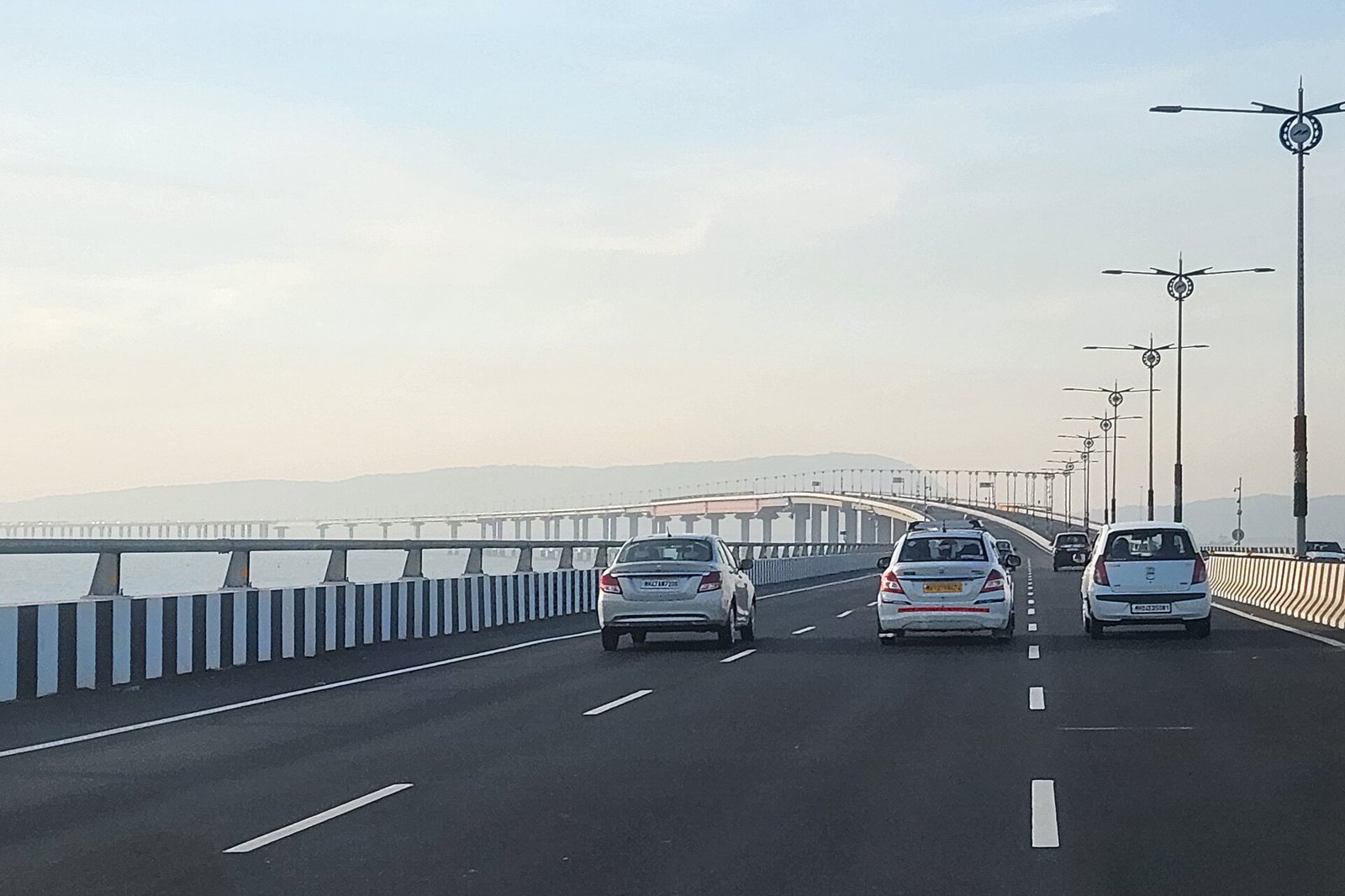
Featured photo: Atal Setu, Trans Harbour Link, Mumbai by Amitbalani, dated 11 February 2024 in the file metadata, released under CC0 via Wikimedia Commons, cropped and resized.
Last verified: 26 August 2026; toll, concession, restriction and project facts rechecked on 3 October 2026. The concession report and the rates were checked again on 17 October 2026, and no later change was found in the reports reviewed.