
Cooking Without Gas: 30+ Indian Recipes You Can Make on Induction, Microwave & Electric Cooker
LPG prices just hit a new high — March 2026 brought a ₹60 hike, pushing domestic gas cylinders to ₹912 in Mumbai. For many families across Navi Mumbai and beyond, that notification is the push they needed to start cooking Indian recipes without gas. The question is no longer “Can I cook without gas?” but rather “Why haven’t I switched sooner?”
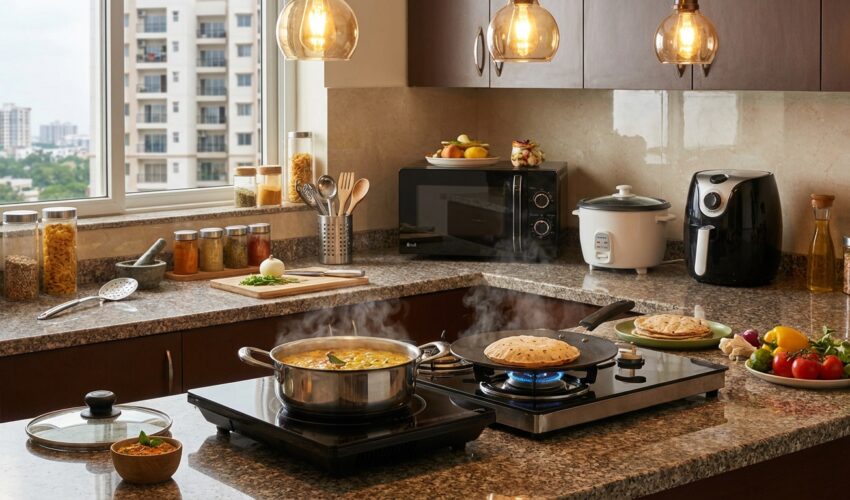
The truth: You can cook virtually everything on induction, microwave, electric cooker, and rice cooker. This comprehensive guide covers everything from everyday dal and rice to elaborate curries and breads — including 30+ tested Indian recipes without gas, appliance comparisons, costs, and practical tips.
Why More Families Are Trying Indian Recipes Without Gas
The shift away from LPG isn’t just about the March 2026 price spike. Here’s what’s driving the change overall:
1. Rising LPG Costs Are Eating Into Monthly Budgets
A 14.2kg cylinder at ₹912 lasts 4-5 weeks for an average family of 4. That’s roughly ₹200-220 per week just on cooking fuel. Furthermore, annual LPG costs now exceed ₹10,000-12,000 for many households. As a result, electric cookers and induction stovetops, once considered luxury items, now offer better economics over 2-3 years.
2. Electricity Rates Haven’t Risen at the Same Pace
In Maharashtra, domestic electricity rates are ₹5-7 per unit for consumption below 300 units monthly. In comparison, a modern induction cooktop uses roughly 1.5-2 units per meal for an average family. That translates to just ₹7.50-14 per meal. In contrast, LPG can consume 30-40% of a cylinder’s monthly cost for a single curry with rice.
3. Safety and Convenience Have Real Value
Say goodbye to gas leaks, refill scheduling, and checking cylinder weight. There are no choking fumes in the kitchen either. Moreover, electric cooking eliminates the indoor air quality problems that gas cooking creates. Studies show gas stoves emit nitrogen dioxide and particulate matter that affect respiratory health, particularly in women who spend hours in the kitchen.
4. Modern Appliances Are Reliable and Affordable
Quality induction cooktops, electric cookers, and microwave ovens have become dependable. We’re past the phase where electric cooking meant slow, inferior results. Indeed, today’s appliances deliver faster cooking, better temperature control, and greater consistency than gas.
Best Appliances for Making Indian Recipes Without Gas
You don’t need to replace everything at once. Start with one or two appliances based on your cooking style and budget. With the right setup, all your favourite Indian recipes without gas become manageable.
Induction Cooktop
Best for: Boiling, frying, slow cooking curries, making rotis (with the right vessels)
Price range: ₹2,500-8,000 for single-burner to dual-burner models
Why it works: Heats 30% faster than gas and provides precise temperature control. Works only with ferromagnetic cookware (most stainless steel and iron vessels work). Zero heat loss to the environment. Safest option, especially with children and older adults at home.
Microwave Oven
Best for: Reheating, quick meals, cooking vegetables, making desserts, warming bread
Price range: ₹4,000-15,000 (500W-25L entry models to 32L convection models)
Why it works: Fastest cooking method for many tasks. Convection microwaves can even bake, making them extremely versatile. Great for meal prep with minimal cleanup. However, they cannot make proper rotis and are limited for traditional curries.
Electric Cooker (Multi-Cooker / Pressure Cooker)
Best for: Dal, rice, beans, stews, slow cooking
Price range: ₹3,000-12,000 (basic electric pressure cooker to advanced multi-cooker with multiple functions)
Why it works: Simply set and forget. It is faster than stovetop pressure cooking. Moreover, some models include slow cooker, rice cooker, steamer, and saute functions — making them excellent for bulk cooking.
Rice Cooker / Smart Cooker
Best for: Rice, pulses, one-pot meals, khichdi
Price range: ₹1,500-6,000
Why it works: Completely foolproof, it prevents overflow and keeps food warm without drying it. Modern models have preset programs for different types of rice and dal. Great for busy professionals.
Air Fryer
Best for: Fried snacks, pakora, samosa, fries, tandoori items
Price range: ₹3,500-10,000
Why it works: Uses 80% less oil than deep frying and produces crispier results than a microwave. As a result, it is much healthier than traditional frying and relatively quick.
30+ Tested Indian Recipes Without Gas
Induction Cooktop: 10 Indian Recipes Without Gas
1. Chicken Curry (Murgh Makhani Style)
First, boil marinated chicken pieces for 8-10 minutes on high heat. Meanwhile, saute ginger-garlic paste, onions, and tomatoes in a pan on the induction. Then add spices (garam masala, red chilli powder, turmeric) and cooked chicken. Simmer for 8-12 minutes on medium heat. Finally, add cream or yogurt in the last 2 minutes.
2. Rajma (Kidney Bean Curry)
First, boil pre-soaked rajma with onion and salt for 45 minutes on medium heat. Meanwhile, in another pan, saute onions, ginger-garlic, tomatoes, and spices. Then combine with cooked rajma and simmer for 10 minutes. Finally, finish with garam masala and coriander.
3. Aloo Gobhi (Potato and Cauliflower Stir-Fry)
First, heat 2 tablespoons oil on induction at medium heat. Then add mustard seeds, cumin seeds, and curry leaves. Next, add diced potatoes and cauliflower florets. Cook covered for 15-20 minutes, stirring occasionally, until both are tender and lightly golden. Finally, season with turmeric, chilli powder, salt, and amchur powder.
4. Dal Tadka (Tempered Lentils)
First, boil 1 cup moong dal or toor dal with turmeric and salt for 25-30 minutes. Separately, heat ghee and add asafoetida, cumin seeds, dried red chillies, and curry leaves. Then pour the tempering over the cooked dal. Finally, garnish with fresh coriander.
5. Paneer Tikka Masala
First, boil a cashew-tomato paste with spices and cream at a simmer for 10 minutes. Meanwhile, pan-fry cubed paneer pieces until light golden (3-4 minutes), then add to the sauce. Let simmer for 5 more minutes. Finally, top with coriander and kasoori methi.
6. Fish Fry (Surmai or Pomfret)
First, apply turmeric, chilli powder, and salt to fish fillets. Next, heat 3 tablespoons oil at high temperature. Once smoking, carefully place the fish and fry 4-5 minutes per side until golden and crispy. Finally, serve with lemon.
7. Butter Naan (Stovetop Version)
First, prepare naan dough and roll into oval shapes. Then heat the induction surface to high. Place naan directly on the hot surface (no oil). Cook 30-40 seconds until bubbles form. Next, flip and cook another 20-30 seconds. Finally, brush with melted butter and garlic.
8. Bhindi Fry (Okra Stir-Fry)
First, heat 2 tablespoons oil and add mustard seeds, cumin, and asafoetida. Then add sliced bhindi and cook on medium-high heat for 12-15 minutes, stirring frequently to avoid stickiness. Next, add amchur powder, chilli powder, and salt. Finally, finish with a squeeze of lemon.
9. Chole Masala (Chickpea Curry)
First, heat oil and saute onions until golden, then add ginger-garlic paste. Next, add tomatoes, turmeric, chilli powder, and garam masala. Simmer for 5 minutes. Then add boiled chickpeas and cook for 10 minutes. Finally, finish with lemon juice and garam masala.
10. Tandoori Chicken (Pan-Roasted)
First, marinate chicken in yogurt, ginger-garlic, and tandoori masala for 2 hours. Then heat oil in a heavy pan to high temperature. Place chicken pieces and cook 6-7 minutes per side, covered with a lid, until cooked through. Finally, serve with lemon and onion.
Microwave: 8 Indian Recipes Without Gas
1. Instant Khichdi
Mix 1 cup rice, 1/2 cup moong dal, 2.5 cups water, salt, turmeric, and cumin seeds in a microwave-safe bowl. Then cover loosely and microwave on high for 12-15 minutes, stirring halfway. Afterwards, let rest for 2 minutes. The result is perfect comfort food in just 15 minutes.
2. Baked Samosa
First, make traditional samosa filling (aloo, peas, spices). Then fill samosa wrappers and brush with water or oil. Arrange on a microwave-safe plate and microwave on high for 8-10 minutes. The result is crispy outside, soft inside, and less oily than fried.
3. Broccoli Cheese
First, chop broccoli florets and place in a microwave-safe dish. Add salt, pepper, and 2 tablespoons water. Then microwave on high for 5 minutes. Meanwhile, drain the water. Top with grated cheese and microwave for another 1-2 minutes until the cheese melts. The whole process is done in just 8 minutes.
4. Methi Fafda (Quick Version)
First, make a simple batter with besan, methi leaves, salt, and cumin seeds. Then pour into microwave-safe molds or spread on a lined plate. Microwave on high for 6-8 minutes. Finally, cut into pieces and serve with jaggery or chutney.
5. Instant Chivda
First, mix roasted peanuts, cashews, raisins, and dried coconut flakes with spices (salt, chilli powder, turmeric). Then spread on a microwave-safe plate and microwave on high for 4-5 minutes, stirring every minute. Afterwards, cool before storing. The result is a tasty snack ready in less than 10 minutes.
6. Poha (Flattened Rice)
First, rinse 2 cups poha. Then add mustard seeds, cumin, peanuts, potatoes, and green chillies to a microwave bowl along with 1/2 cup water. Microwave on high for 5 minutes, stir, then another 3-4 minutes. Finally, garnish with coriander and lemon juice.
7. Momos (Steamed)
First, fill momos with vegetable or meat filling. Next, arrange them in a microwave-safe steamer basket or colander over water. Cover with a lid or damp cloth. Then microwave on high for 8-10 minutes. The result is tender and perfectly steamed momos.
8. Banana Cake (Convection Microwave)
First, mix mashed banana, oil, sugar, and eggs. Then fold in maida and baking powder. Pour into a greased microwave-safe pan. Microwave on high for 10-12 minutes (convection mode gives better results). Finally, cool and serve with tea.
Electric Cooker: 8 Indian Recipes Without Gas
1. Pulao (Vegetable Pulao)
First, saute oil, cumin seeds, bay leaves, and cinnamon in the cooker’s saute function. Then add diced vegetables and rice, and pour in water (2:1 ratio). Close the lid and switch to rice cooking mode. Finally, fluff when done for restaurant-quality results every time.
2. Biryani (Simplified Version)
First, layer par-boiled basmati rice with marinated meat or vegetables and fried onions in the cooker. Then sprinkle saffron soaked in milk and add dots of ghee. Close the lid and switch to rice mode. Let it cook without opening for perfect layered biryani.
3. Dal with Vegetables
First, add washed dal, diced vegetables, turmeric, salt, and water (3:1 ratio) to the cooker. Then switch to cooking mode and wait until the cooker beeps. Meanwhile, separately saute tadka ingredients (cumin, asafoetida, red chilli) in oil and pour over the cooked dal. The result is comforting, nutritious, hands-off cooking.
4. Chicken and Rice (One-Pot Meal)
First, use the multi-function cooker to saute marinated chicken pieces until 60% cooked. Then add rice, vegetables, and broth. Close the lid and use rice cooking mode so everything cooks together. The result is a perfect one-pot dinner for busy evenings.
5. Beans and Lentil Stew
Simply add soaked beans, red lentils, carrots, onions, garlic, and spices with 4 cups water. Then use the slow cooker setting for 45 minutes if available, or regular cooking mode for 30 minutes. Consequently, the result is a rich, hearty, completely automated meal.
6. Tomato Rice
First, saute oil, mustard seeds, onions, and green chillies in the cooker. Then add rice, tomato puree, salt, and water (2:1 ratio). Finally, switch to rice mode for aromatic, tangy rice that pairs beautifully with dal or pickle.
7. Pressure Cook Function: Mutton Curry
First, use the pressure cooking function of advanced electric cookers to saute meat with spices. Then add onions, tomatoes, and water. Close the lid and pressure cook for 20-25 minutes. As a result, the meat becomes incredibly tender and flavors infuse deeply.
8. Steamed Idli (Using Rice Cooker Steamer Attachment)
First, prepare idli batter from fermented rice and dal flour. Then pour into greased molds. Stack molds in the steamer basket and place over boiling water in the rice cooker. Steam for 10-12 minutes for soft, fluffy idlis without needing a traditional steamer.
Air Fryer: 6 Indian Recipes Without Gas
1. Crispy Pakora
First, prepare pakora batter with besan, vegetables, and spices. Then fill into an air fryer-safe container or use the tray. Air fry at 190C for 12-15 minutes, shaking halfway. The result is golden, crispy pakora with 80% less oil than deep-fried versions.
2. Samosa (Baked Version)
First, prepare traditional samosa filling and wrap in phyllo pastry sheets (lower fat than maida) or traditional pastry. Then brush lightly with oil and air fry at 180C for 12-14 minutes until golden. The result is a crispy exterior with soft potato filling — perfect guilt-free snacking.
3. Tandoori Paneer Tikka
First, marinate paneer cubes in yogurt, ginger-garlic paste, tandoori masala, and lemon juice for 30 minutes. Then skewer and air fry at 200C for 10-12 minutes, shaking the basket halfway. The result is charred edges, creamy inside — a perfect appetizer.
4. Aloo Tikki
First, shape seasoned mashed potato with peas and spices into patties. Then air fry at 190C for 10-12 minutes, flipping halfway. Serve with tamarind chutney and green chutney. The result is crispy outside, soft inside, and ready in just 15 minutes.
5. Banana Chips (Homemade)
First, slice raw bananas thinly. Then toss with salt and a tiny bit of oil. Air fry at 160C for 15-18 minutes, shaking every 5 minutes. Finally, these golden, crispy chips are ready to store in an airtight container for up to a week.
6. Garlic Bread
First, mix softened butter with minced garlic and herbs. Then spread on baguette slices. Air fry at 160C for 6-8 minutes until golden and crispy. The result is warm, aromatic garlic bread, perfect with soup or as a starter, and ready faster than a toaster oven.
Cost Comparison: Gas vs Electric Cooking
| Cooking Method | Initial Investment | Monthly Fuel Cost | Annual Cost | Lifespan | Break-Even Period |
|---|---|---|---|---|---|
| LPG Gas Cylinder | ₹3,000-5,000 (stove + regulator) | ₹900-1,100 | ₹10,800-13,200 | 15+ years (one stove) | Immediate |
| Induction Cooktop | ₹3,500-6,000 | ₹250-350 | ₹3,000-4,200 | 5-7 years | 6-8 months |
| Electric Cooker (Multi-Cooker) | ₹4,000-8,000 | ₹200-300 | ₹2,400-3,600 | 5-6 years | 8-12 months |
| Rice Cooker | ₹2,000-4,000 | ₹100-150 | ₹1,200-1,800 | 4-5 years | 18-24 months |
| Microwave Oven | ₹5,000-12,000 | ₹150-250 | ₹1,800-3,000 | 5-7 years | 18-36 months |
| Air Fryer | ₹4,000-8,000 | ₹180-280 | ₹2,160-3,360 | 3-5 years | 12-18 months |
Key insight: By combining induction and microwave for your Indian recipes without gas, you can cut fuel costs by 65-70% compared to pure LPG cooking. Consequently, the initial investment pays back within 12-18 months, after which you’re saving ₹500-800 monthly.
Practical Tips for Cooking Indian Recipes Without Gas
1. Start Small When Cooking Indian Recipes Without Gas
Don’t feel compelled to buy everything at once. Instead, begin with an induction cooktop if you’re a traditional curry maker, or a microwave if you prefer speed. Add appliances as your needs become clear. Meanwhile, many families maintain one gas cylinder as backup for the first few months.
2. Invest in Right Cookware for Indian Recipes Without Gas
For induction, use ferromagnetic cookware — most stainless steel, cast iron, and carbon steel work well. However, avoid aluminum and copper. To be sure, test with a magnet before buying. For electric cookers and rice cookers, standard stainless steel works fine.
3. Adjust Your Cooking Mindset
Electric cooking requires a shift in thinking. For instance, you cannot use a high flame to immediately sear meat like gas allows. Induction heats differently: its peak efficiency is between 50-100% power, not at the absolute maximum. Learn this through experience over 2-3 weeks.
4. Use Lids to Reduce Cooking Time
Electric and microwave cooking both benefit immensely from lids and covers. They trap heat and moisture, thereby reducing cooking time by 20-40%. In addition, this also reduces electricity consumption. For example, a pressure cooker lid for the induction will cut dal cooking time to 6-7 minutes.
5. Maintain Your Appliances
Always clean induction surfaces after every use. Moreover, wipe spills immediately to prevent staining. For pressure cookers, clean seals regularly. Similarly, for microwaves, ensure the interior is dry. Consequently, proper maintenance extends lifespan from 5 years to 7-8 years.
6. Leverage Smart Features
Modern electric cookers and rice cookers often come with presets for specific dishes. Therefore, read the manual and use these presets — they save time and reduce guesswork significantly. Slow cooker functions are excellent for overnight cooking, especially for dal and beans.
7. Consider Your Kitchen Space
Electric appliances are countertop-intensive. Therefore, assess your kitchen layout carefully. A single induction cooktop with a microwave and rice cooker stacks efficiently, and wall mounting can free additional counter space.
Frequently Asked Questions: Indian Recipes Without Gas
Can I make roti on an induction cooktop?
Yes, though it’s trickier than gas. You need a cast iron tawa or griddle. Place directly on the induction surface and preheat for 2 minutes at maximum temperature. If cooked quickly enough, the roti will puff. Alternatively, some recipes recommend using a microwave roti maker as an easier alternative.
Will my electricity bill skyrocket if I switch to electric cooking?
No — induction actually uses 1.5-2 units per meal for a family of 4. At ₹5-7 per unit, that’s ₹7.50-14 per meal in electricity. Compare to LPG: a single meal can use 30-40% of monthly cylinder cost (₹270-330 per meal). Electric is consistently cheaper over the year.
Can I use my existing pressure cooker on induction?
Only if it has a ferromagnetic base. To check, simply test with a magnet. Most modern stainless steel and aluminum pressure cookers work on induction. Older copper-bottomed or pure aluminum cookers won’t work. Budget ₹1,500-3,000 for a new induction-compatible cooker if needed.
Is microwave cooking safe for daily use?
Yes, microwave ovens are completely safe for daily cooking. The radiation is non-ionizing and stays inside the oven. However, avoid heating in plastic containers. Instead, use glass or microwave-safe ceramic. Furthermore, microwaves don’t remove nutrients more than other cooking methods.
Which appliance is fastest for cooking dal?
Electric pressure cooker wins for speed — whole moong dal cooks in 6-8 minutes under pressure. Toor dal takes 10-12 minutes. In comparison, an induction cooktop with a pressure cooker takes 8-10 minutes for toor dal, while microwave takes 12-15 minutes without pressure. Finally, regular stovetop takes 25-30 minutes.
Can I Still Make Traditional Indian Recipes Without Gas?
Absolutely. Butter chicken, paneer tikka masala, chole masala, and all traditional curries cook beautifully on induction. However, the key difference is that induction heats the pan, not the air — so searing happens faster and simmering is more even. As a result, many chefs now prefer induction for its precision.
The Bottom Line
Cooking Indian recipes without gas is no longer a compromise in India. With induction, microwave, electric cooker, and air fryer options available, you have the flexibility to cook anything from dal and rice to tandoori chicken and biryani without ever turning on a gas burner.
The March 2026 gas price hike to ₹912 per cylinder is not an anomaly. In fact, expect further increases as crude oil prices fluctuate globally. Switching to electric cooking now locks in lower, more predictable fuel costs. For a family in Navi Mumbai tracking cost of living expenses, this can save ₹600-800 monthly (₹7,200-9,600 annually), equivalent to a full month of groceries.
Start with a single induction cooktop or microwave. Over 6-12 months, gradually build out your electric kitchen. As a result, you’ll reclaim your cooking confidence and breathe cleaner air. Additionally, watch your monthly fuel bill shrink while your cooking options expand to 30+ new recipes you haven’t considered before.
If you’re planning a move to areas with best areas to live in Navi Mumbai, inquire about electrical infrastructure and kitchen layouts. Many newer residential projects already come equipped with dual-burner induction cooktops and dedicated circuits for high-power appliances, making the switch seamless.
Without doubt, the future of Indian kitchens is electric. Therefore, the price hike of March 2026 is just the wake-up call you needed.