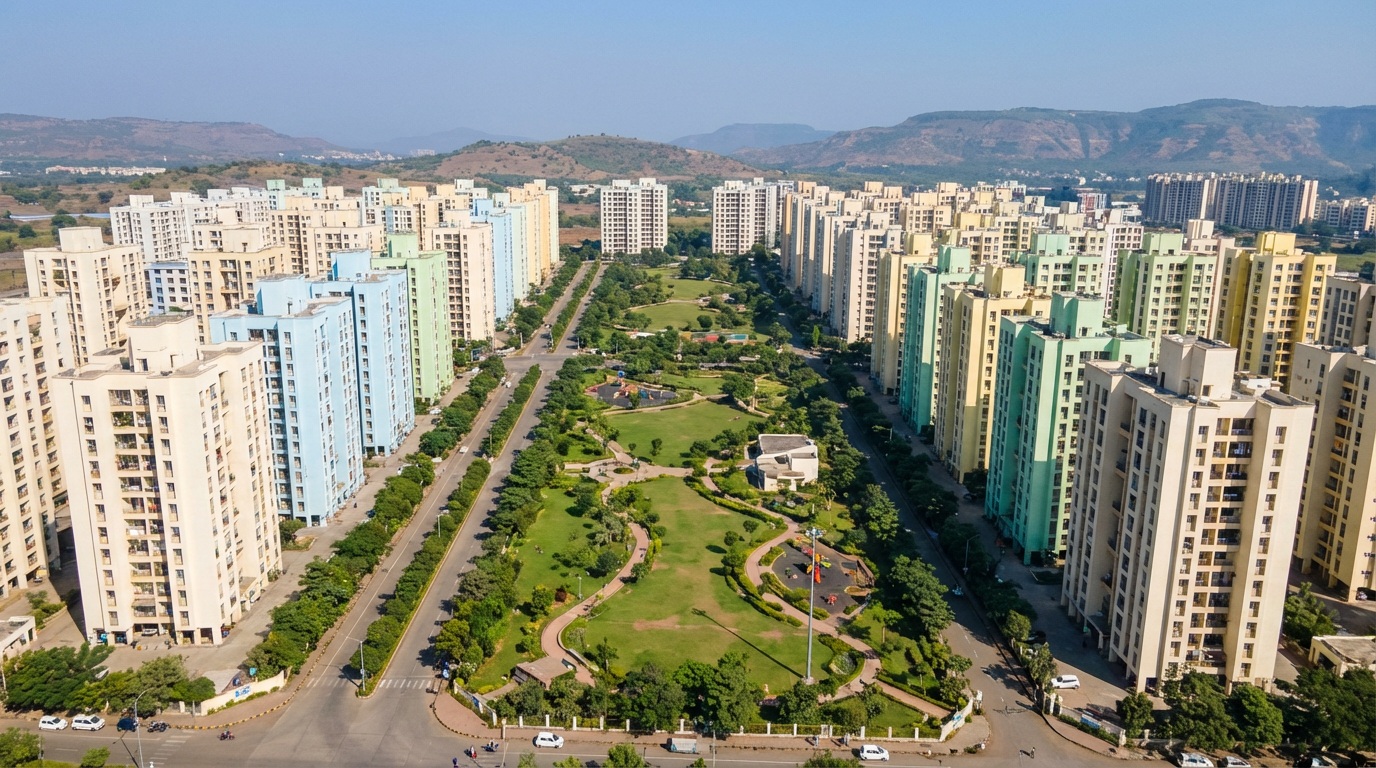
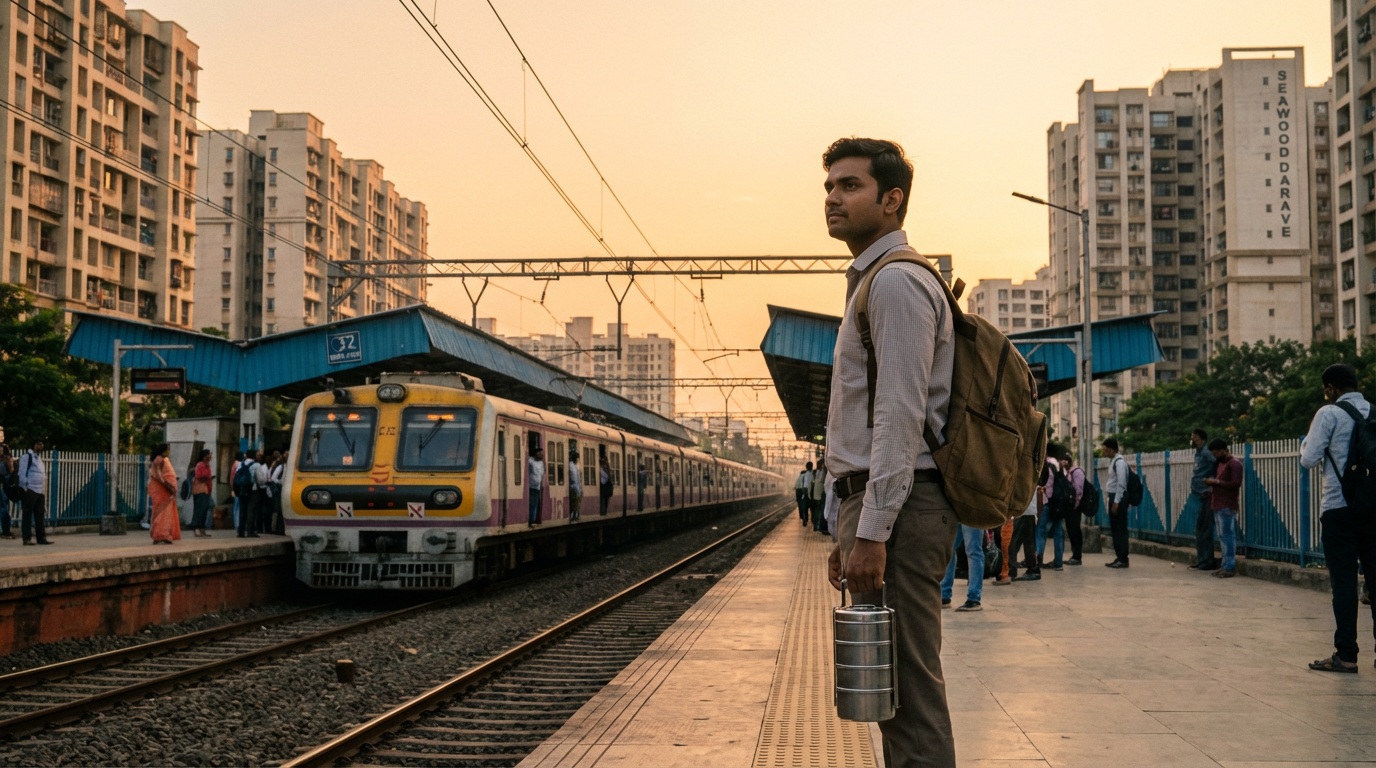
Whether ₹40,000 a month works in Navi Mumbai comes down to one decision more than any other: your housing choice. It’s genuinely workable if you’re single and open to shared accommodation, a PG, or an affordable rental in a lower-cost node. It gets tighter, and can break the budget entirely, if you want a private 1BHK to yourself in a higher-rent area like Vashi, Nerul, or Kharghar. This guide doesn’t try to prove ₹40,000 is enough — it walks through the real variables so you can work out whether it’s enough for your situation.
Quick Answer: Can You Live in Navi Mumbai on ₹40,000?
Yes, if you’re a single professional choosing shared accommodation, a PG, or a lower-rent node such as Taloja or Panvel. It gets considerably tighter if you want a private 1BHK in Vashi, Nerul, or Kharghar, where 1BHK rent alone can run ₹20,000–45,000 depending on the area and building. For couples, ₹40,000 as a household spending cap works only with a compact or lower-cost housing choice — a mid-range 2BHK in a central node will usually push a couple’s total past ₹40,000. The sections below give you a framework to work out your own number rather than a single averaged figure.
Can ₹40,000 Actually Work in Navi Mumbai?
The honest answer is: it depends almost entirely on what you spend on housing, because rent is the one line item with the widest range and the biggest effect on everything else. Two people with identical salaries and similar lifestyles can have completely different experiences of a ₹40,000 budget depending on whether one is renting a shared room in Taloja and the other wants a private 1BHK to themselves in Vashi.
Instead of a fixed budget table that pretends everyone spends the same amount, use this framework to build your own numbers. Fill in what applies to you, using the sections further down this guide (and the linked authority pages) for realistic ranges on each line.
| Expense | What to enter |
|---|---|
| Rent / PG | Your actual shortlisted rent or PG fee, not a citywide average |
| Maintenance | Society maintenance, if it’s billed separately from rent |
| Food | Groceries plus however much you realistically eat out or order in |
| Commute | Train pass, Metro fare, bus fare, or autos/cabs based on your actual route |
| Electricity | Higher in summer with AC use; check a recent bill if you can |
| Mobile / internet | Your current plan cost, or what you expect to pay |
| Healthcare | Routine costs plus a buffer for the unplanned |
| Personal / leisure | Clothes, personal care, entertainment, social spending |
| Emergency / savings | What you can set aside, even if it’s small |
| Total | Add it up and compare against ₹40,000 |
If your total comes in under ₹40,000, you have room. If it doesn’t, the fix is almost always on the rent line, not the smaller ones — see the next section.
Rent Is the Biggest Variable
Rent is where a ₹40,000 budget is won or lost. Navi Mumbai’s rent ranges are wide even within a single node — furnishing, floor, building age, and distance from the station all move the number, sometimes by tens of thousands of rupees for the same locality. Rather than repeat a fixed set of figures here that will drift out of date, this guide points you to the site’s current Navi Mumbai rental and cost-of-living benchmarks and asks you to build your budget around the actual rent of properties you shortlist, not an average.
As a general orientation: a private 1BHK in a well-connected node like Vashi or Nerul commonly asks ₹20,000–45,000, while nodes further from the harbour line, such as Panvel or Taloja, run lower. A shared room or PG runs well below any of those figures. None of this replaces checking real listings for the specific building and locality you’re considering.
You may sometimes see a shared PG bed advertised around ₹7,000. Treat that as a listing snapshot from one specific PG at one point in time, not a standard rent you should expect everywhere — PG pricing varies by locality, room sharing (double vs triple vs dorm), meals included, and season, so the number on any one listing can be a few thousand rupees higher or lower.
Don’t assume one node is reliably a fixed amount cheaper than another. Published comparisons sometimes cite a gap of a couple of thousand rupees between neighbouring nodes, but rent ranges overlap enough locality to locality that a specific property in a “pricier” area can still come in below a specific property in a “cheaper” one. Compare actual listings rather than relying on a rule of thumb.
Shared Accommodation vs Private 1BHK
This is the single biggest lever in a ₹40,000 budget. Sharing a flat or PG with one or more people typically brings your housing cost down to a fraction of what a private 1BHK would cost, freeing up a large part of the budget for everything else. A private 1BHK gives you space and privacy, but in nodes like Vashi, Nerul, or Kharghar it can consume more than half of a ₹40,000 budget on rent alone, before maintenance, deposit, or utilities.
There’s no universally “right” choice here — it depends on how much you value privacy versus how much breathing room you want in the rest of your budget. If ₹40,000 needs to comfortably cover savings, healthcare, and some leisure as well as rent, shared accommodation or a PG is usually the more realistic starting point. If you’re prepared to run a tighter budget elsewhere to have a place to yourself, a private 1BHK in a lower-rent node is more likely to fit than one in a premium pocket of Vashi or Nerul.
For a locality-by-locality look at what shared and PG options cost, see our guide to comparing PG and shared accommodation. For the fuller rent and cost-of-living picture across Navi Mumbai’s nodes, see our current Navi Mumbai rental and cost-of-living benchmarks.
Calculate Your Commute From Your Actual Route
Commute cost depends entirely on where you live, where you work, and which mode you use, so a single citywide figure isn’t useful here. A monthly local train pass, a Metro pass, an NMMT bus pass, and regular autos or cabs can differ by several thousand rupees a month for the same two points on a map. Rather than quote fares that change and go stale quickly, work out your specific route using the site’s dedicated, regularly updated guides:
- For local train fares and pass prices, see our current suburban train fares.
- For Metro fares between Navi Mumbai stations, see our current Navi Mumbai Metro fares.
- For NMMT bus routes and fares, see our NMMT bus routes, timings and fare guide.
As a rule of thumb: a monthly pass on train, Metro, or bus is almost always cheaper than paying per trip, and far cheaper than relying on autos or cabs for a daily commute. If your job allows a stop close to a station or Metro line, that alone can move your commute cost from a few hundred rupees a month to several thousand.
Food: Build It Around How You Actually Eat
Food cost varies more than almost any other line in this budget, because it depends on how much you cook, how much you order in, and how often you eat out — habits that differ hugely from person to person. There isn’t a single reliable “food cost in Navi Mumbai” figure that applies to everyone, so build this line item around your own pattern rather than a fixed number:
- Groceries: what you’d spend cooking most meals at home, which varies by diet and how much you cook from scratch versus using convenience ingredients.
- Tiffin or canteen: a recurring cost if you rely on a tiffin service or workplace canteen for some or all meals.
- Eating out and delivery: the most variable line of all — a few restaurant meals or delivery orders a week can add up to more than groceries and tiffin combined.
A reasonable way to budget this line is to add up what you actually spent on food last month across these categories, rather than estimate from scratch. If you don’t have that number yet, track it for a few weeks before committing to a fixed food budget.
Three Illustrative ₹40,000 Budget Scenarios
These are illustrative budgeting scenarios, not Navi Mumbai citywide averages. Replace each amount with your actual rent, commute and household expenses before making a financial decision.
Scenario A: Single Professional in Shared Accommodation
| Expense | Amount |
|---|---|
| Housing (shared flat or PG) | ₹10,000 |
| Food | ₹8,000 |
| Commute | ₹2,000 |
| Utilities / connectivity | ₹2,500 |
| Healthcare / personal | ₹3,500 |
| Leisure | ₹4,000 |
| Savings / emergency | ₹10,000 |
| Total | ₹40,000 |
This is the version of ₹40,000 with the most breathing room, because shared housing keeps the biggest line item small and leaves meaningful room for savings.
Scenario A-variant: Single Professional, Private 1BHK in a Lower-Cost Node
| Expense | Amount |
|---|---|
| Rent (1BHK, Taloja/Panvel-type node) | ₹18,000 |
| Food | ₹7,000 |
| Commute | ₹2,500 |
| Utilities / connectivity | ₹3,000 |
| Healthcare / personal | ₹3,000 |
| Leisure | ₹3,500 |
| Savings / emergency | ₹3,000 |
| Total | ₹40,000 |
A private 1BHK to yourself is achievable on ₹40,000, but generally only in a lower-rent node, and it comes with a much smaller savings cushion than the shared-accommodation version above.
Scenario B: Couple With a ₹40,000 Household Spending Cap
| Expense | Amount |
|---|---|
| Rent (1BHK, Taloja/Panvel-type node) | ₹15,000 |
| Food | ₹10,000 |
| Commute (both) | ₹3,000 |
| Utilities / connectivity | ₹4,000 |
| Healthcare / personal | ₹3,000 |
| Leisure | ₹3,000 |
| Savings / emergency | ₹2,000 |
| Total | ₹40,000 |
Note that ₹40,000 here is a household spending cap, not necessarily a household income — how much room it leaves depends on what the household earns. This scenario only holds together with a sufficiently low-cost housing choice. A mid-range 2BHK in Vashi, Nerul, or Kharghar commonly asks ₹45,000–1,00,000 on its own, which would push this household well past ₹40,000 on rent alone, before any other expense.
If you’re budgeting as a family rather than a couple, see our guide to build a family monthly budget for a fuller breakdown once children’s costs and larger housing enter the picture.
A student in a shared PG is often the leanest version of all — illustratively, PG plus food and a transport pass can total around ₹16,000 a month. That figure is before education fees, travel home, deposits, medical expenses, and other irregular costs, so don’t mistake a low PG-only total for the full picture of what a student actually spends in a month.
Costs a ₹40,000 Budget Often Misses
Budgets built only from rent, food, and commute tend to look tidier than real life. These are the costs that most often get left out, and that can quietly break a ₹40,000 budget over a few months:
- Rental deposit and brokerage when you first move in, or when you renew or switch flats
- Society maintenance charges, if they’re billed separately from rent
- Electricity bills that spike in summer with AC use
- Household supplies — cleaning products, kitchen basics, replacing things that wear out
- Insurance, whether health, life, or renter’s
- Medical expenses beyond routine healthcare
- Subscriptions — streaming, apps, gym memberships
- Clothes and personal care
- Furniture and appliances when you move in or replace something
- Travel home to see family
- Annual or irregular expenses that don’t show up every month but do show up every year
- An emergency fund, so an unplanned cost doesn’t derail the whole month
None of these are exotic. They’re the ordinary costs of a full life, and a budget that only accounts for rent, food, and commute will look like it works right up until one of these shows up.
Monthly Budget vs Move-In Cost
A ₹40,000 monthly budget and the cash you need to actually move in are two different numbers, and conflating them is a common way people underestimate what it takes to get started in a new home. Even if ₹40,000 comfortably covers your monthly running costs, moving in typically requires a lump sum well beyond that: a security deposit (commonly a multiple of monthly rent in Navi Mumbai), brokerage if you used an agent, and moving costs for transporting your belongings and any furniture or appliances you need on day one.
Before you commit to a property, work out both numbers separately: what the monthly budget looks like once you’re settled, and what you need in hand before you can move in at all. A rent that fits your monthly budget can still be out of reach if you don’t have the deposit and brokerage saved up first.
What Can Push a ₹40,000 Budget Over the Limit?
These are the most common ways a ₹40,000 budget stops working, roughly in order of how often they matter:
- Higher rent than planned — the single biggest risk, since rent has the widest range of any line item.
- Frequent autos or cabs instead of a train, Metro, or bus pass — a daily habit here adds up fast compared with a monthly pass.
- Regular food delivery — a few orders a week can outweigh groceries and tiffin combined.
- Frequent paid leisure — eating out, entertainment, and weekend outings are easy to underestimate.
- Unplanned healthcare costs — a single doctor’s visit or course of medication can use up a week’s worth of budget.
- Electricity and AC use — summer bills can run well above winter ones in the same flat.
- Subscriptions that quietly accumulate — streaming, apps, and memberships add up when you’re not tracking them.
- Deposits and annual expenses — insurance renewals, festival spending, and travel home don’t show up every month, but they do show up.
None of these individually breaks a budget. It’s usually two or three of them showing up in the same month that does.
Can You Live on ₹40,000? Budget Worksheet
Use this worksheet to build your own number instead of relying on someone else’s average. Fill in what you’d realistically spend on each line, based on your shortlisted rent, your actual commute route, and how you eat.
| Expense | Your amount (₹) |
|---|---|
| Rent | |
| Maintenance | |
| Electricity | |
| Internet / mobile | |
| Groceries | |
| Tiffin / canteen / eating out | |
| Train / Metro / bus | |
| Autos / cabs | |
| Healthcare | |
| Personal / leisure | |
| Savings / emergency fund | |
| Other | |
| TOTAL | |
| ₹40,000 − TOTAL |
If the final row is positive, your budget fits within ₹40,000. If it’s negative, the fix is almost always the rent or commute line, not the smaller ones — revisit your housing choice or route before trimming food and leisure to the bone.
For expenses that only come up once or twice a year, such as insurance or festival spending, divide the annual total by 12 and add that monthly share to the worksheet rather than leaving it out entirely.
How to Make the Budget More Resilient
A few habits make a ₹40,000 budget more likely to hold up over months rather than just on paper for one good month:
- Keep a small buffer in the “other” line rather than allocating every rupee, so one unplanned expense doesn’t force a shortfall elsewhere.
- Track actual spending for a month before finalising the budget, rather than estimating every line from scratch.
- Review the budget every few months, since rent, electricity, and subscription costs all drift upward over time.
- Keep the emergency fund line separate from leisure spending, even when the month feels comfortable.
- Revisit the rent-versus-space trade-off if the budget stays tight for more than a couple of months — it’s usually the highest-leverage change available.
- Periodically audit recurring monthly expenses — subscriptions and small recurring costs are easy to lose track of.
For low-cost ways to spend leisure time without straining that line of the budget, see our guide to low-cost things to do in Navi Mumbai.
Frequently Asked Questions
Is ₹40,000 enough for a single person?
For most single professionals, yes — provided you choose shared accommodation, a PG, or a private 1BHK in a lower-rent node. It’s less likely to be enough for a private 1BHK to yourself in a higher-rent area like central Vashi or Nerul once rent, deposit, and daily costs are added up. Use the framework and worksheet earlier in this guide to check your specific situation.
Can a couple live on ₹40,000 a month in Navi Mumbai?
It depends heavily on your housing choice, so there’s no blanket yes or no. A couple in a compact or lower-cost 1BHK, typically in nodes like Taloja or Panvel, can often make ₹40,000 work as a household spending cap. A mid-range 2BHK in a central node such as Vashi, Nerul, or Kharghar commonly asks ₹45,000–1,00,000 on its own, which usually pushes a couple’s total well past ₹40,000.
Can I rent a 1BHK on a ₹40,000 salary?
It depends on where. In lower-rent nodes like Taloja or Panvel, a private 1BHK can fit within a ₹40,000 budget alongside food, commute, and other costs. In higher-rent nodes like Vashi, Nerul, or Kharghar, 1BHK rent alone can run ₹20,000–45,000, which leaves little room for anything else on a ₹40,000 total. Check actual listings in your preferred node before assuming either way.
Which Navi Mumbai areas should I check on a ₹40,000 budget?
Start with lower-rent corridors such as Taloja, Panvel, and nearby areas, or consider shared accommodation in a more central node if connectivity matters more to you than space. We’d avoid naming one permanent “cheapest” area, since rents change and specific listings vary more than any single ranking suggests — see our guide to compare Navi Mumbai neighbourhoods before you shortlist.
How much should I budget for commuting?
It depends entirely on your specific route and mode, so we won’t quote a single figure here that would go stale. See our current suburban train fares and current Navi Mumbai Metro fares for up-to-date pass prices. As a general pattern, a monthly pass on train, Metro, or bus costs far less than relying on autos or cabs for a daily commute.
How much does food cost for one person in Navi Mumbai?
It varies more than almost any other line in this budget, depending on how much you cook versus order in or eat out. Rather than quote one figure, track your actual grocery, tiffin, and eating-out spending for a few weeks and use that as your baseline — see the Food section above for how to break it down.
Is Navi Mumbai cheaper than living in Mumbai?
Navi Mumbai can be materially cheaper than Mumbai, primarily because of housing, though the exact difference depends heavily on which locations you’re comparing — Taloja or Panvel versus Bandra is a very different comparison from Vashi versus a suburban Mumbai locality. See our current Navi Mumbai cost-of-living data for sourced, area-by-area comparisons rather than a single headline percentage.
What costs should I include besides rent?
Beyond rent, budget for maintenance if it’s billed separately, food, commute, electricity, mobile/internet, healthcare, personal and leisure spending, and savings or an emergency fund. Don’t forget the deposit and brokerage you’ll need to move in, and annual or irregular costs like insurance and travel home — see Costs a ₹40,000 Budget Often Misses above for the full list.
The Bottom Line
₹40,000 a month can work well in Navi Mumbai, but it isn’t a guarantee for everyone who has that number to spend. It works most comfortably for a single professional willing to share accommodation or live in a lower-rent node, where housing stays a manageable share of the total and there’s still room for savings. It gets considerably tighter for anyone who wants a private 1BHK in a higher-rent node like Vashi, Nerul, or Kharghar, and for couples it depends almost entirely on finding a compact or lower-cost housing option rather than a mid-range flat in a central area. The honest way to use this guide is to build your own numbers with the framework and worksheet above, rather than treat any single scenario here as a promise about your own budget.
Sources & Methodology
Rental figures referenced in this guide are current asking-rent or listing ranges, not guaranteed achieved rents — actual rent depends on furnishing, floor, building age, and negotiation, so treat any figure here as a starting point for your own search rather than a fixed number. For the fullest, most current locality-by-locality rent data, see our Navi Mumbai cost-of-living guide, which we cross-check this article against rather than maintaining a separate rent dataset here.
Transport fares are maintained in our dedicated local train, Metro, and NMMT bus guides rather than duplicated here, since fares change and a single figure in this article would go stale faster than we could reliably update it.
Food, utilities, and discretionary spending are household-specific by nature. The figures in this guide are budgeting scenarios meant to illustrate a structure, not citywide averages measured from a representative sample of households. All example budgets in this guide are illustrative and are meant to be replaced with your own numbers once you’ve shortlisted an actual property and route.
Last verified: 28 August 2026.