
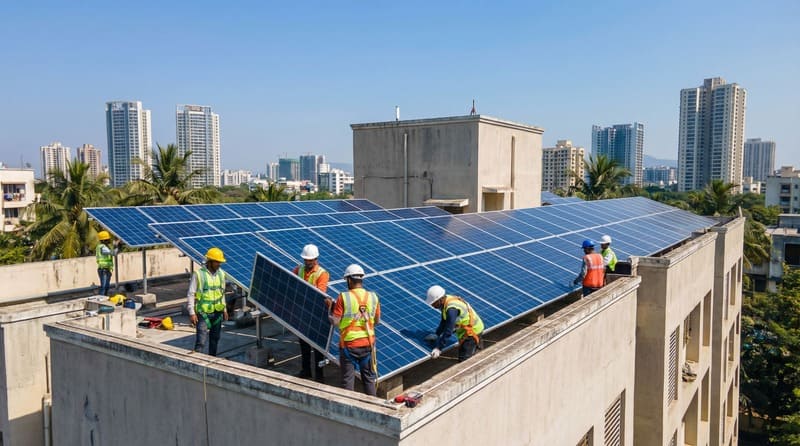
Rooftop solar for homes and housing societies in Navi Mumbai has moved from a niche upgrade to a mainstream decision, driven by the PM Surya Ghar Muft Bijli Yojana subsidy and falling equipment prices. This guide covers realistic costs, the current subsidy structure for households and societies, how net metering and virtual net metering work in Maharashtra, and a practical framework for estimating your own savings.
Last updated: 13 September 2026
Financial and technical information notice: Subsidy amounts, DISCOM procedures, MERC regulations and equipment specifications change over time, and actual costs and generation depend on your specific roof, consumption and installer. This guide is for planning purposes. Before signing a contract, verify current figures on the official PM Surya Ghar portal and with MSEDCL, and get a written, itemised quotation from your installer.
Quick Answer
A grid-tied rooftop solar system for a Navi Mumbai home or society still needs an upfront payment, even after the subsidy. Individual households can currently claim a central subsidy of up to ₹78,000 (capped at a 3 kW allocation) under PM Surya Ghar, while group housing societies can claim ₹18,000 per kW for common-area systems, up to 500 kW per society. What you actually pay, and how quickly it pays back, depends on your roof’s usable area and shading, your household or society’s electricity consumption pattern, the equipment and installer you choose, and whether your connection qualifies for net metering. There is no single “right” system size or price. Use the frameworks below with your own electricity bills and an itemised installer quotation, not a generic number from this or any other article.
How Rooftop Solar Works, Briefly
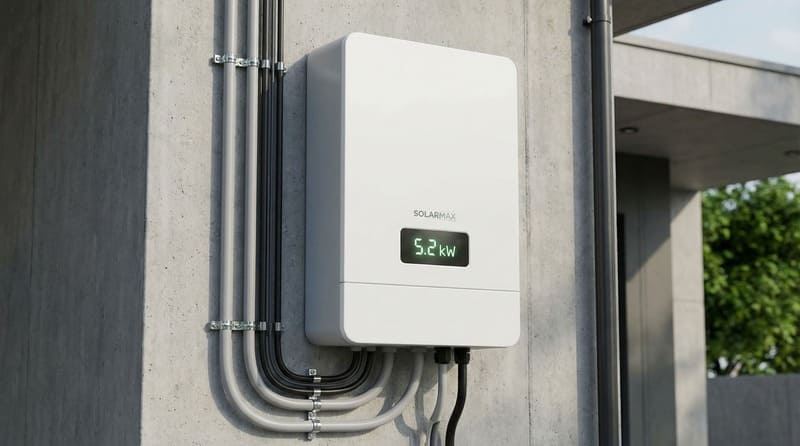
A rooftop solar system converts sunlight into DC electricity through PV panels, which an inverter converts to grid-compatible AC power. That power first serves whatever your home or society is using at that moment; anything left over is exported to the grid through a bidirectional (net) meter, which is where net metering and net billing come in. When the sun isn’t generating enough (early morning, monsoon cloud cover, night), you draw power from the grid as usual. The system does not include battery storage unless you specifically add one, which most residential and society installations in Navi Mumbai don’t.
How Much Does Solar Cost in Navi Mumbai?
Installed cost (before subsidy) is driven by several factors rather than a fixed rate per watt: panel and inverter brand and tier, mounting structure complexity (flat RCC roof versus a roof with existing water tanks, parapets or shading obstacles), cabling and protective equipment, structural work if the roof needs reinforcement, and the installer’s own labour and margin. Published per-watt or per-kW figures circulating online vary widely because they rarely specify which of these are included, so treat any number you see, including ranges in older versions of this article, as indicative only until confirmed by a written quotation for your specific site.
What should genuinely change your decision is not a headline price but what is actually included in a quote. At minimum, ask every installer to itemise:
| Component | What to check |
| Panels | Manufacturer, exact model, wattage, quantity, DCR status if claiming subsidy |
| Inverter | Manufacturer, model, capacity, string or micro-inverter design |
| Mounting structure | Material, galvanisation spec if disclosed, anchoring method |
| Cabling and protection | DC/AC cabling, earthing, surge protection, isolation switches |
| Approvals and meter work | Whether DISCOM application, inspection coordination and net meter charges are included |
| Installation and commissioning | Labour, transport, commissioning, and any civil or waterproofing work |
| Taxes and exclusions | GST treatment and anything explicitly excluded |
A lower headline price with fewer of these itemised almost always means something is missing, not that you found a better deal. The comparison worksheet later in this guide gives you a structured way to line up two or three quotations side by side.
PM Surya Ghar Subsidy: What You Can Actually Claim
PM Surya Ghar Muft Bijli Yojana is the Ministry of New and Renewable Energy’s central subsidy scheme for rooftop solar, and it treats individual households and group housing societies differently.
For Individual Households
- First 2 kW: ₹30,000 per kW (₹60,000 total)
- Additional capacity up to 3 kW: ₹18,000 per kW
- Maximum subsidy: ₹78,000, for a 3 kW system. Installing a larger system doesn’t increase the subsidy beyond this cap.
This subsidy is disbursed directly to the applicant’s bank account after commissioning and inspection are confirmed on the PM Surya Ghar national portal, not deducted upfront by the installer. Treat any quote advertising “post-subsidy pricing” with caution until you understand exactly when and how that subsidy actually reaches you.
For Group Housing Societies (GHS) and RWAs
- Subsidy rate: ₹18,000 per kW for common-area rooftop solar systems, covering common electricity loads such as lifts, lobby lighting, pumps and (where applicable) EV charging infrastructure
- Capacity basis and cap: allocated at roughly 3 kW per flat, up to a maximum of 500 kW per society
- Equipment requirement: panels must meet DCR (Domestic Content Requirement) or Approved List of Models and Manufacturers criteria to qualify
This is a separate provision from the individual household subsidy above, aimed at common-area consumption rather than any single flat’s meter. A society considering a 50 kW common-area system, for example, could be eligible for roughly ₹9,00,000 in central subsidy against that capacity, treated strictly as a subsidy against project cost, not as an automatic reduction that a vendor bakes into a discounted headline price. Confirm the applicable rate and cap on the official portal before budgeting around it, since scheme parameters are periodically revised.
Two things this guide will not do: promise that every applicant receives the maximum subsidy regardless of eligibility and process compliance, and combine the individual and society provisions as if they were the same benefit. Verify your own eligibility, connection type and application stage directly through the PM Surya Ghar portal and your installer, rather than assuming a figure quoted online applies automatically to you.
How to Apply: The Official Process
Based on the current PM Surya Ghar and MSEDCL process for Maharashtra:
- Register and apply on the PM Surya Ghar national portal, and separately on MSEDCL’s Rooftop Solar (RTS) portal, using your consumer number.
- Choose an installer registered under the scheme for your DISCOM area. For a housing society, the application is typically routed through the RWA or society office rather than an individual flat owner.
- MSEDCL reviews feasibility for your connection and sanctioned load, then the chosen installer carries out the installation.
- MSEDCL conducts a technical site inspection and completes a joint inspection report confirming the installation meets requirements.
- A net or bidirectional meter is installed, generally by MSEDCL’s metering agency, at no separate charge to the consumer for standard residential capacities.
- Once commissioning is confirmed on the portal, the subsidy is disbursed to the applicant’s registered bank account.
For residential systems under 10 kW, this process has generally been completing in a few weeks once documents and site access are in order, though timelines vary by circle and season. Systems above 10 kW, or society-scale installations, typically take longer due to additional technical review. Keep copies of your electricity bill, ownership or consent documents, and Aadhaar handy, since these are commonly requested at application stage.
How Much Solar Capacity Do You Actually Need?
Skip the shortcut that ties system size to your flat’s BHK count. A 2 BHK with a family that runs two air conditioners through the afternoon consumes very differently from a 2 BHK that’s empty most of the day. Size around these instead:
- Your actual consumption. Pull your last several electricity bills and look at typical monthly units consumed, not one unusually high or low month.
- When you use electricity. A household or office that draws more power during daylight hours gets more value from direct solar consumption than one that’s mostly active in the evening.
- Usable roof area. Water tanks, lift rooms, parapets, other equipment and shading from neighbouring towers all reduce the area actually available, sometimes significantly.
- Your sanctioned load and connection type. This determines what capacity your connection can technically support and export under net metering rules.
As a general reference point, PM Surya Ghar’s own guidance links indicative system sizes to average monthly consumption: roughly 0 to 150 units a month suggests a 1 to 2 kW system, 150 to 300 units suggests 2 to 3 kW, and above 300 units typically points to 3 kW or more (subsidy caps at the 3 kW slab either way). Treat this as scheme-level guidance for a starting conversation with your installer, not a sizing formula that overrides your actual roof and consumption data.
How Much Electricity Can Solar Actually Generate?
Generation depends on system capacity, panel orientation and tilt, shading, panel degradation over time, local irradiance, and weather, including Navi Mumbai’s monsoon cloud cover. There is no single “1 kW generates X units a month” figure that holds everywhere; it is a modelled, site-specific estimate. Ask your installer for their projected annual generation figure along with the assumptions behind it (irradiance data source, shading losses, degradation rate) rather than accepting a flat multiplier, and treat that projection as an estimate rather than a guarantee.
Net Metering, Net Billing and Virtual Net Metering in Maharashtra
These three terms get used loosely and interchangeably online, but they aren’t the same thing.
- Net metering is the standard mechanism for an individual rooftop connection: the bidirectional meter nets what you import against what you export within a billing cycle, with any surplus generally carried forward as a credit.
- Net billing refers to arrangements where imported and exported units are valued and settled separately rather than simply netted, an approach that has been discussed for larger or newer categories of installations under evolving Maharashtra Electricity Regulatory Commission (MERC) regulation. Which arrangement applies to your specific connection and capacity is something to confirm with MSEDCL directly, since it depends on current regulation and your connection category, not a fixed rule this article can state as universal.
- Virtual net metering (VNM) was introduced through MERC’s Second Amendment (2024) to the Grid Interactive Rooftop Renewable Energy Generating Systems Regulations, specifically to let multiple residential consumers in a multi-storey building or housing society draw benefit from one shared system installed on a common rooftop or common area, where individual flat-level rooftop installations aren’t practical. Under VNM, the electricity a shared system generates offsets participating consumers’ consumption within the same billing cycle according to a pre-agreed allocation, with surplus generation carried forward as credit to the next cycle. The allocation between participating flats is formalised with the distribution licensee in advance; it isn’t something residents manually divide up after the fact.
If your society is considering a common rooftop system serving individual flats rather than only common-area load, ask your installer and MSEDCL specifically whether VNM applies to your case, what the current participation and capacity rules are, and how allocation and billing actually get formalised, since this is a comparatively newer regulatory mechanism and implementation details continue to be refined.
How to Estimate Solar Savings and Payback
Instead of quoting a fixed “pays back in X years” number, use this sequence with your own figures:
- Get your net upfront cost. Total quoted project cost, minus subsidy you are genuinely eligible for and have confirmed you will receive.
- Get a realistic annual generation estimate from your installer, with assumptions stated.
- Estimate self-consumption versus export. Electricity you use directly typically offsets your bill at your retail tariff; exported surplus is credited under net metering/billing rules, which can value it differently.
- Apply your actual electricity tariff, including any fixed charges that continue regardless of solar generation.
- Account for degradation. Panel output typically declines gradually year over year; a realistic model reflects this rather than assuming flat output for 25 years.
- Factor in maintenance and any component replacement (inverters, in particular, often have a shorter service life than panels).
- Divide net upfront cost by estimated first-year net savings for a simple payback estimate, understanding this simplifies a more complex multi-year picture.
- Ask your installer to show the full calculation behind any payback or lifetime-savings figure they quote you, including every assumption above, before treating it as anything more than an illustration.
Illustrative example only, not a guarantee: a society spending ₹22,00,000 on a 50 kW system and receiving the full ₹9,00,000 GHS subsidy has a net cost of ₹13,00,000. If that system’s generation offsets common-area consumption worth roughly ₹78,000 a month at current tariffs, simple payback on the net cost alone works out to a little under 14 months, before accounting for degradation, maintenance and any shortfall between modelled and actual generation. A more conservative model that builds in those factors will land on a longer, more realistic payback period. Run the same steps with your own quotation and consumption figures rather than reusing this example’s numbers.
Solar During Navi Mumbai’s Monsoon
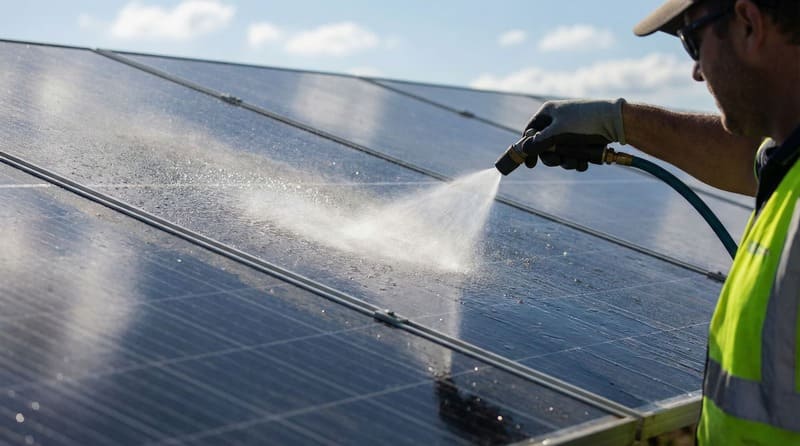
Solar panels keep generating through the monsoon; they don’t stop working. What changes is output: sustained cloud cover reduces irradiance and therefore generation compared with clearer months, so a realistic annual estimate should account for seasonal variation rather than assuming every month performs like a bright winter day. Rain can help wash some surface dust off panels, but it isn’t a substitute for periodic inspection, and any visible damage, unusually low output, or signs of an electrical fault after severe weather should be checked promptly by a qualified technician.
Solar for Apartments and Housing Societies
Who can actually install what depends on the property type and roof control, not just interest in going solar.
- Individual house or bungalow: the owner directly controls the roof, which generally makes the process more straightforward, subject to the usual technical and DISCOM approvals.
- Housing society common-area system: the society or RWA applies, typically to offset common-area electricity load (lifts, pumps, common lighting), under the GHS subsidy provision described above, or increasingly under a VNM arrangement where the regulatory framework supports it.
- Individual flat within a society: this is the most constrained case. It requires confirming who actually controls the terrace, obtaining society permission, and resolving the metering and electrical configuration with the applicable DISCOM rules, since a single flat generally cannot simply claim a section of a shared terrace without the society’s and DISCOM’s involvement.
Don’t assume every flat owner in a society can independently install a subsidised rooftop system on the common terrace. That requires society consent at minimum, and depending on capacity and configuration, may fall under group rather than individual scheme provisions.
Panels, Inverters and Coastal Conditions: What to Ask, Not What to Assume
Navi Mumbai’s coastal, humid environment is a genuine consideration for outdoor electrical equipment, but the right response is asking your installer pointed questions, not treating any single specification as mandatory for every installation.
- Mounting structure and corrosion resistance: ask what galvanisation or coating specification the mounting structure uses and why, rather than assuming a particular micron thickness is a universal requirement.
- Inverter enclosure rating: ask whether the inverter’s ingress protection rating is appropriate for its actual installation location (fully outdoor and exposed versus a sheltered utility area), since requirements differ by placement.
- Conformal coating on electronics: ask whether the inverter and any exposed electronic components have protective coating suited to a coastal, humid environment, and treat this as a question for your specific equipment and installer rather than a blanket mandate for every product on the market.
This guide avoids ranking specific panel or inverter brands, since price tiers and marketing claims aren’t reliable stand-ins for build quality or suitability to your site. Ask for manufacturer datasheets, not just a brand name, and compare warranty documentation (see the installer checklist below) rather than assuming a higher price automatically means better protection against Navi Mumbai’s coastal air.
Solar Panel Maintenance in Navi Mumbai
How often panels need cleaning and what maintenance actually costs depends on dust and soiling levels, nearby construction activity, bird activity, rainfall, roof access, and your specific equipment and installer’s guidance, not a universal schedule. Follow your manufacturer’s or installer’s actual maintenance recommendations for your system rather than a generic interval, and don’t climb onto an unsafe or unfamiliar roof to clean panels yourself; arrange safe, professional access instead.
Before You Pay a Solar Installer: A Practical Checklist
This is the single most useful section in this guide if you’re about to sign a contract. Work through it before paying any advance.
1. Verify the installer
Ask for the legal business or entity name, GST details where applicable, office and contact details, experience with residential rooftop solar, experience with the relevant DISCOM’s process, and references for comparable installations where available. Confirm whether the vendor is registered or empanelled where that’s required for the subsidy or process you’re using. If you’re applying under PM Surya Ghar, verify the vendor through the official portal or process rather than accepting “government approved” as sufficient evidence on its own.
2. Get a fully specified proposal
A proper written proposal identifies: proposed capacity in kW, number of panels, panel manufacturer and exact model, wattage per panel, inverter manufacturer and model, inverter capacity, mounting structure, cabling, protection equipment, earthing, monitoring system, what meter-related work is included or excluded, any battery component, civil or roof work required, and installation and commissioning. Avoid quotations that simply say “3 kW premium solar system” without specifying the actual components.
3. Ask why that system size was recommended
A credible installer explains sizing using your recent consumption, available unshaded roof area, orientation and shading, the applicable connection and net-metering framework, how you intend to use the electricity, and any expected future changes in consumption. Don’t accept “2 BHK needs 3 kW” or “3 BHK needs 5 kW” as an actual sizing methodology; flat size doesn’t determine electricity consumption.
4. Confirm a real site assessment happened
Before finalising anything, confirm the installer has actually assessed your roof: usable area, shading from nearby towers, water tanks, lift rooms, parapets, other rooftop equipment, access, mounting arrangement, cable routing and roof condition. For societies, also confirm who controls the roof and whether the proposed area can legally and contractually be used for the installation.
5. Ask about structural suitability
For larger or unusual installations, structural suitability of the roof and mounting arrangement should be assessed by a suitably qualified professional where required. Not every concrete terrace can automatically carry a solar installation without that check.
6. Get an itemised price, and identify every exclusion
Ask for a quotation itemising panels, inverter, mounting structure, cables, electrical protection, earthing, installation, transport, commissioning, monitoring, meter or application assistance, documentation, taxes, any civil work, waterproofing-related work, and annual maintenance if included. Then explicitly list what’s excluded.
7. Separate the subsidy from the vendor’s price
The quotation should clearly show gross system price, minus subsidy (if you’re actually eligible and it’s actually received), equalling effective net cost. Don’t accept a quote advertised only as “₹XX,XXX after subsidy” without seeing the actual pre-subsidy price and the conditions attached. The subsidy is a government disbursement, not an instant vendor discount, unless the specific applicable mechanism genuinely operates that way.
8. Confirm subsidy eligibility independently
Don’t rely solely on the salesperson. Verify current consumer eligibility, connection type, system requirements, vendor requirements, application stage, inspection and commissioning requirements, and the disbursement process directly through the official PM Surya Ghar and MNRE channels.
9. Understand the DISCOM and net-metering process
Ask who submits the application, which documents are required, who coordinates inspection, who handles meter-related work, whether statutory, application or meter charges are included, what happens if the application needs changes, and at what stage the system can actually be commissioned and export electricity. “Net meter guaranteed” is not a substitute for actually going through the approval process.
10. Get real warranty documentation
Separate the panel product warranty, the panel performance warranty, the inverter warranty, the installer’s workmanship warranty, and any mounting or other component warranty. Ask for the actual manufacturer documentation, not a verbal claim. “25-year solar warranty” is too vague on its own; it often refers to a defined performance commitment for the module, not free replacement of every system component for 25 years.
11. Get a real generation estimate
Ask the installer to state estimated annual generation, the assumptions used, shading and degradation assumptions, and whether the figure is guaranteed or modelled, along with what happens if actual generation differs. “1 kW equals X units every month” is not a guarantee; generation varies seasonally and by site.
12. Ask for the savings calculation, not just the headline number
If an installer quotes a specific monthly or lifetime savings figure, ask for the calculation behind it: expected generation, self-consumption, export treatment, current and assumed future tariffs, degradation, maintenance assumptions, and the analysis period used. A large lifetime-savings number with no visible assumptions is marketing, not a financial model.
13. Understand the payment schedule
Confirm booking or advance amount, equipment payment, installation payment, commissioning milestone, final payment, and how the subsidy relates to this schedule. Payment structures vary by installer; there’s no single standard split to expect.
14. Confirm what happens at handover
Before making the final payment, confirm you’ll receive system and component documentation, invoices, serial and model details where relevant, warranty documents, commissioning information, monitoring access, applicable approvals, meter and net-metering documentation, subsidy documentation where relevant, and an after-sales service contact.
Don’t choose an installer solely on the lowest ₹/kW quote or the largest advertised subsidy or savings figure. Compare the proposed equipment, site assessment, expected generation, approvals support, exclusions, warranty terms and after-sales responsibilities together.
Solar Quote Comparison Worksheet
Use this to compare two or three quotations side by side before deciding.
| Item | Quote A | Quote B | Quote C |
| Proposed capacity | ___ kW | ___ kW | ___ kW |
| Number of panels | |||
| Panel manufacturer/model | |||
| Panel wattage | |||
| Inverter manufacturer/model | |||
| Inverter capacity | |||
| Mounting structure | |||
| Earthing/protection included | |||
| Monitoring included | |||
| Site survey completed | Yes/No | Yes/No | Yes/No |
| Shading considered | Yes/No | Yes/No | Yes/No |
| Estimated annual generation | ___ kWh | ___ kWh | ___ kWh |
| Generation assumptions supplied | Yes/No | Yes/No | Yes/No |
| Gross system price | ₹___ | ₹___ | ₹___ |
| Taxes included | Yes/No | Yes/No | Yes/No |
| Application/meter assistance | |||
| Other charges/exclusions | ₹___ | ₹___ | ₹___ |
| Subsidy quoted | ₹___ | ₹___ | ₹___ |
| Subsidy independently verified | Yes/No | Yes/No | Yes/No |
| Effective cost after eligible subsidy | ₹___ | ₹___ | ₹___ |
| Panel product warranty | |||
| Panel performance warranty | |||
| Inverter warranty | |||
| Workmanship warranty | |||
| Installation timeline | |||
| Payment schedule | |||
| After-sales/service terms |
Compare the gross price before subsidy as well as the effective cost after any eligible subsidy. A lower post-subsidy headline price can hide differences in equipment, exclusions or service that only show up later.
Financing Rooftop Solar
Some banks and NBFCs offer solar-specific loans, and some installers arrange EMI options through partner lenders. Terms vary by lender, borrower profile, system size and scheme, so don’t rely on a generic advertised interest rate. Compare the total amount repayable, the actual interest rate, processing charges, tenure, prepayment terms, and whether receiving the subsidy affects how the loan is structured. PM Surya Ghar itself is a subsidy scheme; it doesn’t automatically come bundled with financing, even though some lenders position products alongside it.
How to Shortlist an Installer
Rather than looking for a “best solar company in Navi Mumbai” ranking, which this guide won’t manufacture without a transparent methodology, check: current eligibility or registration where required, relevant experience, the exact components they’re proposing, whether they’ve actually done a site survey, their generation estimate and its assumptions, support through the approvals process, warranty terms, after-sales process, references, and a proper written quotation. If your scheme requires portal-registered vendors, use the official current vendor list as your starting point rather than a search-engine ranking.
Frequently Asked Questions
How much does rooftop solar cost in Navi Mumbai?
It depends on system capacity, equipment tier, roof complexity and installer, and there’s no single reliable per-watt figure that applies everywhere. Use the itemised quote checklist and comparison worksheet in this guide to get and compare real, written quotations for your specific site.
How much PM Surya Ghar subsidy can a household receive?
Up to ₹78,000 for an individual household, structured as ₹30,000 per kW for the first 2 kW and ₹18,000 per kW for the third kW, capped at a 3 kW allocation regardless of actual installed capacity. Group housing societies have a separate common-area provision of ₹18,000 per kW, up to 500 kW per society. Confirm current figures on the official portal, since scheme parameters can change.
Who is eligible for the rooftop solar subsidy?
Eligibility depends on your connection type, consumer category and compliance with the scheme’s application and inspection process. Verify your specific eligibility directly through the PM Surya Ghar national portal rather than assuming it based on general information.
How much electricity can a 3 kW solar system generate?
Generation varies by site, orientation, shading and season, so there’s no single reliable figure. Ask your installer for a site-specific generation estimate with stated assumptions, and treat it as a modelled estimate rather than a guarantee.
How do I decide what solar system size I need?
Base it on your actual electricity consumption from recent bills, your usable roof area after accounting for shading and obstructions, and your sanctioned load, not on the number of bedrooms in your home. PM Surya Ghar’s consumption-based guidance (roughly 1 to 2 kW for 0 to 150 units a month, 2 to 3 kW for 150 to 300 units, and 3 kW or more above that) is a reasonable starting point for discussion with an installer, not a rule.
Does rooftop solar work during Navi Mumbai’s monsoon?
Yes, panels continue generating whenever there’s daylight, but output is typically lower during sustained cloud cover than on clear days. A realistic annual generation estimate accounts for this seasonal variation.
Can an individual flat owner install rooftop solar in a housing society?
Not independently. It requires confirming who controls the terrace, getting society permission, and resolving the metering and electrical configuration with MSEDCL, and may fall under group rather than individual scheme provisions depending on the setup.
How does net metering affect solar savings?
Net metering nets what you import against what you export within a billing cycle, generally carrying surplus forward as credit. Some connection categories may fall under net billing, which settles imports and exports separately, or under virtual net metering for shared society systems. Confirm which applies to your specific connection with MSEDCL.
How long does rooftop solar take to recover its cost?
There’s no fixed number that applies to every installation. Use the eight-step estimation framework in this guide with your own net cost, generation estimate, consumption pattern and tariff to calculate a realistic payback period for your specific situation.
Bottom Line
Rooftop solar can meaningfully reduce grid-electricity consumption for suitable homes and housing societies in Navi Mumbai, but the actual financial outcome depends on your roof, system design, electricity use, applicable billing arrangement, installation cost, and any subsidy you’re genuinely eligible for. Start with your electricity bills and a proper roof assessment, verify current PM Surya Ghar and MSEDCL requirements directly, and compare itemised installer quotations using the checklist and worksheet above. Treat generation, savings and payback figures as estimates built on stated assumptions, not guarantees.
Sources and Methodology
Subsidy figures in this guide are checked against the official PM Surya Ghar/MNRE scheme structure. Maharashtra grid-connectivity, net metering and virtual net metering information is checked against MERC’s Grid Interactive Rooftop Renewable Energy Generating Systems Regulations and its Second Amendment (2024), and against MSEDCL’s published rooftop solar process. Installation cost ranges are treated as indicative planning information rather than vendor pricing unless a specific, dated, published figure is disclosed. Equipment specifications and warranty terms should be verified against current manufacturer documentation. Generation and savings estimates are site-specific; this guide does not treat a fixed monthly generation figure, savings amount or payback period as guaranteed performance. Scheme benefits, vendor requirements, electricity regulations and subsidy processes can change, so readers should confirm current details on the official portals referenced here before making a purchase decision.
Last verified: 13 September 2026