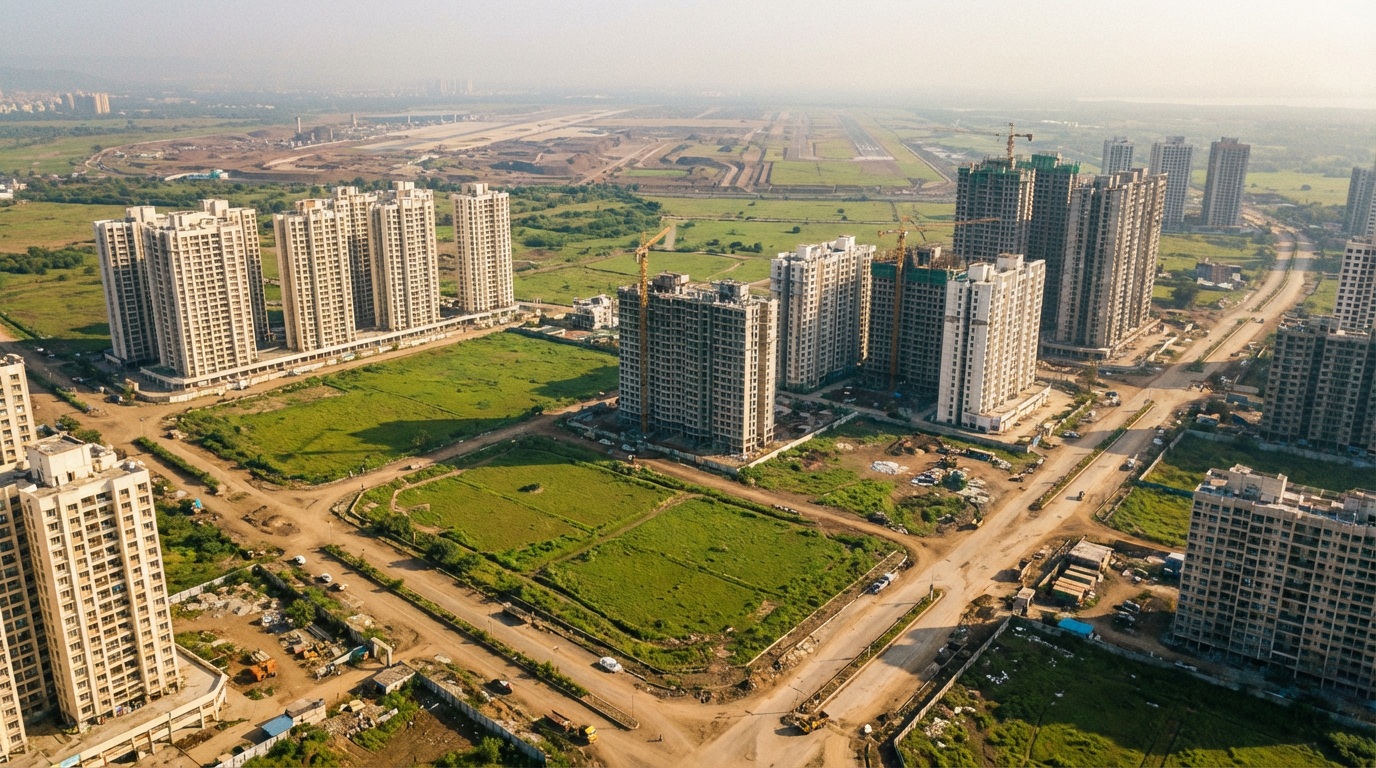

Looking for the best investment options in Navi Mumbai? You’re in one of the few Indian cities where real estate, equities, and small business plays are all running parallel growth stories at the same time. The international airport, Atal Setu, metro expansion, and a maturing financial ecosystem have changed what smart money looks like here. This guide walks through the main investment avenues people consider in Navi Mumbai, what each one actually involves, and what the current data says. Research further before deciding.
This guide covers residential real estate along the airport corridor (Ulwe, Dronagiri, Panvel, Kharghar, Taloja), commercial office space in Airoli, Mahape, and Belapur, equities, government savings schemes, gold, and REITs. It’s meant as a comparison of how each option works, not a recommendation of what you personally should do with your money.
Investment figures, return estimates, and product comparisons in this guide are for informational purposes only and are based on publicly available data as of August 2026. All investments carry risk, and every figure here can change. This is not financial advice. Consult a SEBI-registered investment advisor before making investment decisions.
Why Navi Mumbai is on investors’ radar in 2026
Property prices in Ulwe, Panvel, and Dronagiri have risen meaningfully over the past few years, though the pace varies a lot by node and by source. 99acres’ own price index puts Ulwe’s three-year appreciation at around 16.6%. A more bullish estimate from PropertyPistol founder Ashish Narain Agarwal puts appreciation across Ulwe, Panvel, Dronagiri and Taloja at 30-40% over three to four years, with Panvel land specifically up as much as 74-93% over a slightly longer window. That is a real outlier rather than the norm across all three nodes. Commercial leasing in Airoli and Belapur has also been strong, and SIP inflows from Navi Mumbai PIN codes have grown.
Put simply: this city is no longer just a satellite of Mumbai. It’s a real investment destination on its own merits, with infrastructure catching up faster than many expected, though how much of that is already priced in is genuinely debatable, and depends on which node and which source you trust.
Investment options in Navi Mumbai for 2026
Here’s a breakdown of the main options people consider, what each actually demands in capital, time horizon, and risk appetite, and what current data says about returns.
1. Residential real estate near the airport corridor
Ulwe, Dronagiri, Panvel, Kharghar, and Taloja are the nodes most directly affected by the airport launch and metro expansion. Entry tickets start around ₹50 lakh for a 1BHK in Ulwe and stretch past ₹1.5 crore for premium 2-3BHK builds in Kharghar.
Some analysts, including PropertyPistol’s Ashish Narain Agarwal, project further appreciation once Navi Mumbai International Airport reaches full commercial operation. His estimate is roughly 10-15% additional upside for nodes like Panvel. That’s one analyst’s view, not a market consensus, and timing predictions for real estate carry real uncertainty. Infrastructure projects in India have a track record of slipping schedules, and “the market has already priced this in” is just as plausible a read as “there’s a window left.” For a deeper neighbourhood breakdown, see our guide to the best areas to invest in Navi Mumbai.
2. Commercial real estate and rental properties
Office space in Airoli, Mahape, and Belapur has seen strong leasing activity and rents in the broad range of ₹45-110/sq ft depending on grade and micro-market, per Cushman & Wakefield-sourced data. Treat any specific yield percentage you see quoted for these micro-markets with some skepticism unless it’s sourced.
Retail shops in high-footfall zones like Vashi and Nerul are another option, especially for investors with deeper pockets. Warehousing near JNPT and Taloja is a further angle, driven by e-commerce demand and the freight corridor, though yields here vary widely by lease terms and location.
3. Mutual funds and SIPs
For many working professionals in Navi Mumbai, equity mutual funds via SIPs are a common way to build wealth over a 7 to 10 year horizon. Index funds tracking Nifty 50 and Nifty Next 50 are a low-cost, low-friction starting point that don’t require picking individual funds.
Some investors add a flexicap or large-and-midcap fund for diversification, and a debt fund allocation for stability. Apps like Zerodha Coin, Groww, and Kuvera make SIP setup quick, though the platform you choose matters less than the underlying fund and your consistency.
4. Direct stocks and equity for higher risk appetites
Direct equity gives investors control over individual stock selection, but also carries greater concentration risk and requires substantially more research than diversified mutual funds. Investors who go this route generally focus on companies with strong cash flows, manageable debt, and a clear competitive position. Acting on unverified stock tips (including the ‘WhatsApp tip culture’ common in India) is a well-documented way to lose capital quickly.
5. Fixed deposits, bonds, and government schemes
For capital preservation, bank FDs, RBI Floating Rate Bonds, NSC, and PPF remain common choices. As of the Jul-Sep 2026 quarter, PPF pays 7.1% (tax-free, EEE status) with a 15-year lock-in, per the Finance Ministry’s quarterly small savings notification. SCSS (Senior Citizens’ Savings Scheme) currently pays 8.2% for the same quarter, the highest of the government small savings instruments, available to those 60 and above (or 55+ for certain retirees). Both rates are reviewed quarterly by the government and can change.
6. Gold and Gold ETFs
Gold is generally treated as a portfolio hedge rather than a growth play. An important update if you’ve read about Sovereign Gold Bonds (SGBs) elsewhere: the government paused new SGB issuance in February 2024, and the Finance Ministry confirmed to the Rajya Sabha in July 2025 that this was a deliberate move. SGBs had become a costlier way for the government to borrow than regular bonds as gold prices rose. As of this update, no new tranche or issuance calendar has been announced. If you already hold SGBs, you can sell on the secondary market (NSE/BSE, though liquidity is thin), use the RBI’s periodic premature-redemption windows after year five, or hold to the eight-year maturity, which is exempt from capital gains tax.
For investors wanting paper/exchange-traded gold exposure today, Gold ETFs and gold mutual funds (including gold SIPs) are the practical current options. They don’t carry SGB’s old 2.5% coupon or maturity tax exemption, since those benefits were specific to the now-paused SGB scheme, but they’re liquid, SEBI-regulated, and don’t require physical storage.
7. REITs (Real Estate Investment Trusts)
REITs let you invest in fractional ownership of Grade A commercial real estate without buying a whole office. Embassy, Mindspace, and Brookfield REITs all hold Mumbai-region assets. Mindspace in particular owns Mindspace Airoli East and West, which it describes as the largest business park in Navi Mumbai, alongside a planned Navi Mumbai data-center campus.
Current distribution yields vary by trust: Brookfield India REIT is around 6.4%, Embassy Office Parks around 5.6%, and Mindspace Business Parks around 4.9% (all approximate, trailing-twelve-month figures that move with unit price). A reasonable current range to expect is roughly 5-6.5%, not a flat 6-7% across all three.
How people typically think about allocation
There’s no single right allocation, and a percentage table would not make a plan. The framework below is only meant to show the kinds of factors that typically shift how people split their money, not to tell you what your numbers should be.
Time horizon tends to be the biggest driver: money you won’t need for 15+ years can absorb more equity volatility, while money earmarked for a near-term goal (a down payment in 2-3 years, for instance) generally sits in lower-volatility instruments like FDs or debt funds. Liquidity needs matter too. Real estate is the least liquid major asset class here, so an emergency fund or near-term goal is rarely a good fit for it. Risk tolerance is personal and not just a function of age. A financially secure 60-year-old with other income sources may reasonably hold more equity than a 30-year-old who’s risk-averse or already has significant exposure through a business or property.
Because these factors interact in ways that are specific to your situation: income stability, existing assets, debt, dependents, goals. A generic allocation table risks being actively wrong for a given reader even if it looks reasonable on average. Consider speaking with a SEBI-registered investment adviser before making a material investment decision or building an allocation around your personal circumstances.
Common mistakes investors make in Navi Mumbai
The biggest one: putting everything into property because “land always goes up.” It doesn’t always, and property is wildly illiquid compared to most other asset classes. The second: chasing pre-launch projects from unknown developers based on glossy brochures rather than verified RERA registration and delivery track record. The third: ignoring tax planning, which can quietly eat into returns through avoidable structuring choices.
Diversification isn’t a buzzword. It’s one of the few things that reliably protects a portfolio when a single asset class corrects.
Related Guides
- Upcoming Residential Projects in Navi Mumbai 2026: New Launches, Prices & Top Areas
- Rent vs Buy in Navi Mumbai 2026: What Makes More Financial Sense?
- Home Loans in Navi Mumbai 2026: Compare Banks, Rates & Fees
- NAINA Navi Mumbai 2026: Map, Development Plan, TPS & Infrastructure
Official portals named in this guide: MahaRERA, Reserve Bank of India, SEBI.
Investing from abroad? Our NRI property guide for Navi Mumbai covers what NRIs can buy, how to pay and how to send sale proceeds back.
Frequently Asked Questions
What are some low-friction starting points for beginners in Navi Mumbai?
Index fund SIPs and PPF are commonly cited as low-friction starting points. They’re straightforward to set up, have low costs, and don’t require active monitoring. Note that Sovereign Gold Bonds, sometimes mentioned alongside these, are not currently available for new purchase (see the gold section above).
Is it still a good time to buy property in Navi Mumbai?
There’s no universal answer. It depends on your timeline, financing, and risk tolerance. Nodes near the airport corridor like Ulwe, Panvel, and Dronagiri have seen real price appreciation and some analysts project further gains once the airport reaches full commercial operation, but that’s a projection, not a guarantee, and property is illiquid if your circumstances change. Weigh it against your own situation rather than a general market view.
What is the average rental yield in Navi Mumbai?
Mumbai-region residential rentals average roughly 3.5-5% gross depending on unit size (smaller units tend to yield more), per Global Property Guide data updated May 2026, a bit higher than some older estimates you may see cited. Yield figures for Airoli/Mahape/Belapur commercial property should be sourced before you rely on them; warehousing yields vary widely by lease terms and location.
How much should I invest in mutual funds versus real estate?
This depends on your age, risk profile, existing assets, income stability, and goals. There isn’t a single benchmark split that fits most people, and claims of one should be treated skeptically. Younger investors with a long horizon often lean more equity-heavy since they have time to ride out volatility; investors prioritizing tangible, long-term holdings sometimes prefer more real estate. A SEBI-registered advisor can help you work out a split based on your actual numbers.
Are REITs better than buying a flat for rental income?
REITs and rental property provide very different forms of real-estate exposure. REITs generally require less capital, are exchange-traded and don’t involve managing an individual property. A physical flat offers direct ownership and different financing, use and appreciation considerations. Current REIT distribution yields run roughly 5-6.5% depending on the trust, and unit prices (like any listed security) can fluctuate.
Build a smarter portfolio in 2026
The best investment options in Navi Mumbai are the ones that match your timeline, risk tolerance, and financial goals, not a generic list. Get the latest area-specific real estate insights and money-smart guides on NaviMumbai.com. We track the news that actually affects your investment decisions.