Live charging notice: EV charging locations, operating status, connector availability, charging power and prices can change. Check the charging operator’s current app or official station listing before travelling, especially if your remaining battery range is limited.
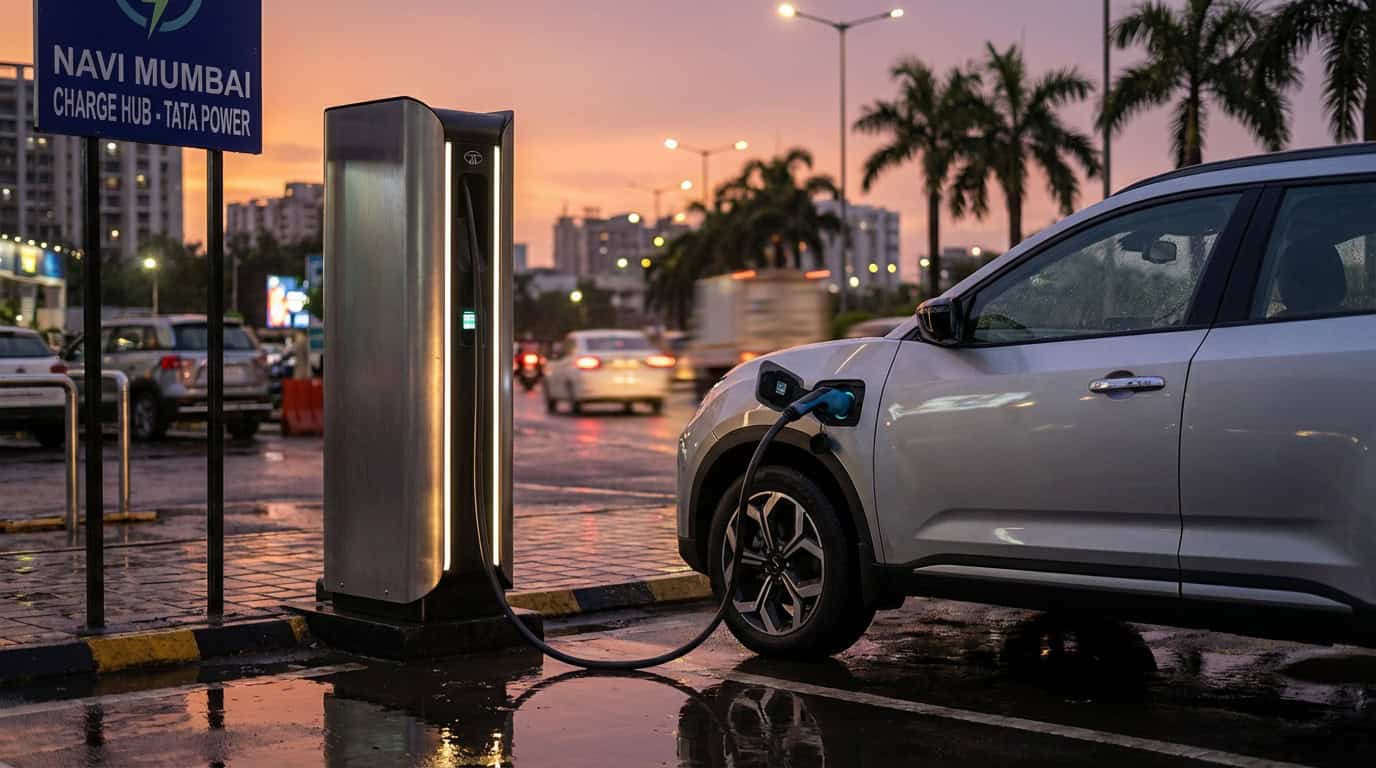
EV charging is available across multiple Navi Mumbai nodes through several charging networks, but station availability, connector type, charging power, access and pricing can change frequently.
This guide identifies charging locations that can be verified through current operator or location sources and explains how to check live availability before travelling, along with what to check before installing a charger at home or in a housing society. It does not treat a charger shown on an old map or directory as permanently operational.
Quick Answer
Navi Mumbai has EV charging locations across Airoli-Ghansoli, Vashi-Sanpada, Nerul-Seawoods, CBD Belapur, Kharghar and the Panvel-Kamothe-Taloja belt, run by operators including Tata Power, Statiq, ChargeZone and Jio-bp pulse. There is no single citywide count, tariff or charging-time figure that stays accurate for long, so this guide points you to verified locations and to each operator’s own app for what changes: connector availability, current price and whether a specific charger is public or restricted. For home or society charging, the property’s electrical capacity and the housing society’s own process matter more than any fixed cost figure.
1. How to Find a Working EV Charger
Searching “EV charging station near me” works best directly in Google Maps or a charging app (see below) rather than a static list, since availability and working status change constantly. That said, here’s how to find one reliably wherever you are in Navi Mumbai:
A charging location is included in this guide only where a current operator listing, first-party location source or a sufficiently current location record supports its existence. NaviMumbai.com does not treat an old charging-map pin, a user review or a third-party directory alone as proof that a charger is currently operational.
Because charger status, tariffs, connector availability and access can change, confirm the station through the operator’s current app or website immediately before travelling, not from this article. For each location named below, this guide records the operator, the venue, and, where the source shows it, the connector or charger power.
2. EV Charging Locations by Area
Always verify a charger by property address or a known landmark rather than by locality name alone, since a single node can have several unrelated stations run by different operators, and some of these sit on hotel, mall or industrial premises rather than open kerbside parking.
| Area | Operator | Venue | Access note |
|---|---|---|---|
| Airoli / Ghansoli | Charge-point operator listed via Statiq | Electronic Zone, MIDC Industrial Area, Mahape | Industrial-belt location; several corporate campuses in this stretch also run chargers reserved for occupants only |
| Vashi / Sanpada | ChargeZone | Four Points by Sheraton, Sector 30A, Vashi | On hotel premises but open to the public through the ChargeZone app; 60 kW dual-gun CCS2 unit |
| Nerul / Seawoods | ChargeZone | Renault service centre, TTC Industrial Area, Shiravane, Nerul East | Listed on ChargeZone’s own Nerul station locator |
| Nerul / Seawoods | Charge-point operator listed via Statiq | Palm Beach Road | Listed under a partner network on Statiq’s platform, not operated by Statiq itself |
| CBD Belapur | Tata Power | The Park hotel, Sector 10 | Listed on both Tata Power’s and Statiq’s directories |
| Kharghar | Charge-point operator listed via Statiq | Omkar Heights, Sector 19 | Listed under a partner network on Statiq’s platform, not operated by Statiq itself |
| Panvel / Kamothe / Taloja | Jio-bp pulse | Jio-bp fuel station, Rohinjan, Taloja | Co-located with a Jio-bp petrol pump; confirm public access hours at the pump |
| Ulwe / Airport corridor | No operator listed | No current operator-confirmed public charging location for this node at the time of writing; check operator apps directly as the airport-linked area develops |
This is not an exhaustive list of every charger in Navi Mumbai, and coverage will change faster than this article gets rewritten. A charger on a fuel-station forecourt is not automatically open to every vehicle at every hour, and one inside a hotel, mall, office campus or dealership is not automatically public either; some are genuinely open through an operator’s app, as with the Vashi hotel station above, while others are restricted to guests, customers or employees. Confirm access, hours and any parking or validation requirement in the operator’s app before you rely on a specific location. Several stations above are found through Statiq’s platform, which lists chargers from multiple charge-point operators alongside its own network; Statiq being the discovery source for a listing does not mean Statiq operates that specific charger, so check each listing’s own operator detail before assuming which network is actually responsible for it.
3. AC vs DC Charging
Public and home EV chargers fall into two broad categories.
AC charging is generally slower and depends heavily on the vehicle’s own onboard charger, which converts the incoming alternating current to direct current for the battery. A higher-rated AC charging point does not guarantee faster charging if your vehicle’s onboard charger is the limiting factor.
DC fast charging supplies direct current straight to the battery, bypassing the onboard charger, and may support substantially higher charging power where both the vehicle and the charger permit it. A charger rated at 60 kW does not mean every connected EV continuously receives 60 kW; actual charging power depends on the vehicle, the battery’s state of charge, temperature, the charger’s own capability and the vehicle’s charging curve.
| Charger | General use |
|---|---|
| Lower-power AC | Longer-duration charging, typically overnight, at home or the workplace |
| Higher-power AC | Faster AC charging where the vehicle supports it |
| DC fast charger | Faster public charging where both vehicle and charger support a compatible DC input |
4. Connector and Vehicle Compatibility
CCS2 is the common DC fast-charging connector on current Indian passenger EVs and appears at most of the verified stations above, but not every EV uses it. Confirm your vehicle manufacturer’s own charging specification for the connector type and maximum accepted power before relying on a specific station, and follow the vehicle or charger manufacturer’s supported configuration if an adapter is involved rather than improvising one.
Electric two-wheelers and three-wheelers commonly use a different charging arrangement from passenger cars. Some two-wheeler manufacturers run their own dedicated network or battery-swap arrangement rather than the CCS2-based public DC network described above, and portable, lower-power home charging is far more common for two-wheelers. If you ride a two-wheeler or three-wheeler, check that manufacturer’s own app or network first rather than assuming a passenger-car charging station will have a compatible connector.
5. How Much Does Public EV Charging Cost?
Public charging prices are set by charging operators and can vary by station, charger type, membership or payment arrangement, and additional parking or session fees. Check the current tariff in the operator’s app before starting a session rather than relying on a generic per-unit rate, since operators may bill by energy used, by time connected, as a flat session fee, with a separate parking or idle-time charge, or some combination of these.
To estimate what a session might cost, use energy added in kWh multiplied by the operator’s current applicable tariff, then add any session fee, parking charge or idle-time fee the operator applies. For home charging, the relevant cost is your own household’s applicable electricity tariff and billing structure, not a public charging rate; estimate it from your own electricity bill rather than a universal Navi Mumbai residential figure. If you want a running-cost comparison against fuel, the underlying framework is charging energy cost per kWh divided by your specific vehicle’s efficiency in kilometres per kWh; treat that as a calculation you run with your own numbers, not a fixed citywide rupees-per-kilometre figure, since it depends on the vehicle, the electricity source, and whether you are charging at home or in public.
6. How Long Does Charging Take?
Charging time depends on usable battery capacity, your starting and target state of charge, the vehicle’s maximum charging capability, the charger’s actual output and the vehicle’s own charging curve. As a rough concept, energy required in kWh divided by effective charging power in kW gives an approximate duration, but this is only a theoretical calculation; most vehicles charge faster at a low state of charge and slow down as the battery fills, particularly on DC fast charging, so the last stretch of a session often takes longer than the first. Unless quoting a specific vehicle, a specific charger and the manufacturer’s own tested conditions, treat any “20 to 80 percent in X minutes” claim as an example for that combination, not a citywide promise.
Because of this, check the estimated completion time the operator’s app shows for your specific vehicle and starting charge level, and build in a buffer, rather than planning a trip around a fixed number of minutes.
7. Before You Drive to a Public EV Charger
A charger appearing in a directory does not establish that it is currently operational, compatible with your vehicle, or available when you arrive. Work through this before a longer or time-sensitive trip.
Verify the charger is currently listed. Check the operator’s current app, website or another first-party source close to your departure time, not an old map pin. Confirm the exact location, the operator, the connector type, charging capacity where shown, current operational status where available, access hours, whether the charger is public or restricted, and any payment or app requirement.
Check vehicle compatibility. Confirm your vehicle can use the connector provided; not every modern EV can use every public charger, and connector and charging compatibility vary by vehicle and by charger.
Check access. Some chargers sit inside malls, hotels, office parks, dealerships, residential complexes, paid parking areas or fuel stations. Confirm whether public entry is permitted, whether parking charges apply, whether venue opening hours restrict access, whether any validation is required, and whether the charger is reserved for customers, residents or employees.
Check the current price. Do not rely on a per-unit rate from an older article. Operators may charge per kWh, on a time basis, as a session fee, with parking or idle-time charges, or a combination, so check the operator’s current tariff before starting the session.
Have a backup charger in mind. For a longer or time-sensitive trip, identify another compatible charger nearby or on-route, ideally from a different operator, since no charger’s uptime is guaranteed.
Plan around your actual state of charge. Do not deliberately arrive with an extremely low battery merely because a charger appears online. Plan according to your remaining range, traffic, weather, route and backup charging options; there is no single safe minimum battery percentage that applies to every vehicle and trip.
Know what to do if a charger fails. Use the operator’s official support channel, and note the charger or station identifier, the time and location, and any error message shown. Do not attempt to open, reset or repair charging equipment yourself.
8. Installing a Charger at Home
For an independent home with a dedicated parking space, installing a charger involves more than buying the unit. Check the property’s existing electrical load and whether a dedicated circuit is available, the earthing and electrical protection the installation needs, the specific charger’s technical requirements, the parking location and cable-routing distance, weather protection for an outdoor installation, and any requirement from your electricity distribution licensee for the connection type you choose.
A separate electricity meter is not universally mandatory. Under the Ministry of Power’s Guidelines for Installation and Operation of Electric Vehicle Charging Infrastructure, 2024, residential owners can use their existing electricity connection to charge an EV at home, or request a separate metered connection from the distribution licensee with a dedicated EV charging tariff; which option suits a given household depends on its existing electrical load, the charger’s power rating and its own preference, and it is worth confirming the current process with the licensee for the specific property.
Use a qualified electrician or installer for the actual work, and do not attempt the wiring yourself; an ordinary extension cord or improvised socket arrangement is not suitable for prolonged EV charging, and appropriate charging equipment and electrical infrastructure should match the vehicle and the installation.
9. EV Charging in Housing Societies
Apartment charging is more involved than an independent home, because it touches parking allocation, common-area cable routing, the building’s overall electrical load, whether billing runs through an individual or a common meter, fire and electrical safety, the society’s own approval process, and how the arrangement scales if more residents want chargers later. A flat owner should not simply run a cable from their own meter to a parking space without going through this process.
Start with the society or building management and a qualified electrical assessment. Identify whether charging will be supplied from the resident’s individual consumer connection, a shared society connection, or a managed charging system the society installs, and document how the electricity used will be measured and billed before installation begins.
The 2024 national framework speaks directly to this situation. For a private charging point in a resident’s own designated parking space within a group housing society, the Ministry of Power’s guidelines require the distribution licensee to ensure electricity supply through either the resident’s existing meter or a separate sub-meter, depending on the consumer’s choice, rather than forcing one specific metering arrangement on every resident. Confirm with the society and the distribution licensee which of the two your specific installation will use.
On the legal position in Maharashtra, be careful not to treat a policy target as an automatic entitlement. The Bombay High Court, ruling on a petition (Amit Dholakia versus State of Maharashtra) in February 2025, directed the state government and the Registrar of Cooperative Societies to finalise guidelines for EV charging installation in housing societies and to communicate them to societies, rather than declaring an immediate, self-executing right for every resident to install a charger regardless of a society’s objection. Maharashtra’s EV policy separately sets new residential buildings on a path to being “EV-ready,” which is a forward-looking construction standard for new developments, not a retrofit mandate for an existing society. Check the current, finalised state guidance and your society’s own bye-laws before assuming a specific outcome either way.
10. Installation Cost and What to Compare
Installation cost is not a fixed citywide figure; it depends on the charger hardware chosen, the cable distance from the electrical source to the parking spot, any civil work required, whether the electrical panel needs an upgrade, the protection equipment installed, metering, and, for a society-wide setup, any load augmentation or charging-management software involved. Get a written quotation from the installer for your specific property and charger rather than budgeting around a number from an older article, and compare more than one quotation where the installation is non-trivial, such as a society-wide setup.
Check what your vehicle’s purchase package actually includes, since whether a home charger is bundled, discounted or sold separately depends on the manufacturer, model, variant, campaign and dealer, and this changes over time.
11. Charging Safety
EV charging equipment should be installed according to applicable electrical and fire-safety requirements, using equipment suited to the installation and qualified professionals for the work. Housing societies should consider charger placement, electrical protection, cable management, emergency isolation and access, and how a charging installation fits the building’s overall fire-safety arrangements, rather than treating it as a purely electrical add-on.
For an active vehicle or battery fire, contact emergency services and follow official emergency guidance; this is not something to address with DIY firefighting attempts, since a lithium-ion battery fire behaves differently from an ordinary electrical or fuel fire and untrained intervention can make it worse.
12. Intercity Charging
If you are planning a longer trip out of Navi Mumbai, such as toward Pune, Lonavala or beyond, plan charging stops around your actual route and your vehicle’s real-world range using current operator or network information, rather than assuming this city-focused guide covers highway charging. Verify each planned stop close to your departure time using the relevant operator’s app, and keep a backup option in mind, the same way you would for a shorter trip within the city.
Related Guides
- Solar Panels in Navi Mumbai 2026: Cost, PM Surya Ghar Subsidy & Savings Guide
- Atal Setu Toll 2026: Charges, FASTag, Route & Rules
- Water, Electricity & Gas Connections in Navi Mumbai 2026: Providers, Applications & Complaints
Frequently Asked Questions
Where can I find EV charging stations in Navi Mumbai?
Verified charging locations exist in Airoli-Ghansoli, Vashi-Sanpada, Nerul-Seawoods, CBD Belapur, Kharghar and the Panvel-Kamothe-Taloja belt, run by operators including Tata Power, Statiq, ChargeZone and Jio-bp pulse. Check the relevant operator’s app for the closest currently active station, since coverage changes over time.
How do I check whether an EV charger is working before I travel?
Check the charging operator’s current app, website or another first-party source close to your departure time, and confirm the connector, access and current status rather than relying on an old map listing or a static table in an article.
How much does public EV charging cost in Navi Mumbai?
There is no single citywide tariff. Prices vary by operator, station, charger type and any membership or payment arrangement, and may include separate parking or idle-time charges. Check the current tariff in the operator’s app before starting a session.
How long does it take to charge an EV at a public charger?
It depends on the battery’s usable capacity, the starting and target state of charge, the vehicle’s charging capability, the charger’s output and the vehicle’s charging curve, and charging typically slows as the battery approaches full. Check the estimated completion time the operator’s app shows for your specific vehicle rather than assuming a fixed duration.
Can every EV use every charging station?
No. Connector and charging compatibility vary by vehicle, and CCS2, while common on current Indian passenger EVs, is not universal, while two-wheelers and three-wheelers often use different networks entirely. Check your vehicle manufacturer’s charging specification before relying on a specific station.
Can I install an EV charger in my housing society?
Often yes, but it needs to go through the society and a qualified electrical assessment covering parking allocation, load, metering and billing, and safety, rather than an individual resident wiring a connection independently. The Bombay High Court has directed the state to finalise guidelines for this, so check current, finalised state guidance and your society’s own bye-laws rather than assuming an automatic right either way.
How much does it cost to install a home EV charger?
There is no fixed citywide figure; cost depends on the charger hardware, cable distance, any civil work or electrical panel upgrade, and metering. Get a written quotation from a qualified installer for your specific property rather than budgeting around a number from an older article.
Can I charge an EV during a power cut?
Not through a home connection or a charger that depends on grid power reaching that location; if the property itself has a functioning backup power supply capable of running the charger, that is a property-specific setup rather than something this guide can generalise. A public charging station may also be affected by an outage in its own area, so check the operator’s app for the station’s current status.
Do public EV chargers require an app?
Most do, since starting a session, checking live availability and paying commonly happen through the specific operator’s app, and different networks may use different apps or payment systems. Check which operator runs the station you intend to use and whether registration or an app is required before you arrive.
What should I do if a public charger isn’t working?
Use the operator’s official support channel, and note the charger or station identifier, the time and location, and any error message shown, rather than attempting to open, reset or repair the equipment yourself. Have a backup charger in mind for time-sensitive trips.
Bottom Line
Navi Mumbai has public and private EV charging infrastructure across multiple operators, but a charger appearing in an online directory does not guarantee that it is currently operational, publicly accessible or compatible with your vehicle. Verify the exact station through the operator’s current app or website before travelling.
For home or society charging, start with the vehicle’s charging requirements and the property’s electrical infrastructure. An apartment installation should account for parking, electrical load, cable routing, metering and billing, and the building’s or society’s own requirements, rather than relying on an improvised socket arrangement.
Charging cost and speed depend on the operator, the charger, the vehicle and the electricity source, so use current tariffs and vehicle-specific information rather than a universal Navi Mumbai rupees-per-unit or minutes-to-charge figure.
Sources and Methodology
Public charging locations in this guide are checked primarily against current charging-network or operator sources, including Tata Power, Statiq, ChargeZone and Jio-bp pulse‘s own listings, and against official infrastructure information where available. Third-party maps, mapping-service records and user reviews provided discovery context for verification but are not treated alone as proof that a charger is currently operational.
Charging tariffs, access conditions, connector availability and station status can change; verify the station in the operator’s current app or website before travelling.
Home and housing-society charging guidance reflects the Ministry of Power’s Guidelines for Installation and Operation of Electric Vehicle Charging Infrastructure, 2024 and the Bombay High Court’s February 2025 ruling directing the Maharashtra government to finalise EV charging guidelines for housing societies. NaviMumbai.com does not provide electrical-engineering or fire-safety design advice; installations should be assessed and carried out by appropriately qualified professionals.
Charging-time and cost examples in this guide are not treated as universal Navi Mumbai benchmarks, since actual results depend on the vehicle, charger, tariff, battery state and installation. Current official and operator information takes precedence over any static example given here.
Last verified: 14 September 2026