
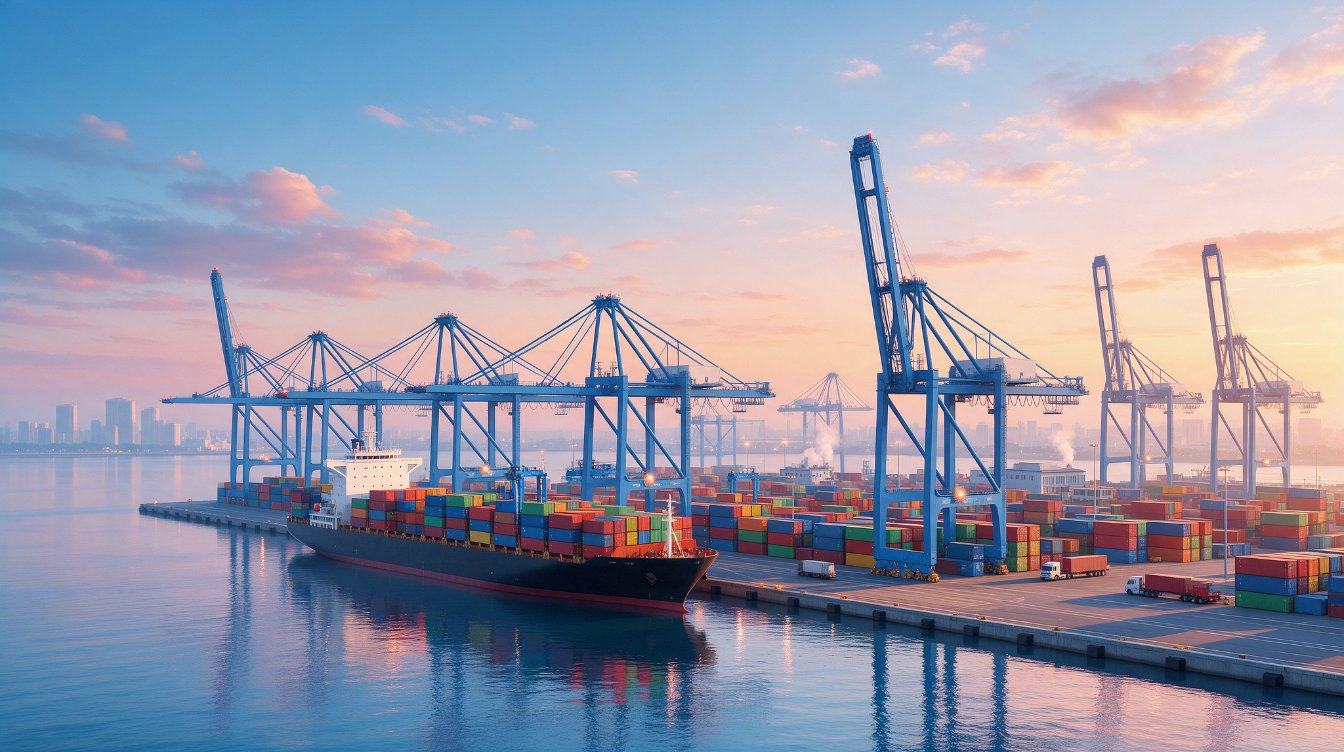
Quick answer: an IEC is DGFT’s identification code for international trade. It is not permission to ship every product, and it does not replace customs clearance. Commercial goods traders generally need an IEC unless they fall under a listed exemption. For shipments through the Jawaharlal Nehru Port Authority (JNPA, still widely called JNPT) at Nhava Sheva, check product permissions, customs arrangements, applicable GST requirements and banking procedures separately. DGFT’s published fee for an IEC application is Rs 500. An IEC has permanent validity, but the holder must complete the annual electronic update or no-change confirmation during April to June, or the code can be deactivated.
This guide is for people in Navi Mumbai, Panvel and Uran who are starting a small import or export business, or adding overseas trade to an existing shop, factory or online business. It covers sea cargo of ordinary goods through JNPA, not air cargo, courier exports or goods that need special permits. Set up your business basics first. The guide to starting a business in Navi Mumbai covers entity type, GST and Udyam, so this page goes deeper on the trade-specific steps.
What an IEC does and does not cover
DGFT’s Foreign Trade Policy makes the IEC mandatory for import or export of goods unless the person is specifically exempt. It is a 10-character code that matches your PAN, it covers all your branches, and only one IEC is issued against a PAN. The handbook’s exemptions include goods for personal use that are not connected with trade, manufacture or agriculture, and a few small border-trade cases.
- It does: identify you to DGFT and Customs as an importer or exporter of goods.
- It does not: make a product legal to trade. Product rules come from the product’s own policy and other laws.
- It does not: replace the Bill of Entry or Shipping Bill, customs assessment, release of cargo, the AD code or an LUT.
Step 1: Check the product before anything else
Check the product’s current ITC (HS) classification, import or export policy and applicable conditions before committing to a transaction. Restricted and prohibited categories are different. An IEC does not override a prohibition or replace product-specific permissions.
DGFT’s policy treats imports and exports as free unless they are regulated as prohibited, restricted or reserved for State Trading Enterprises, and some free items carry conditions under other laws. SCOMET items have specific controls. Ask your customs broker or a trade consultant to confirm the classification and any permit before you pay a supplier or accept an order.
Step 2: IEC application, documents and authentication
- Apply online on dgft.gov.in in form ANF-2A, with the fee and documents.
- Documents: a cancelled cheque bearing the entity’s pre-printed name, or a bank certificate, and an address proof. DGFT says the firm needs a PAN, a bank account in its name and a valid address, and that DGFT may physically verify the address.
- Application authentication: use a supported DSC or Aadhaar-based e-Sign where eligible under DGFT’s current validation requirements. DGFT’s help document says which signers can use e-Sign and which DSC types suit which entity. Check ICEGATE’s separate authentication requirements for the intended user role. Do not assume one setup works for both portals.
- Fee: Appendix 2K of the handbook lists Rs 500 for an IEC application. Pay it only on the official DGFT portal.
- Issuance: DGFT describes IEC generation as automated following successful submission and validation. Data mismatches or application issues can delay completion. Do not schedule a shipment on the assumption that issuance and downstream customs activation will be instantaneous.
- Check the status: the handbook says IEC details can be viewed on the DGFT website. Before you file anything, check that your IEC shows as active there and is accepted in the customs system, for example when you register on ICEGATE.
Requirements at a glance
| Item | How to frame it | Where to apply or confirm |
|---|---|---|
| IEC | Generally required for commercial goods trade, subject to the exemptions in DGFT’s handbook. | DGFT portal |
| PAN and bank evidence | Follow DGFT’s requirements for your entity type. | DGFT portal, your bank |
| DGFT authentication | A supported DSC, or Aadhaar-based e-Sign where you are eligible. | DGFT portal; a certifying authority licensed in India for DSC |
| GST registration | Depends on your GST obligations. It is a separate question from the IEC. | Your tax adviser, GST portal |
| ICEGATE account | Pick the role that matches what you will do, and decide whether you or a broker will file. | icegate.gov.in |
| AD code and account registration | The banking workflow for exports. See the banking section below. | Your authorised dealer bank, then ICEGATE |
| LUT or bond | The GST route for exporting without paying IGST. Depends on your GST status and eligibility. | GST portal, your tax adviser |
| RCMC | Depends on the scheme or product. The policy asks for it when you apply for an authorisation or a benefit, unless exempt. | The export promotion council for your product |
| Customs broker | Optional assistance. Agree the scope and charges in writing. | Ask for the licence number and check it with JNCH |
Keeping the IEC active
An IEC has permanent validity, but the holder must complete the required annual electronic update or no-change confirmation during April to June, subject to any applicable DGFT extension notice. This is separate from updating changed business details.
- Annual update: DGFT’s policy requires the update every year in April to June. Where nothing has changed, that too has to be confirmed online. Appendix 2K lists no fee for it.
- If you miss it: the policy says an IEC not updated within the prescribed period is de-activated, and that it can be activated again on successful updating. Check the status before every shipment.
- Changes during the year: if your constitution, address, bank details or other primary details change, update the IEC online within 30 days, as the handbook asks.
ICEGATE, GST and banking
ICEGATE. This is the Customs portal where Bills of Entry and Shipping Bills are filed. Its registration manual lists many roles, including importer or exporter and customs broker. The sign-up flow asks you to verify a GSTIN and, for importers and exporters, a valid IEC. It uses the email and mobile number held in GST and DGFT records, so keep those current. Have your IEC copy, PAN, Aadhaar linked with DigiLocker, a DSC and an authorisation letter ready. The application then goes to ICEGATE’s approving authority. Whether you must hold a GST registration depends on your GST obligations. If you do not have a GSTIN, ask the ICEGATE helpdesk (1800-3010-1000) or your customs broker which route applies to you before you apply.
AD code and bank accounts. For exports, obtain and register the relevant bank details. The bank side has more than one part, and each part concerns a different account or code:
| What | What it concerns | How to confirm it worked |
|---|---|---|
| AD code | The code your authorised dealer bank issues for your exports. ICEGATE’s advisory says it must be valid, issued by the concerned bank and mapped to the relevant account and authorised branch. | After you enter the code, ICEGATE shows the bank and branch. The verification result on ICEGATE comes from the bank’s response. |
| Account linked to the AD code | The bank account used in the AD code registration. Ask your bank which account it mapped for your exports. | Same ICEGATE verification, then ask the bank to confirm in writing. |
| Incentive bank account | A separate ICEGATE registration for export incentives. You choose the Customs port locations it applies to. | ICEGATE verification result. Check the application status before you submit again. |
ICEGATE’s advisory of 1 October 2026 says the entity name, PAN, IEC, account number, IFSC code and AD code must be consistent across ICEGATE, DGFT and bank records. The account must be active, with complete KYC. If verification fails, re-check what you entered and ask the bank to correct its records. Confirm the procedure with your bank and ICEGATE before you start.
Realising export payments (RBI). RBI’s Foreign Exchange Management (Export and Import of Goods and Services) Regulations, 2026, amended up to 22 September 2026, came into force on 1 October 2026. Regulation 5 sets the time to realise and repatriate the full export value:
- Ordinary goods exports: nine months from the date of shipment.
- Services: nine months from the date of the invoice.
- Goods sent to an overseas warehouse: nine months from the date of sale from the warehouse.
- Exports invoiced or settled in Indian rupees: twelve months, counted from the same starting event.
- Project exports: as per the payment terms of the contract.
- Extensions: the authorised dealer bank can extend the period if the exporter asks, gives reasons and the bank is satisfied.
The January 2026 text gave fifteen months, and the September amendment cut it to nine. For goods shipped through an electronic (EDI) port, the Regulations treat the export declaration form as submitted with the shipping bill. Your bank may still ask for documents, so ask what it needs and by when. RBI’s earlier Export Master Direction (updated 17 July 2026) is still listed on its site, and the amendment refers to it for transactions before 1 October 2026. Ask your bank which RBI directions it applies to your shipment.
LUT. Eligible GST-registered exporters can furnish an LUT for exports without payment of IGST, subject to the applicable conditions. A bond may be required in other cases. Confirm the appropriate route and financial-year requirements before shipment. Under Rule 96A of the CGST Rules the LUT or bond is furnished before the export in Form GST RFD-11. CBIC’s circular of 4 October 2017 says an LUT is valid for the financial year in which it is given. Registered taxpayers file it on the GST portal with a DSC or EVC. For goods, Rule 96A requires tax and interest to be paid within fifteen days after three months from the invoice date if the goods have not been exported, unless the Commissioner allows more time.
The import route
- Settle the product and terms first. Confirm the product code, duty rate and any permit before the goods ship.
- Decide who files. The Customs Act says the importer presents the Bill of Entry electronically on the customs system. You can do this on ICEGATE if you hold the importer role, or authorise a licensed customs broker to do it for you.
- Start the Bill of Entry early. Section 46 of the Customs Act generally requires presentation before the end of the day (holidays included) before the vessel arrives, with exceptions. Filing up to thirty days before expected arrival is allowed, and late presentation can attract charges. Arrange the documents early and confirm the applicable advance-filing deadline with the customs broker. Do not wait for the container to arrive before starting the Bill of Entry process.
- Respond to assessment and examination. Customs may assess the bill, examine the goods or ask for documents. Duty and charges must be paid before clearance.
- Collect the container. The shipping line issues the delivery order, which JNPA says now runs through its PCS 1x system. The box is collected from the terminal under Direct Port Delivery or moved to a CFS first. Your broker should tell you which applies.
- Pay port and carrier charges and arrange the truck. Gate out only when Customs and the shipping line or terminal have both released the cargo.
The export route
- Get the banking and tax pieces ready. Register the AD code and bank details, and furnish the LUT if you will export without paying IGST.
- Prepare the shipment: commercial invoice, packing list, and any certificate your buyer or the goods need.
- File the Shipping Bill. The Customs Act says the exporter presents a shipping bill electronically on the customs system. You can file through ICEGATE or through your broker.
- Move the container to JNPA. JNPA says exporters can bring factory-stuffed containers straight to the port under Direct Port Entry (DPE) instead of routing them through a CFS. Confirm the gate-in cut-off for your vessel with your shipping line and broker.
- Wait for the export release. Customs verifies the shipping bill, examines the goods if needed and then gives the Let Export Order, which permits clearance and loading.
- Keep the shipment records and follow up with your bank on the payment timeline above.
Customs release milestones in short
This is a brief overview, not a clearance manual.
| Stage | What it means | Who acts |
|---|---|---|
| Filing accepted | The system has taken your Bill of Entry or Shipping Bill. This is not clearance. | Importer, exporter or their broker |
| Assessment and examination | Customs may assess the bill, examine the goods or ask for clarification. You may need to pay or provide documents. | Customs, with the importer or broker responding |
| Import release | Customs gives its clearance order after duty and charges are paid. Release by the shipping line (delivery order) and by the terminal or CFS is separate. | Customs; shipping line; terminal or CFS |
| Export release | After verification and any examination, Customs gives the Let Export Order on the Shipping Bill. | Customs |
| Vessel loading | Gate-in at the port does not prove the box was loaded or has sailed. The carrier files the Export General Manifest before departure, which Customs treats as proof of shipment. | Shipping line or agent; Customs |
| Post-shipment records | Confirm the shipment evidence and reconcile the export with your bank against receipts. | Exporter and bank |
Who files what: the carrier or shipping agent files the manifests, the Import General Manifest for arriving vessels and the Export General Manifest before departure. The importer or exporter, usually through a broker, files the Bill of Entry or Shipping Bill. The exporter does not file every document.
JNPA: who does what
- JNPA is the port authority. Its admin office is at Admin Building, Sheva, Uran, Raigad 400 707, and its helpline is 1800 22 8282.
- Terminals are run by private operators. JNPA’s terminals page lists five container terminals: NSFT, NSICT, GTI, BMCT and NSIGT. Operator names change over time, so ask your shipping line or broker in writing which terminal handles your container.
- JNCH, the Jawaharlal Nehru Custom House at Nhava Sheva, is Customs. JNPA’s contact page sends AD code and ICEGATE queries to JNCH.
- Shipping lines issue delivery orders and set vessel cut-offs. CFS operators handle cargo that does not move directly through the terminal.
- DPD: JNPA says Direct Port Delivery lets importers collect a container from the terminal without moving it to a CFS. Ask your broker whether your cargo qualifies and whether you need to register.
- Cut-offs and notices: check the vessel cut-off with your shipping line and terminal for every booking. JNPA also publishes operating notices, such as its trade advisory of 6 October 2026, so check them before you book.
Toll costs for goods vehicles depend on the truck’s actual route from your warehouse or factory to the port. The Navi Mumbai toll plaza guide covers the main plazas. If your route uses the sea link, see the Atal Setu toll guide. Rates change, so confirm the current figure before you quote a buyer.
Costs: build a quotation worksheet
The IEC application fee is a published government charge. Total shipment costs depend on the goods, taxes, service providers and handling arrangements. Obtain the applicable tariffs and a written quotation. Use this worksheet to compare quotes:
| Cost line | What to ask for |
|---|---|
| Freight and insurance | The freight quote and the insurance cover, in writing. |
| Duties and taxes | A duty and tax estimate from your broker, based on the product classification. |
| Broker and documentation charges | What the fee includes, such as filing and CFS coordination, and what is billed extra. |
| Terminal, CFS and shipping line charges | The tariff from each operator involved in your route. |
| Inland transport | Trucking from your premises to the port or CFS, with tolls shown separately. |
| Free time and what follows | How many free days you get, and the storage, demurrage and detention charges after they expire, each shown separately. |
| Government and bank fees | The IEC fee, any DSC cost and validity, and bank charges for export documents. |
Before your first shipment
- Check the product’s classification, policy and any permit before you pay a supplier.
- Confirm your IEC shows as active, and that you know your April to June update date.
- Confirm your ICEGATE role and approval, and who will file.
- For exports, confirm the AD code and incentive account verification on ICEGATE, and the LUT or other GST route.
- Choose a licensed customs broker. The JNCH Nhava Sheva (General) page lists customs broker licence management, so ask the broker for the licence number and check it with that office.
- Get the full route in writing: terminal, CFS or DPD or DPE, and who pays for each step.
- Check that the name, PAN, IEC, bank account and GSTIN are written the same way in every record.
- If you are still choosing the business structure, return to the Navi Mumbai business start-up guide first.
Sources and dates
DGFT: Foreign Trade Policy 2023, Chapter 2 (paras 2.01 and 2.05), the Handbook of Procedures, Chapter 2 (July 2026), Appendix 2K, the digital signature and e-Sign FAQ, the IEC profile management FAQ and the IEC page. RBI: the Export and Import of Goods and Services Regulations, 2026 (amended up to 22 September 2026), the amendment of 22 September 2026 and the Export Master Direction page (updated 17 July 2026). ICEGATE: the registration manual page (manual PDF) and the AD code and incentive account advisory of 1 October 2026. Customs and GST: the Customs Act, 1962 on CBIC’s tax information portal (sections 46, 47, 50 and 51), CBIC’s Customs Manual 2025 (updated to 1 February 2025), Rule 96A, Circular 8/8/2017-GST and the GST portal’s LUT guide. Port: JNPA’s terminals, DPD, CFS list, ease of doing business and contact pages (shown as updated 8 October 2026), the 6 October 2026 trade advisory, and the JNCH Nhava Sheva (General) page. Fees, rules, forms and port procedures change, so confirm them with DGFT, RBI, ICEGATE, JNPA, your bank and a licensed customs broker before you rely on them. This guide is general information and not legal, tax or customs advice. Last verified: 8 October 2026. NaviMumbai.com is an independent information site and is not affiliated with JNPA, DGFT, RBI, CBIC, Customs or any broker or CFS named here.
For what the port is, where it sits and what its terminals handle, see our JNPT port guide.
For air cargo, rail links and who to ask for shipment checks, see our cargo and logistics guide.
Frequently Asked Questions
How much does IEC registration cost?
DGFT’s Appendix 2K lists Rs 500 as the fee for an IEC application. This is a published government charge. The annual update in April to June carries no fee. Pay only on the official DGFT portal.
How long does it take to get an IEC?
DGFT describes IEC generation as automated following successful submission and validation. Data mismatches or application issues can delay completion. Do not schedule a shipment on the assumption that issuance and customs activation will be instant, and check that the IEC is active before you file.
Is an IEC valid for life?
An IEC has permanent validity, but the holder must complete the required annual electronic update or no-change confirmation during April to June, subject to any applicable DGFT extension notice. An IEC that is not updated can be deactivated, and updating it can activate it again. This is separate from updating changed business details within 30 days.
Do I need an IEC to import or export?
Generally yes, for commercial trade in goods. The handbook lists exemptions, such as goods for personal use not connected with trade, manufacture or agriculture, and the exemption does not apply to exports of SCOMET items. An IEC does not give permission to trade restricted or prohibited goods.
Do I need GST registration to get an IEC?
The IEC and GST are separate registrations. Whether you need GST depends on your GST obligations, so ask your tax adviser. ICEGATE’s registration flow asks for a GSTIN, so if you do not have one, ask the ICEGATE helpdesk or your customs broker which route applies.
Do I need a customs broker to clear goods at JNPT?
A broker is optional assistance. Importers and exporters can file on ICEGATE if registered in the right role, and many new traders still hire a licensed customs broker. Agree the scope and charges in writing, and ask for the licence number.
What is the difference between JNPT and JNPA?
JNPA is the Jawaharlal Nehru Port Authority, the port’s official name on its own website. JNPT is the older name, Jawaharlal Nehru Port Trust, which people and some Customs pages still use. Both mean the port at Nhava Sheva.
Do I need a GST LUT to export?
Eligible GST-registered exporters can furnish an LUT for exports without payment of IGST, subject to the applicable conditions. A bond may be required in other cases. Confirm the appropriate route and financial-year requirements with your tax adviser before shipment.
How long do I have to receive export payment?
Under RBI’s Export and Import of Goods and Services Regulations, 2026, in force from 1 October 2026, ordinary goods exports have nine months from shipment. Exports invoiced or settled in Indian rupees get twelve months, and project exports follow the contract’s payment terms. Your bank can extend the period on request if it accepts your reasons. Confirm the details with your bank.