
Quick answer: Mirror placement affects three separate things worth considering on their own terms: how it reflects light and makes a room feel, what it reveals to the outside or to anyone passing a doorway, and, for some households, traditional Vastu guidance on direction. First identify placements that can be installed safely and meet your privacy and practical needs. If Vastu matters to your household, use your preferred interpretation to choose between those suitable options.
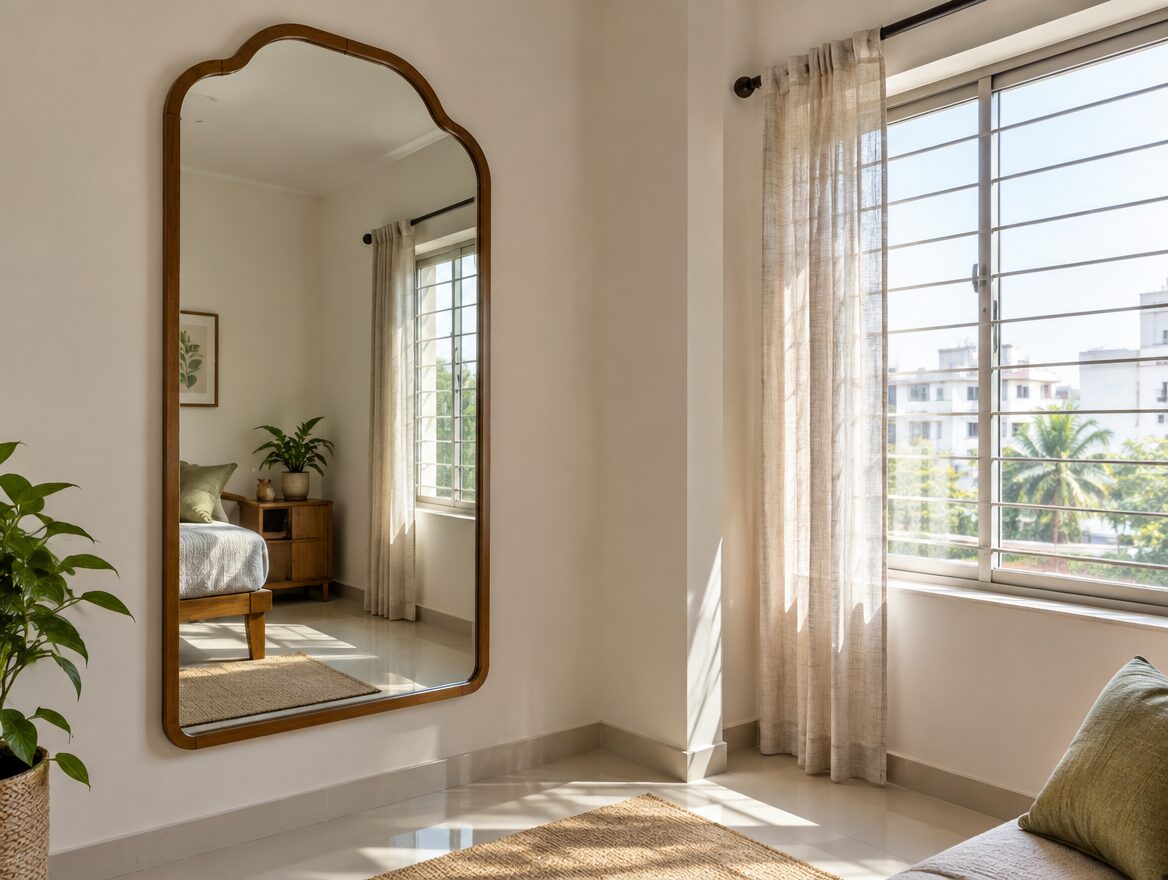
This guide uses an AI-generated room illustration and an editorial schematic. Neither establishes a measured lighting improvement, a verified installation, or a room-specific recommendation.
What Mirror Placement Actually Does to Light and Space
A mirror can reflect daylight and create an impression of greater depth, but the result depends on the window’s position, the mirror’s angle, and what it actually reflects. Opposite a window and on an adjacent wall are positions worth assessing, not guaranteed solutions (Rocky Mountain College of Art + Design: mirrors, light, and illusion in interior design). Check the reflection from the places where you actually sit, work, and move through the room, at different times of day, rather than assuming a given position will work from a photo or general description.
Check whether reflected sunlight causes glare at seating, work, or dressing positions. Follow the mirror manufacturer’s care instructions for any restrictions concerning sunlight, heat, or moisture, since these vary by the mirror’s backing and frame material.
Privacy: What a Mirror Actually Reveals
A mirror may reveal a part of the room that isn’t directly visible through a doorway or window. The relevant question isn’t simply whether the mirror faces a window or door, but what someone outside or in a hallway can actually see in the reflection. Check the reflected view from the relevant hallway or other accessible viewing position, with doors and curtains in their usual positions, and repeat the check after dark with the room lights on, since a reflection that reveals nothing in daylight can behave very differently once it’s the brightest thing visible from outside at night.
Mounting a Mirror Safely
Follow the mirror manufacturer’s installation instructions, including its designated mounting points. Choose fixings suitable for the mirror’s actual weight and the wall’s material and condition. Don’t assume that a generic picture hook, an adhesive strip, or additional fixing points will support the mirror safely on their own; the mirror’s designated mounting system matters alongside its weight and your wall’s construction. As one example of what manufacturer-specific guidance looks like, IKEA’s NISSEDAL mirror instructions specify a different number of screws depending on whether it’s hung flat or mounted with hinges, and require screws suited to the wall material (IKEA: NISSEDAL mirror). That’s a product-specific requirement for one mirror, not a universal instruction for every mirror. If your mirror’s instructions, weight, or wall construction are unclear, ask a competent installer to assess the installation.
If you’re renting, obtain any required permission before drilling, and don’t substitute an unsuitable mounting method simply to avoid holes.
What Vastu Shastra Traditionally Says About Mirror Placement
Separately from the practical factors above, some contemporary Vastu practitioners and consultancies offer guidance on mirror direction and placement. DesignCafe’s published guidance, as one identifiable example, recommends north or northeast walls for a bedroom mirror, and advises against a mirror facing the bed or positioned at the bedroom entrance (DesignCafe: mirror position in the bedroom as per Vastu). Other sources and traditions describe this differently; interpretations vary, and this is one practitioner’s interpretation, not a universal rule from classical texts or scientific evidence. These are belief-based preferences, not evidence that a mirror’s placement changes health, wealth, or relationships.
It’s worth distinguishing two different things when reading this kind of guidance: “on the north wall” describes the wall’s location, while the direction the mirror’s reflective face points is a separate description. A mirror mounted on a room’s north wall and facing into the room generally faces south. Guidance that names a wall and guidance that names a facing direction aren’t always describing the same thing, so check which convention your source is using.
This diagram illustrates one attributed interpretation (DesignCafe) of wall location versus facing direction. It isn’t a scaled plan, doesn’t account for your room’s actual door, window, or furniture layout, and isn’t a recommendation for your specific room.
Choosing Between Practical and Traditional Guidance
First identify placements that can be installed safely and meet your privacy and practical needs. If Vastu matters to your household, use your preferred interpretation to choose between those suitable options. If sleeping direction also matters to your household, our guide to sleeping direction as per Vastu covers the same kind of traditional guidance for bed orientation.
Practical Placement Checklist
| Check | What to establish |
|---|---|
| Reflected view | What appears in the mirror from normal sitting, standing, and dressing positions? |
| Daylight and glare | Does the reflection remain comfortable at different times of day? |
| Privacy | Can someone through a doorway or window see a private area through the reflection? |
| Mounting | Are the mirror’s instructions, weight, mounting points, and suitable wall fixings known? |
| Clearance | Can doors, wardrobe shutters, and nearby furniture operate without striking the mirror? |
| Height | Can the intended users see what they need without awkward positioning? |
| Household preferences | If relevant, which Vastu interpretation are you following, and does it distinguish wall location from facing direction? |
Frequently Asked Questions
Where should I place a mirror to reflect natural light?
Assess positions opposite a window and on an adjacent wall. The useful reflection depends on the window, mirror angle, and room layout. Check the view and glare from normal seating and working positions at different times of day.
Can a mirror reduce privacy in a room?
It can if someone through a window or doorway can see a private area in the reflection. Check the actual sightline rather than assuming every window-facing or door-facing mirror creates the same problem.
What does Vastu say about bedroom mirrors?
Some contemporary Vastu practitioners favour north or east walls and discourage mirrors reflecting the bed. These are belief-based recommendations, and interpretations differ. They shouldn’t be presented as proven health or relationship effects.
Does a mirror facing the main door cause bad luck?
Some Vastu interpretations discourage this placement, but the sources referenced in this guide don’t establish that it causes bad luck. Assess the reflection, glare, privacy, and installation requirements separately from any household belief.
How should a heavy mirror be mounted?
Follow its manufacturer’s instructions and use fixings appropriate to its weight, designated mounting points, and wall construction. Ask a competent installer to assess the installation if those requirements are unclear.
What if practical placement conflicts with Vastu advice?
Choose a position that can be installed safely and meets your privacy and practical needs. If you follow Vastu, use your preferred interpretation to choose among the suitable options.
Sources & Notes
Interior-design guidance on light and space references the Rocky Mountain College of Art + Design’s guide to mirrors in interior design. Installation guidance should primarily follow your mirror’s own manufacturer instructions; IKEA’s NISSEDAL mirror instructions are referenced as one product-specific example, with TaskRabbit’s general hanging guidance as supplementary, general reading rather than a specification. Vastu guidance in this article is attributed to DesignCafe’s published interpretation; other practitioners and traditions describe this differently, and none of it is presented as evidence of a measurable health, wealth, or relationship effect. The room illustration in this guide is AI-generated, and the wall-location diagram is an editorial schematic; neither is a photograph of a real room or a scaled, room-specific plan.