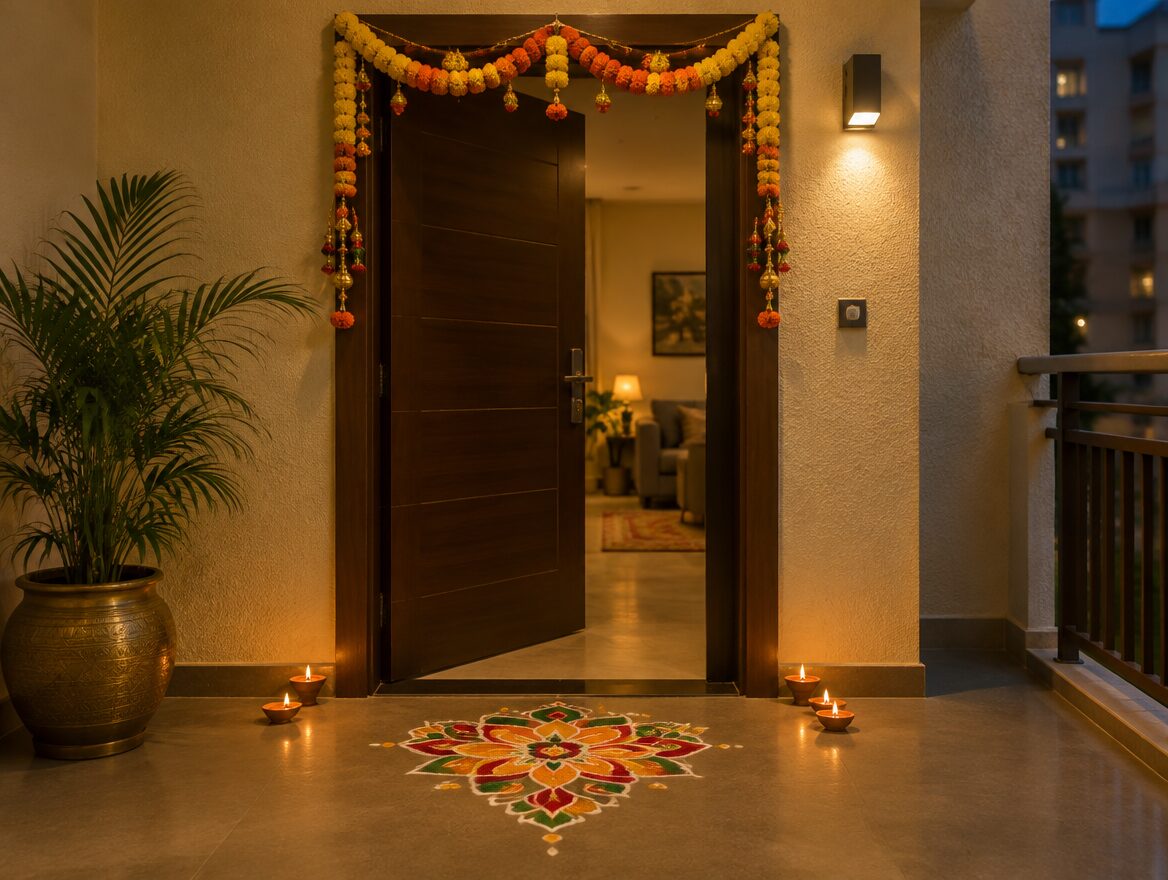
Quick answer: For a small home, choose one main Diwali display and a few coordinated accents: a lightweight toran at the entrance, a compact tabletop arrangement, and suitable decorative lighting at a window or balcony. Reuse what you already own, keep doors and walking routes clear, and separate decorative lighting from any supervised ritual flame.
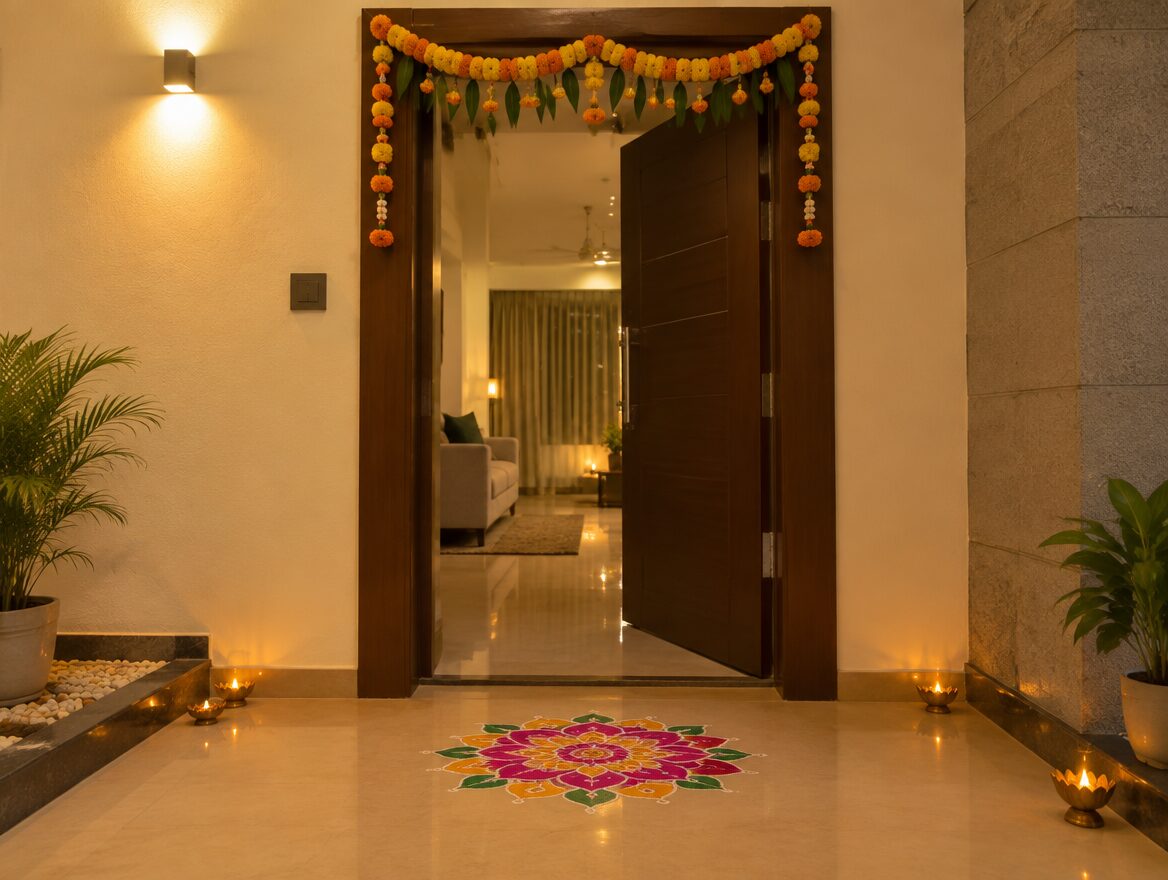
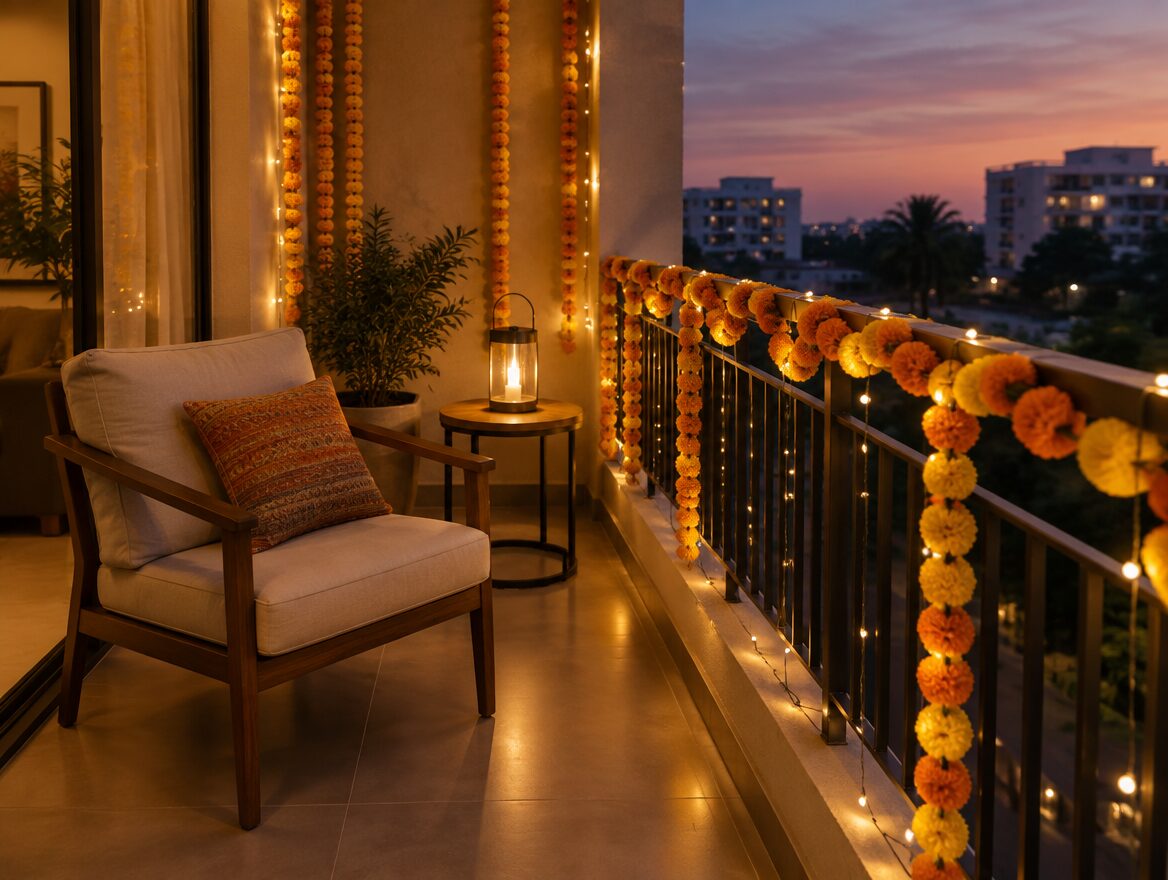
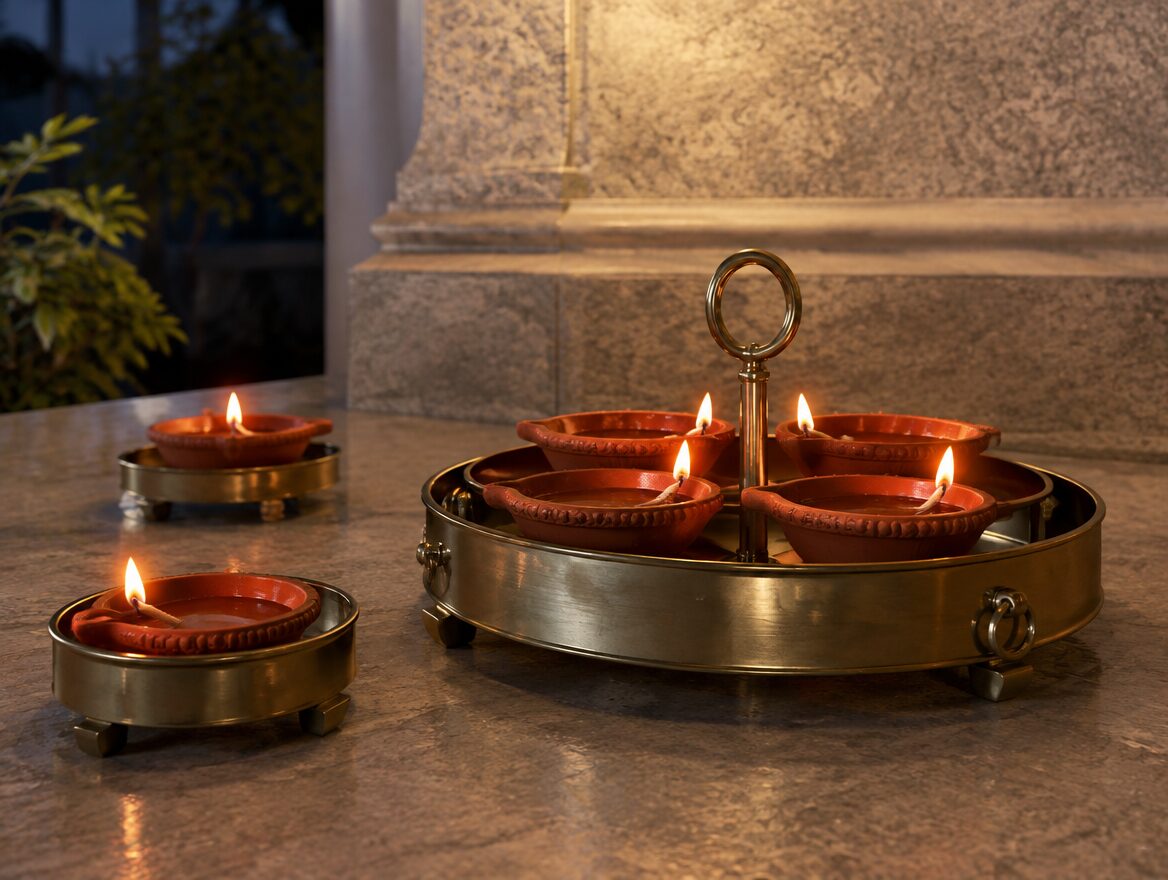
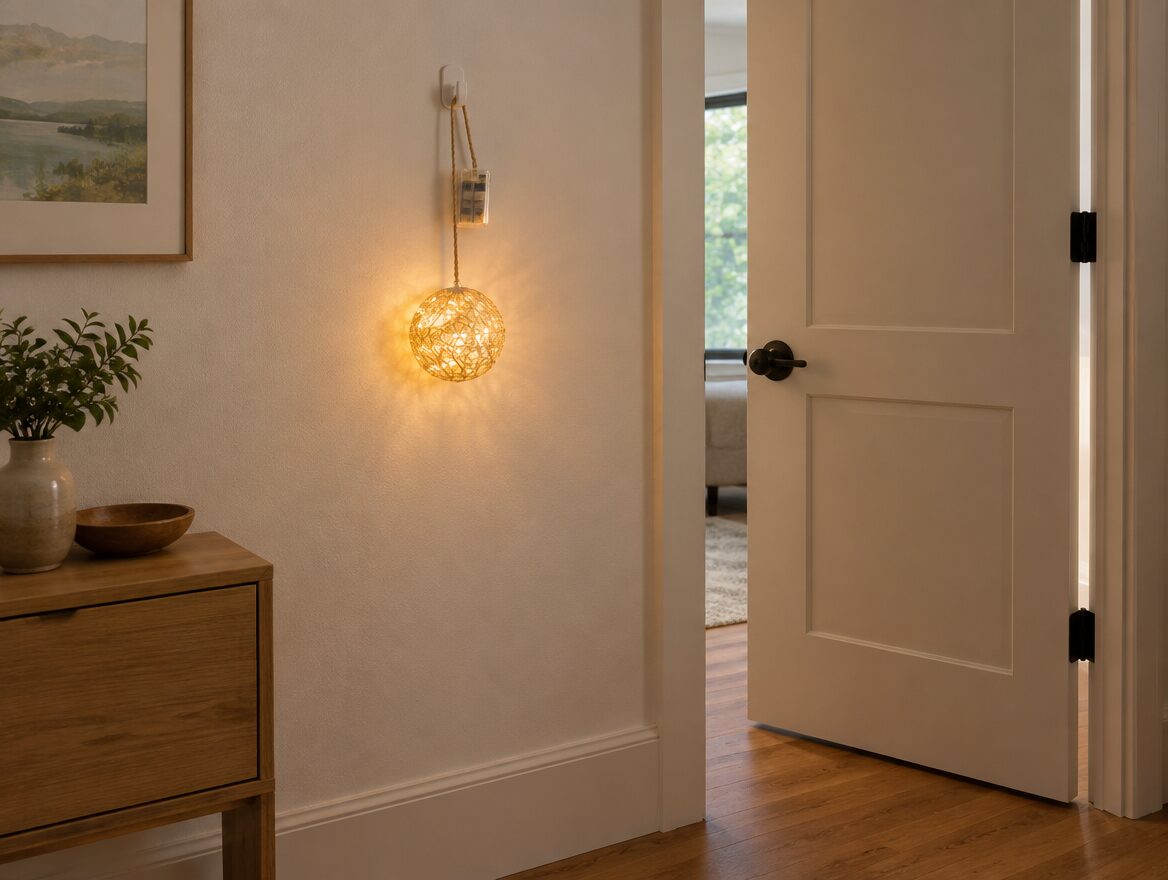
This guide uses original, AI-generated room visuals to illustrate decoration concepts. They are conceptual references, not photographs of any real, installed setup or a tested safe arrangement for your home.
Shared Corridors and Escape Routes Come First
If your apartment entrance opens onto a shared corridor, confirm permission with building management before decorating that space at all. Keep corridors, stairs, exits, and access to fire equipment clear; decorations must not interfere with doors opening or closing. Removability doesn’t establish permission or safety on its own, since a removable stand, a loose cable, or a floor decoration can still obstruct an escape route. If the rules are unclear, keep the display within your own home until building management confirms what’s permitted. This reflects the general safety principle behind keeping communal escape routes free of stored items and clutter (London Fire Brigade: escape plans for blocks of flats), not a specific Maharashtra regulation.
Decorating Ideas for a Small Home
| Idea | How to create it | Small-home advantage | Main check |
|---|---|---|---|
| Simple entrance toran | Use one lightweight hanging and keep the surrounding doorway uncluttered | Creates a focal point without a floor display | Permission, fixing suitability, and door movement |
| Compact festive tray | Group existing decorative objects with flameless lights on a stable surface | Contains the display in one place | Keep away from edges and normal working space |
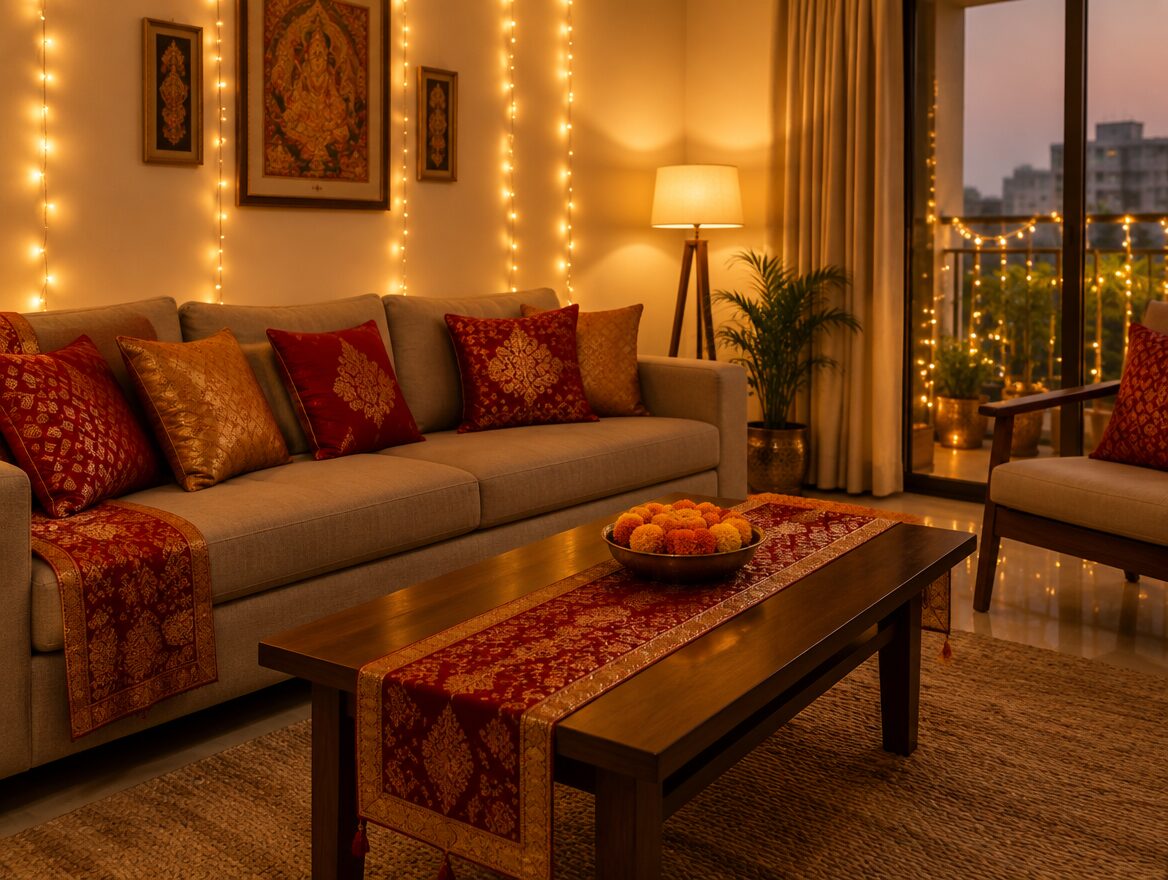
| Two-colour living room | Repeat a chosen colour pair through existing cushions, a runner, and a decorative accent | Gives consistency without many purchases | Keep real flames away from textiles |
| Dining-table centrepiece | Use a low arrangement that leaves room for serving | Works without extra furniture | Avoid unstable or trailing items |
| Window-light outline | Use suitable lights on a fixed part of the window surround | Uses vertical space | No pinched cables or interference with window operation |
| Balcony light accent | Decorate one approved section rather than covering every surface | Preserves seating and circulation | Exposure rating, secure fixing, and protected connections |
These are editorial suggestions to adapt to your own space, not claims about what most households do.
Entrance and Doorway Decoration
A toran can make the entrance the main focal point. A small rangoli pattern just inside or outside the threshold adds to it. Keep rangoli outside the walking route and separate from any lamp placed near it; don’t assume every powder or decorative material is non-combustible, and keep flowers, paper, fabric, and other decorations away from flames generally.
Living Room and Dining Styling
Start with decorations you already own and can store afterward. A two- or three-colour palette across cushions, a table runner, and one decorative accent is a straightforward way to coordinate a room without many new purchases; treat it as one option, not a rule. Paper decorations can also be reused if their condition and construction allow it, not only textiles.
Balcony and Window Lighting
String lights along a balcony railing or window frame are a common way to extend the decoration beyond the entrance without needing floor space. If you’re decorating a balcony for Diwali on top of its everyday use, our guide to balcony decoration for small Indian apartments covers the underlying space and installation checks that still apply during festival decoration, including checking your society’s rules on anything fixed to the railing.
Diya and Candle Safety
Place diyas and candles in a sturdy, heat-resistant holder on a stable, flat surface, away from curtains, furniture, loose decorations, and anything else that can catch fire. This reduces the risk of nearby materials catching fire. Never leave an open flame unattended, and extinguish diyas and candles before leaving the room, leaving the house, or going to bed. Keep them out of reach of children and pets. Use only enough oil for the intended puja duration, as advised by London Fire Brigade; this doesn’t replace continuous supervision or extinguishing the lamp before leaving the room. The brigade’s Diwali safety advice also recommends LED tea lights or flameless battery candles as a lower-risk alternative to open flames for purely decorative use (London Fire Brigade: Diwali safety advice, with detailed holder, clearance, and supervision guidance on its candles and fire safety page).
If you’re decorating a pooja space as part of your Diwali setup, our guide to small pooja room designs covers the same diya and incense safety considerations in more depth, including why a cabinet’s doors should never be closed over a burning lamp.
String Light and Electrical Safety
Inspect string lights each year before using them: look for frayed or exposed wires, damaged insulation, broken bulbs, loose connections, and damaged plugs. If anything looks damaged, don’t use that set; it’s safer to replace a faulty string than to repair it yourself unless the manufacturer specifically provides repair instructions. Follow the product’s permitted connection and load limits rather than guessing, and avoid plugging too many light strings or decorations into a single socket or extension lead. Check the exposure rating for every component you’re using outdoors, not just the bulbs: the controller box and power supply need to be suitable for the conditions too, and any cable splices or connections should be protected rather than left exposed. Use suitable clips to route cords without piercing the cable, and don’t run cords under rugs or through doorways where they can be damaged underfoot. Turn decorative lights off when you leave the house or go to bed, the same as diyas and candles (Electrical Safety Authority: holiday electrical safety).
Decorating Rented Apartments and Shared Building Entrances
- Society and building rules. Many societies have specific rules about what can be fixed to shared corridor walls, railings, or doors. Check before drilling, taping, or fixing anything outside your own door, and see the escape-route guidance above before decorating any shared space.
- Removable hooks. For lightweight decorations, use removable adhesive hooks only where the specific product’s instructions permit that surface and that load; weight capacity alone isn’t enough, since surface compatibility, condition, and the product’s preparation and removal instructions all matter. Removable doesn’t mean suitable for every painted surface.
- A contained display instead of a floor stand. A flameless display on an existing stable surface is generally a better renter-friendly default than a freestanding diya stand, which can occupy walking space or be knocked over.
- Storage for next year. Reusable decorations only help if they survive storage; follow the product’s instructions for packing lights and batteries, keep cables coiled without sharp bends, and store fabric items somewhere dry.
Frequently Asked Questions
How can I decorate a small home for Diwali without adding clutter?
Choose one main display and repeat a small number of colours through existing textiles and decorative objects. Use a compact tabletop arrangement or suitable vertical decoration while keeping doors, seating, and walking routes usable.
Can I decorate a shared apartment corridor for Diwali?
Confirm permission with building management first. Keep escape routes and access to fire equipment clear, and don’t interfere with doors. Removable decorations aren’t automatically permitted.
How should I use diyas in a small apartment?
Use suitable heat-resistant holders on a stable surface, away from combustible materials and children or pets. Supervise the flame and extinguish it before leaving the room or sleeping. Flameless lights are an alternative for purely decorative displays.
Can indoor string lights be used on a balcony?
Don’t assume so. Check the manufacturer’s instructions for the actual exposure and for every component, including the power supply and connections. Don’t use a set with damaged wiring, plugs, or insulation.
How can I decorate a rented home without drilling?
Start with existing furniture and a compact flameless display. For lightweight hangings, check removable-hook load limits, surface compatibility, and installation instructions. Confirm any relevant rental or building restrictions.
How can I reuse Diwali decorations next year?
Check their condition before storage. Follow product instructions for packing lights and batteries, avoid sharply bending cables, and store clean, dry decorations where they won’t be crushed or exposed to moisture.
Sources & Notes
Diya and candle safety guidance references the London Fire Brigade’s Diwali safety advice and its candles and fire safety guidance. Shared-corridor guidance references the brigade’s general principle of keeping escape routes clear (escape plans for blocks of flats), not a specific Indian regulation. String-light and electrical safety guidance references the Electrical Safety Authority’s holiday electrical safety guidance, general principles that apply regardless of which festival or season you’re decorating for. Removable-hook guidance reflects the general product category of adhesive wall hooks, whose manufacturers specify surface compatibility and weight limits by product size; check your specific product’s instructions rather than assuming any hook suits any surface. Images in this guide are AI-generated design concepts, not photographs of a real, completed setup or a tested safe arrangement; confirm safety and installation details for your own home before decorating.