
Quick answer: Vastu Shastra’s traditional guidance commonly recommends sleeping with your head toward south or east, and avoiding north. This is a cultural and family tradition some households choose to follow, not a scientifically established health rule; if it matters to your family, factor it into your bedroom planning alongside the sleep-environment factors that do have strong scientific support, such as darkness, temperature, and noise.
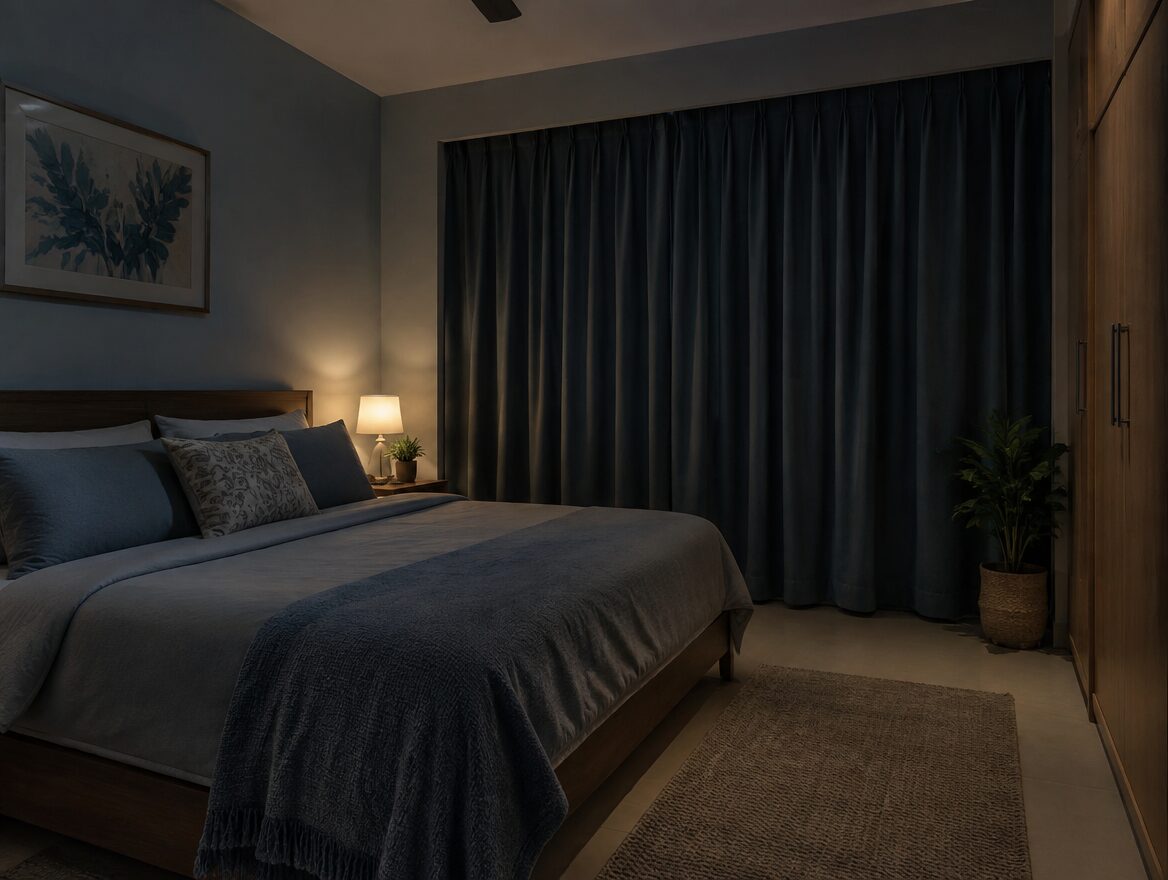
This guide uses an original schematic diagram and AI-generated room visuals. They illustrate traditional guidance and general bedroom planning concepts, not a verified “correct” layout for your specific room.
What Vastu Shastra Traditionally Recommends
Vastu Shastra is a traditional Indian system of architectural and spatial guidance. On sleeping direction specifically, commonly cited teaching recommends sleeping with your head toward the south as the most favoured direction, with east as a second choice, often associated with mental clarity and recommended for students. Sleeping with the head toward the north is traditionally discouraged; some teachings also note the south-west corner of the bedroom as a favoured position for the bed itself. Specific recommendations vary between different Vastu schools, regional traditions, and individual practitioners, so treat this as general traditional guidance rather than one single fixed rule.
These are beliefs rooted in a specific tradition. We’re describing them as traditional guidance, not asserting that they produce measurable health, financial, or relationship outcomes.
This diagram illustrates the traditional head-direction guidance described above. It isn’t a scaled plan and doesn’t account for your room’s actual door, window, or furniture layout.
What the Scientific Evidence Actually Says
Separately from the tradition, researchers have looked at whether sleep direction affects sleep quality or health. The Sleep Foundation’s own review of this question notes that some small studies have found the brain responds to changes in magnetic fields, and a few limited studies have reported associations between north-south sleeping orientation and measures like sleep quality or blood pressure. However, no randomized controlled trial has established that sleeping in a specific direction produces a clinically meaningful difference in sleep quality or health outcomes, and the evidence for direction specifically is far weaker and more preliminary than the evidence for environmental factors like temperature, light, and noise (Sleep Foundation: which direction should you sleep facing?). Treat sleep direction as a personal or family tradition to factor in if it matters to you, not as a scientifically proven health intervention.
Bedroom Factors With Strong Scientific Support
If improving actual sleep quality is the goal, these factors have considerably stronger evidence behind them than direction does, according to the Sleep Foundation’s bedroom-environment guidance (Sleep Foundation: bedroom environment for sleep):
- Temperature. A cooler room, roughly 15 to 19 degrees Celsius, supports the natural drop in body temperature that accompanies falling asleep. Indian bedrooms vary widely in how achievable this is without air conditioning, especially outside winter months, so treat it as a direction to aim for rather than a fixed requirement.
- Darkness. A dark room supports the release of melatonin, the hormone associated with sleep onset. Blackout curtains or blinds help in rooms that face streetlights or get early morning sun.
- Noise. Consistent, lower background noise supports deeper sleep and fewer night-time wakings. This matters in dense Indian apartment buildings where traffic, neighbours, or shared walls can be a bigger factor than room orientation.
- A consistent sleep schedule. Going to bed and waking at consistent times supports the body’s own sleep-wake rhythm, independent of the room itself.
Practical Bedroom Planning Checklist
| Check | Why it matters |
|---|---|
| Actual room orientation (use a compass app, not assumption) | Confirms which direction the room’s walls and your intended head position actually face |
| Window placement and light control | Affects both darkness for sleep and which wall gets direct morning or afternoon heat |
| Noise sources (road-facing wall, shared walls, building services) | Often a bigger factor in apartment living than orientation |
| Door swing and walking space around the bed | Needed regardless of which direction the bed faces |
| Switchboard and existing electrical points | Affects where bedside lighting and chargers can realistically go |
| Ceiling fan or AC position relative to the bed | Affects airflow and comfort at the position you’ll actually sleep in |
What If Your Room’s Layout Doesn’t Allow the Recommended Direction?
Many Indian apartments have a fixed room shape, door position, and window placement that limits how the bed can realistically be arranged. If the traditionally recommended direction doesn’t fit your room without blocking a door, a window, or a walking path, that’s a genuine trade-off households weigh differently: some prioritise following the traditional guidance as closely as the room allows, others prioritise the practical factors above, and many blend both. There’s no single correct answer here, and we wouldn’t frame it as one.
Frequently Asked Questions
Which direction is best for sleeping according to Vastu?
Commonly cited Vastu teaching favours sleeping with the head toward south, with east as a second choice. Sleeping with the head toward north is traditionally discouraged. Specific guidance varies between different Vastu schools and traditions.
Is there scientific evidence that sleep direction affects health?
Not conclusively. Some small studies have found the brain responds to magnetic field changes, and a few limited studies have reported associations between sleep orientation and measures like sleep quality, but no randomized controlled trial has established a clinically meaningful health effect from sleep direction specifically.
What actually improves sleep quality, if not direction?
A cooler room, consistent darkness, reduced noise, and a consistent sleep schedule all have considerably stronger evidence behind them than sleep direction does, according to the Sleep Foundation’s bedroom-environment guidance.
What if my bedroom’s layout doesn’t allow the recommended sleeping direction?
This is a genuine trade-off many apartment households face. Some prioritise the traditional guidance as closely as the room allows; others prioritise practical factors like light, noise, and walking space. There’s no single correct choice; it’s a personal or family decision.
Does the bed need to be in a specific corner of the room?
Some Vastu teaching favours the south-west corner for the bed’s position, though this varies by tradition and by the room’s actual layout. Treat it as traditional guidance to factor in, not a fixed requirement that overrides practical access and safety considerations in your specific room.
Should I follow Vastu guidance or scientific sleep advice?
These aren’t mutually exclusive. Many households follow traditional direction guidance where the room allows it, while also applying the practical, evidence-based factors like darkness, temperature, and noise reduction, which have stronger scientific support for actual sleep quality.
Sources & Notes
Traditional guidance in this article reflects commonly cited Vastu Shastra teaching; specific recommendations vary between schools and regional traditions, and this article doesn’t assert that following them produces measurable health, financial, or relationship outcomes. Scientific context references the Sleep Foundation’s review of sleep direction research and its bedroom-environment guidance. The diagram in this guide is a simplified schematic, not a scaled plan, and the room visual is an AI-generated design concept, not a photograph of a real, completed room.