
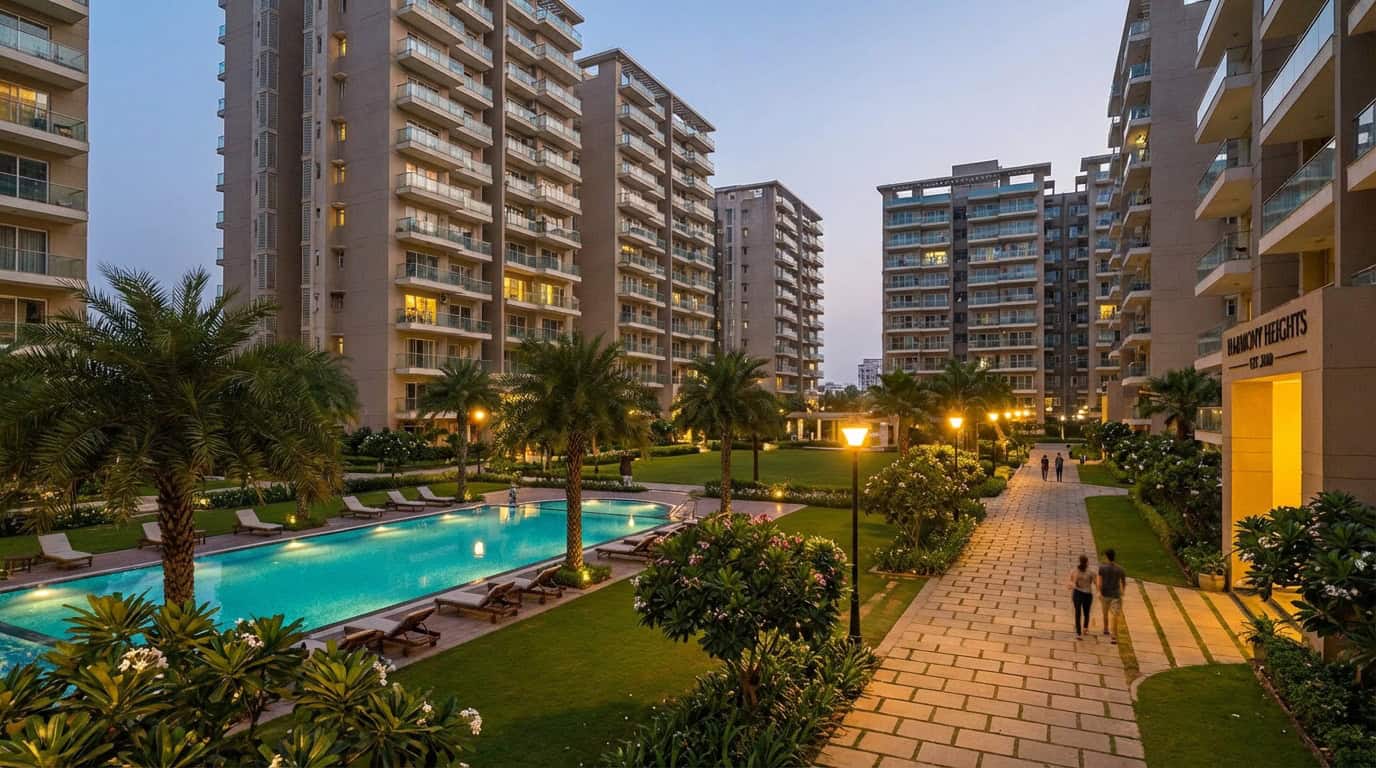
If you own an apartment in Navi Mumbai, you already know that maintenance charges are not optional. They’re the cost of keeping your building running smoothly. But here’s the thing: not all maintenance charges are the same. What you pay in Kharghar might be wildly different from what someone pays in Panvel, even for a similar-sized flat.
This guide breaks down exactly what maintenance covers, how charges are actually calculated and apportioned under Maharashtra’s cooperative housing bye-laws, and what to do if you want to audit or dispute an increase.
Maintenance charge rates, legal provisions, and dispute procedures in this guide are based on Maharashtra Co-operative Society regulations and publicly available data as of early 2026. Rules and rates vary by society and may change. Consult a registered housing society lawyer or your district Registrar of Co-operative Societies for advice on specific disputes.
Quick Answer
There is no single government-fixed monthly maintenance rate for housing societies in Navi Mumbai. Charges depend on the society’s actual expenses, approved budget, applicable bye-laws, and how different cost heads are apportioned among members.
Maintenance charges in a Navi Mumbai cooperative housing society are proposed by the managing committee and approved by the general body under Maharashtra’s Model Bye-Laws, using a mix of area-based, equal-split, and usage-based formulas rather than one blanket rate. There’s no reliable ₹/sq ft benchmark by locality. Charges depend on your building’s amenities, staffing, lift count, water source, and how the sinking and repair funds are budgeted. Maintenance revisions should follow the society’s registered bye-laws, approved budget, applicable meeting requirements and Maharashtra cooperative-housing law. A 2/3 majority should not be presented as a universal requirement for routine maintenance revisions. If you disagree with a charge, the correct first step is a written complaint to the managing committee, keeping a copy, and following the escalation procedure prescribed by the society’s applicable bye-laws if it isn’t resolved.
What Society Maintenance Charges Cover
Society maintenance charges cover the cost of running your building. What counts as the single biggest line item varies by society: common major heads include water, security, housekeeping, lift maintenance, common-area electricity, repairs, insurance, and administration. Understanding each one makes it easier to judge whether your charges align with the society’s approved budget and actual expenses.
Water Supply and Storage
The society may receive water through the applicable local authority or other approved supply arrangements, depending on the property’s location. Tanker supply may supplement this where required. It is stored in overhead tanks or underground sumps and distributed to every flat. Costs include tank cleaning, pipe repairs, and metering. This tends to be a larger share of the bill in tanker-dependent societies.
Security and Safety
Guards at the gate, CCTV systems, access control, and sometimes guards inside the building. Staffing levels and the number of entry points drive this cost more than location does.
Lifts and Escalators
Monthly AMC (Annual Maintenance Contract) for lifts, spare parts, and emergency repairs. Buildings with multiple lifts or older lift models typically pay more here.
Generator and Power Backup
For buildings with diesel generators, this covers fuel, servicing, and AMC. Societies running generators for longer daily hours pay proportionally more, even where grid power cuts have reduced.
Common Area Electricity
Lighting for corridors, stairwells, lobbies, and parking areas, plus power for lifts, pumps, and other shared equipment.
Garden and Landscaping
Where a society has landscaped common areas, this covers gardeners, plants, and pest control. Societies with minimal green space carry little or no cost here.
Administration and Staff
Society secretary or facility manager, accounting support, office expenses, and statutory filings. This should appear as its own line in the budget rather than being absorbed into a vague “miscellaneous” head.
How Maintenance Charges Are Actually Calculated
There’s no single citywide formula, and no verified ₹/sq ft benchmark by locality. No major property research firm (ANAROCK, Housing.com, 99acres, Magicbricks) publishes locality-wise maintenance-rate data for Navi Mumbai the way they do for property prices. What you’ll find circulating online as “typical rates by area” are illustrative blog estimates, not surveyed figures.
What actually drives your maintenance charge is your specific building: its amenities, age, staffing levels, number of lifts, dependence on tanker water, and how well the managing committee runs its budget process. Two similarly sized flats in the same node can carry very different maintenance bills depending on these factors. Charges are proposed by the managing committee and placed before the general body as part of the annual budget for the next financial year, then approved by the members.
Charges Based on Flat/Area vs Charges Shared Equally
Under Maharashtra’s Model Bye-Laws, different cost heads are meant to use different apportionment bases, not one formula applied across the board:
| Cost Head | How It’s Apportioned |
|---|---|
| Property taxes | Per NMMC/local-authority assessment, apportioned by area |
| Water charges | Per inlet/tap connection |
| Repairs & maintenance fund | Based on the prescribed Repairs & Maintenance Fund contribution under the applicable bye-laws |
| Lift maintenance | Equally among all members of the building served by the lift, regardless of whether they personally use it |
| Sinking fund | Per the 0.25% construction-cost formula |
| Service charges (salaries, office admin) | Equally divided by flat count |
| Car parking | As fixed by the general body |
| Non-occupancy charges | Capped at 10% of service charges (see below) |
| Insurance, lease rent, NA tax | Per built-up area |
| Education & training fund | Small fixed per-flat contribution to the state federation |
| Election fund | Equally, as prescribed by the State Cooperative Election Authority |
| Sundry | As decided by the general body |
If your society applies a single ₹/sq ft rate to every cost head, or splits everything equally regardless of head, that’s worth raising at a general body meeting. The bye-laws expect a mixed basis, not one formula for everything.
Maintenance vs Repair Fund vs Sinking Fund
These three are often confused, but they’re legally distinct, and one shouldn’t be used to argue against another.
Maintenance / Service Charges
Covers day-to-day running costs (as listed above). Reviewed and approved annually by the general body as part of the budget.
Repairs and Maintenance Fund
Set at a minimum of 0.75% per annum of the architect-certified construction cost of each flat (Bye-law 13(a)), not its current market value. Meant for ongoing and periodic repairs and renewals (Bye-law 14(b)), not major structural work.
Sinking Fund
Set at a minimum of 0.25% per annum of the architect-certified construction cost of each flat, excluding the proportionate cost of land (Bye-law 13(c)). A ring-fenced capital reserve, usable only for reconstruction or structural additions and alterations, and only via a resolution passed by the general body (Bye-law 14(c)).
A Sinking Fund balance should not automatically be treated as money available for routine operating expenses. Whether routine charges need revision should instead be assessed against the society’s approved operating budget and the permitted use of each fund.
What Your Maintenance Bill Should Show
A properly itemised bill should let you see, at minimum:
- Each cost head separately (water, security, lift AMC, sinking fund, repair fund, electricity, administration, and so on) rather than one lump “maintenance” figure
- The basis used for each head: area-based, equally split, or usage-based
- Your flat’s specific calculation, including the area figure and rate or formula applied
- Any one-off or special charges shown separately from recurring monthly charges
Members can request the society’s annual accounts and budget in writing, and the annual general meeting framework requires the budget to be placed before the general body for consideration each year.
How to Audit a Maintenance Increase
If your society proposes a maintenance increase, work through these before objecting or approving:
- Check the approved budget. Was a budget presented to the general body explaining the increase?
- Review the audited accounts. Review the society’s audited financial statements and confirm that statutory audit requirements applicable to the society have been complied with.
- Check vendor contracts. Are security, housekeeping, and lift AMC contracts current, and were they competitively bid recently?
- Look at water/tanker expenditure. This is often the most volatile cost head. Check for unexplained month-to-month spikes.
- Verify lift AMC costs against the actual signed contract.
- Review security and housekeeping contract terms for staffing levels and rates.
- Check common-area electricity for any unexplained increase.
- Check repair fund provisions. Is a genuine capital project driving the increase, and was it approved by resolution?
- Check outstanding member dues. A rise in per-member charges sometimes reflects other members’ arrears rather than actual cost increases. Ask what the default rate is.
Most savings a committee finds through this kind of review come from unglamorous places: renegotiating a water-tanker or housekeeping contract that hasn’t been rebid in years, switching common-area lighting to LED, or right-sizing generator run-hours. None of this requires a legal dispute, just a committee willing to ask vendors for current rates.
Documents Members Should Review
- Audited annual financial statements
- The budget presented at the AGM
- Bank statements showing where collected funds actually went
- Vendor contracts for security, housekeeping, lift AMC, and water tanker supply
- Sinking fund and repair fund ledgers, showing balance and any utilisation
- Minutes of the general body meeting where the increase was approved
You can request these in writing from the managing committee.
Common Disputes Over Maintenance Charges
Red Flags to Watch For
- Sudden spikes with no explanation: if maintenance jumps sharply in one month with no major repair, ask why
- Vague expense categories such as “miscellaneous” or “contingency” making up a large share of the budget
- No audited financial statements available for review, despite the society being required to get its accounts audited
- Vendor relationships with an obvious conflict of interest, such as a committee member’s relative supplying services
- No visibility into where the sinking fund is held or invested
- No functioning, elected managing committee providing oversight
The most frequent formal disputes involve:
- An increase pushed through without being placed on record at a general body meeting
- Charges applied on an inconsistent basis, with some heads billed per sq ft and others per flat with no stated logic
- Non-occupancy charges levied above the statutory cap
- Sinking fund or repair fund money spent without a general body resolution
- Lack of transparency on vendor contracts or bank statements
What to Do if You Disagree With a Charge
Maharashtra’s Model Bye-Laws set out a specific escalation path. It isn’t just “complain to the Registrar”:
- Written complaint to the managing committee. Put your objection in writing and keep a copy.
- Follow the escalation procedure prescribed by the society’s applicable bye-laws if the matter remains unresolved at the committee level.
- If unresolved, the complaint routes to the appropriate authority depending on what it concerns: the Registrar of Co-operative Societies, the Co-operative Court, the municipal corporation, or the general body, rather than one single authority handling everything.
- For a genuine dispute on the merits (an improperly approved increase, or a financial irregularity), certain disputes that fall within Section 91 of the Maharashtra Co-operative Societies Act, 1960 may be referred to the Co-operative Court. The appropriate forum depends on the nature of the dispute and the parties involved.
The Registrar of Co-operative Societies, part of the state Commissioner for Co-operation’s office (Sahakarayukta), delegated locally to the Divisional Joint Registrar, District Deputy Registrar, or Assistant Registrar, also runs an online grievance channel called Sahakar Samvad, alongside the state’s general Aaple Sarkar portal, where complaints can be filed and tracked.
Withholding payment altogether isn’t the right response to a disputed charge. It can expose you to recovery action by the society, even on a genuinely disputed amount. If you dispute part of a bill, get professional guidance before withholding payment: pay what isn’t in dispute, formally challenge the increase in writing, and keep records, since the unresolved balance may still count as outstanding until the dispute is settled.
Non-Occupancy, Parking, and Major Repair Charges
Non-Occupancy Charges
If your flat is rented out or otherwise not occupied by you or your family, the society can levy a non-occupancy charge, but it’s capped at 10% of the flat’s service charges (not total maintenance, and excluding municipal taxes), under a Co-operation & Textile Department Government Resolution dated 1 August 2001, upheld by the Bombay High Court in 2007. The charge doesn’t apply where the flat is occupied by specified close relatives. In practice this cap is often exceeded; if your society charges more, that’s worth raising in writing.
Parking Charges
Parking charges are determined in accordance with the applicable bye-laws and general-body decisions rather than a single Navi Mumbai-wide statutory rate.
Major Repair / Special Levies
One-off levies for structural work beyond what the sinking fund covers require a specific general-body resolution, and should be itemised separately from routine maintenance rather than folded into the monthly figure.
Buyer Checklist: Maintenance Questions Before Buying a Resale Flat
Before finalising a resale flat, ask the seller or society for:
- The current monthly maintenance amount, broken down by cost head
- Whether any dues, including the seller’s, are outstanding on the flat
- The sinking fund and repair fund balances, and whether any major work is planned or already resolved but unbilled
- Minutes of the last AGM where the budget or any increase was approved
- Whether the flat currently attracts non-occupancy charges, relevant if you plan to rent it out
- Any pending disputes between the society and vendors, or between members and the committee, that could affect future charges
This is worth reading alongside our Flat Buying Checklist for Navi Mumbai, which covers the wider due-diligence process.
Official portals named in this guide: Navi Mumbai Municipal Corporation, Aaple Sarkar.
Frequently Asked Questions
Is there a maximum maintenance charge cap in Navi Mumbai?
No single citywide cap exists. Charges are set by the general body as part of the approved budget, following the approval process set out in the society’s applicable bye-laws. If you believe charges are unreasonable or improperly approved, raise a written complaint with the managing committee and escalate to the Registrar of Co-operative Societies or the Co-operative Court if it isn’t resolved.
Do maintenance increases need a 2/3 majority?
Not necessarily. Maintenance revisions should follow the society’s registered bye-laws, approved budget, applicable meeting requirements and Maharashtra cooperative-housing law. A 2/3 majority should not be presented as a universal requirement for routine maintenance revisions. Check your society’s specific bye-laws and the resolution on record to confirm the applicable threshold.
What’s the difference between maintenance charge, repair fund, and sinking fund?
Maintenance/service charges cover day-to-day running costs. The repairs and maintenance fund (minimum 0.75% of the architect-certified construction cost annually) covers ongoing repairs. The sinking fund (minimum 0.25% of the architect-certified construction cost annually, excluding land) is a separate reserve for major structural work, usable only via a general body resolution. All three are legally distinct and shouldn’t be mixed.
Can I refuse to pay maintenance charges I disagree with?
Do not assume that withholding the disputed portion automatically protects you from recovery action or interest. If a material amount is disputed, document the objection in writing and obtain appropriate professional advice before withholding payment.
Who audits society accounts?
Review the society’s audited financial statements and confirm that statutory audit requirements applicable to the society have been complied with. Members can request the audited statement and the budget presented at the AGM in writing.
What’s the correct authority for a maintenance dispute?
Start with a written complaint to the managing committee, and follow the escalation procedure prescribed by the society’s applicable bye-laws if it isn’t resolved. Unresolved complaints route to the Registrar of Co-operative Societies, the Co-operative Court for disputes on the merits under Section 91 of the MCS Act 1960, or another body depending on the subject matter.
Is there a cap on non-occupancy charges for a rented-out flat?
Yes. Non-occupancy charges are capped at 10% of the flat’s service charges, not total maintenance, under a 2001 Government Resolution upheld by the Bombay High Court. The charge doesn’t apply if the flat is occupied by specified close relatives.
Can I ask my housing society for a breakdown of my maintenance bill?
Yes. Members can request details of the bill, including its component charges and the basis or resolution under which they have been levied.
Do ground-floor residents have to pay lift maintenance?
Under the Maharashtra Model Bye-Laws reviewed, lift running and maintenance expenses are shared among members of the building served by the lift irrespective of whether an individual member uses it.
Can a society charge larger flats more for maintenance?
It depends on the charge head. Service charges (staff, administration, and similar common costs) are typically divided equally by the number of flats, regardless of size. Other heads (such as insurance, lease rent, and non-agricultural tax) are usually apportioned by built-up area. Check your bill against the apportionment table above to see which basis applies to each line item.
Official Sources / Last Verified
This guide was last verified against the following sources on 27 August 2026:
- Maharashtra Co-operative Societies Act, 1960, and Maharashtra Co-operative Societies Rules, 1961
- Model Bye-Laws of Co-operative Housing Societies, issued by the Commissioner for Co-operation & Registrar, Co-operative Societies, Maharashtra: provisions relating to society charges, funds and apportionment
- Government Resolution No. Sa.Gru.Yo-1094/15165/Pra.kra.317/14-C (1 August 2001), Co-operation & Textile Department, on non-occupancy charges
- Mont Blanc Co-operative Housing Society Ltd. v. State of Maharashtra, Bombay High Court, upholding the non-occupancy charge cap (2 March 2007)
Rules, formulas, and figures can change, and individual society bye-laws can vary from the model. This is general information, not legal advice. Consult a registered housing-society lawyer or your district Registrar of Co-operative Societies for guidance on a specific dispute.
For more on housing costs in Navi Mumbai, read our guide on home loan EMI calculations and the best areas in Navi Mumbai for your budget.