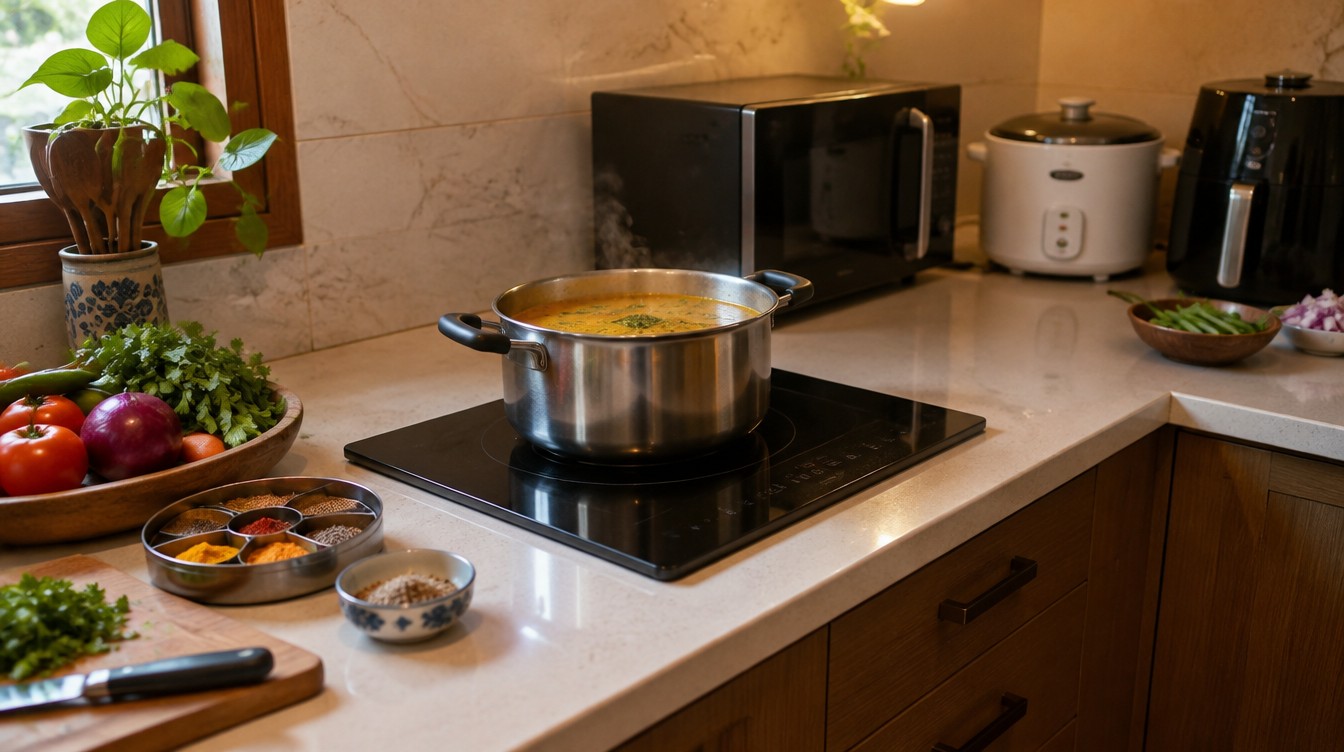
You can prepare many Indian meals without an LPG connection, but induction cooktops, microwaves, rice cookers and electric pressure cookers work differently. This guide helps you match dishes to suitable appliances, check cookware and cooking modes, and plan costs. For quantities and cooking instructions, use a complete recipe suited to your appliance and batch size.
NaviMumbai.com has not tested every dish idea listed here. Where a dish needs a complete, precise method, especially anything involving meat, fish or dried beans, follow a recipe written and tested for your specific appliance rather than a generic outline.
Match the Appliance to the Dish
| Appliance or mode | Relevant uses | Essential distinction |
|---|---|---|
| Induction cooktop | Pan-based curries, vegetables, rice and flatbreads | Requires compatible cookware |
| Microwave mode | Reheating and recipes developed for microwave cooking | Does not reproduce ordinary oven baking automatically |
| Convection mode | Baking and roasting in equipped models | Uses oven temperature settings and suitable ovenware |
| Electric pressure cooker | Recipes designed for pressure cooking | Requires suitable liquid, fill limits and a release procedure |
| Basic rice cooker | Rice and specifically supported dishes | Not interchangeable with a pressure cooker |
| Air fryer | Suitable roasting, baking and crisping recipes | Batch size, airflow and accessories matter |
Many appliance manuals, including Panasonic’s convection microwave instructions, treat microwave power and convection heat as genuinely different operations with different suitable containers. Check which mode a recipe actually needs before assuming any setting will do.
Cookware That Actually Works
Check the cookware manufacturer’s induction marking and the cooktop’s requirements for base material, shape and size. Some aluminium cookware has an induction-compatible base; stainless steel alone does not establish compatibility. A magnet check is useful, but it does not replace the model’s stated cookware requirements. For rice cookers and multicookers, use the supplied or manufacturer-approved cooking vessel and accessories rather than assuming any stainless steel pot fits.
Never place roti or naan dough directly on an induction cooktop’s glass surface. Use a suitable induction-compatible tawa or pan; heat settings and preheating time depend on that cookware and your specific appliance.
Induction: Meal Ideas
| Dish | What it needs | Key caution |
|---|---|---|
| Chicken curry | A compatible pan; a complete recipe with quantities | Check doneness by temperature, not by the clock |
| Rajma (kidney bean curry) | Fully cooked or canned kidney beans | Do not rely on soaking plus a slow-cooker setting alone to prepare dried kidney beans safely |
| Aloo gobhi | A compatible pan; potato and cauliflower cut to even size | A full recipe needs exact quantities for consistent results |
| Dal tadka | A compatible pan; moong and toor dal need different cooking times | Do not use one timing for every lentil type |
| Paneer tikka masala | A compatible pan; a complete sauce recipe | Follow a sourced recipe for consistent results rather than a rough outline |
| Fish fry | A compatible pan; oil heated to a moderate frying temperature | Never heat oil until it smokes; check the fish is opaque and flakes, not just “golden” |
| Roti or naan | An induction-compatible tawa or pan | Never on the bare cooktop glass |
| Bhindi fry | A compatible pan; dry, cut okra | A properly sourced method avoids sogginess |
| Chole | Fully cooked chickpeas as the starting point | Treat this as a sauce recipe, not a from-dried-chickpea method |
| Pan-roasted chicken | A compatible pan; a food thermometer | Minutes per side alone does not prove the chicken is safely cooked |
Microwave and Convection: Meal Ideas
| Dish | What it needs | Key caution |
|---|---|---|
| Reheating cooked food | A microwave-safe container; even stirring partway through | Reheat to piping hot throughout, not just warm on the surface |
| Poha | A pan or stovetop-style method, or a microwave recipe written for it | Tempering, potato and peanut timing need a proper sequence, not one generic bowl of instructions |
| Vegetable momos | A steamer or steaming accessory; a complete, sourced recipe | Vegetable and meat fillings need separate recipes and different safety checks |
| Samosas | An air fryer or convection oven, not microwave-only heat | Microwave mode alone will not produce a crisp, baked result |
| Banana cake | Convection mode with correct oven temperature and bakeware | Microwave-only “cake” settings are not the same as baking |
Electric Pressure Cooker and Rice Cooker: Meal Ideas
| Dish | What it needs | Key caution |
|---|---|---|
| Pulao or tomato rice | A model that supports a sauté step, or pre-sautéed ingredients added before cooking | Not every rice cooker has a sauté function |
| Dal with vegetables | The correct pulse-to-water ratio for that specific dal | Moong and toor dal are not interchangeable on one fixed setting |
| Idli | A steaming accessory compatible with your model | Follow the model’s own steaming instructions, not a generic time |
| Biryani or chicken with rice | A complete, appliance-specific recipe for cooking raw meat and rice together safely | Do not use a generic rice-mode setting for raw meat; follow a tested recipe with a doneness check |
| Mutton curry | A complete pressure-cooking recipe stating liquid quantity, cut of meat, pressure setting and release method | Do not improvise pressure-cooking steps; follow your appliance’s manual and a tested recipe |
Air Fryer: Meal Ideas
| Dish | What it needs | Key caution |
|---|---|---|
| Roasted vegetables | An even, uncrowded layer for airflow | Batch size affects the result; do not overfill the basket |
| Paneer tikka skewers | Skewers sized for your basket; turning partway through | Follow your model’s own guidance on turning rather than a fixed shake count |
| Baked snacks in a suitable wrapper | A wrapper or batter genuinely rated for air-frying | A wet pakora-style batter needs a recipe developed specifically for an air fryer, not a tray placed on the assumption it will work |
Meat, Fish and Dried Bean Safety
Cooking time depends on thickness, starting temperature, quantity and your specific appliance’s performance, so a fixed number of minutes is not a safety check. Use a food thermometer where you can: FoodSafety.gov recommends an internal temperature of 74°C for poultry and 63°C for fish. A rice cooker’s beep, a “golden” colour, or a stated percentage such as “60% cooked” does not confirm safe doneness.
Dried red kidney beans (used in rajma) contain a natural compound that needs proper preparation to neutralise. The US FDA’s own food-safety handbook specifically warns against relying on a slow cooker to prepare dried kidney beans safely. The simplest safe option for a home cook is to start from fully cooked or canned kidney beans rather than preparing dried ones in a slow cooker.
Food Storage
- Keep raw ingredients separate from ready-to-eat food.
- Cool and refrigerate leftovers promptly rather than leaving them at room temperature for extended periods.
- Reheat leftovers evenly and thoroughly; FoodSafety.gov recommends reheating to 74°C.
- Do not treat a “keep warm” function as safe storage for an unlimited time.
What This Actually Costs
Costs depend on the meal, appliance, usage, your electricity rate and any equipment you need to buy. Rather than a fixed savings figure, use this for a specific meal:
| Input | Your figure |
|---|---|
| Appliance and meal or batch size | |
| Measured electricity used, in kWh | |
| Your electricity rate, per kWh | |
| Electricity cost for the batch | |
| Servings produced | |
| Additional cookware or equipment required |
Batch electricity cost equals measured kWh used, multiplied by your applicable rate per kWh. If you cannot measure actual consumption, label any power-times-duration estimate clearly as an estimate; an appliance’s rated maximum power is not the same as its continuous draw. Compare equivalent meals and quantities rather than one appliance cooking a side dish against LPG cooking an entire meal. For the broader question of switching fuels, see our LPG, PNG and induction cost comparison.
Frequently Asked Questions
Can I cook Indian meals without an LPG connection?
Yes. Many dishes can be prepared using induction, microwave, rice-cooker, pressure-cooker or air-fryer methods. Choose a complete recipe suited to the appliance and mode you have.
Can I put roti or naan directly on an induction cooktop?
No. Use a suitable induction-compatible tawa or pan. Do not place dough directly on the cooktop glass.
Will all my existing cookware work on induction?
No. Check the cookware’s induction marking and the cooktop’s requirements for base material, size and shape. A magnet check can help, but it does not establish every aspect of compatibility.
Can a basic microwave bake crispy samosas?
Microwave mode is different from convection baking. Use a recipe written for the mode your appliance supports, with the specified cookware and settings.
Are rice cookers and electric pressure cookers interchangeable?
No. Their operating methods and functions differ. Do not transfer a pressure-cooker recipe to a basic rice cooker without an applicable method.
Can I cook dried rajma using a slow-cooker setting?
Do not rely on slow cooking alone to prepare dried kidney beans safely. Use a reliable preparation method or start with fully cooked beans.
Is electric cooking always cheaper than LPG?
No. Costs depend on the meal, appliance, usage, electricity rate and equipment purchases. Compare equivalent meals using measured consumption where possible.
Do the stated cooking minutes prove chicken is safe to eat?
No. Time alone is insufficient. Use a food thermometer and an appropriate safe internal-temperature guideline; FoodSafety.gov recommends 74°C for poultry.
Sources & Verification Date
Sources checked on 28 September 2026: FoodSafety.gov’s safe minimum internal-temperature guidance for poultry, fish and reheated leftovers; the US FDA’s food-safety handbook regarding dried kidney beans and slow cookers; Panasonic’s published convection-microwave operating instructions, referenced to show that microwave and convection modes are genuinely different operations; and Philips’ induction-cookware guidance. These are US consumer food-safety and manufacturer sources, cited for general cooking-safety principles rather than Indian regulatory requirements. This guide has not independently tested the listed dishes; treat it as a starting point for choosing the right appliance, and follow a complete, sourced recipe for the actual cooking method.