
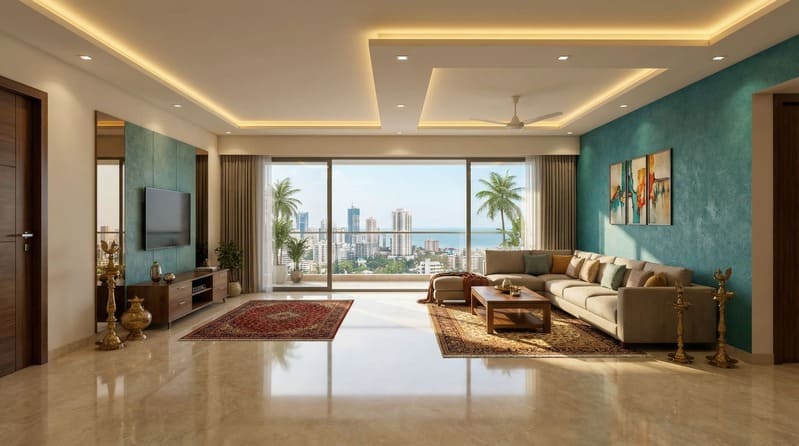
Getting an interior design quote in Navi Mumbai without a clear grip on what drives the cost is how homeowners end up signing contracts that balloon by 30% halfway through the project. This guide breaks down what actually moves the number: scope, material specifications, and who you hire, so you can read any quote you receive and know whether it is complete.
A note on the figures below: these are indicative planning ranges built from current published pricing by modular furniture brands, hardware manufacturers, and contractor rate cards available publicly as of September 2026, not a proprietary survey of local contractors. Treat every number here as a starting point for your own quote comparison, not a quotation. Actual project cost depends on your flat’s condition, the specifications you choose, and the vendor you hire.
Quick Answer
A full interior fit-out (modular kitchen, wardrobes, false ceiling, painting, and basic electricals) for a 2BHK in Navi Mumbai typically runs ₹4 Lakhs to ₹12 Lakhs, and for a 3BHK ₹6 Lakhs to ₹18 Lakhs, depending on the specification level (laminate vs. acrylic finishes, standard vs. branded hardware) and how much civil or electrical work is involved. Soft furnishings, appliances, and false ceiling upgrades beyond the basics are usually quoted separately. The only way to get an accurate number for your flat is a written quote against a defined scope, which is exactly what Section 2 below helps you request.
1. What Determines Interior Cost?
Two quotes for the same flat size can differ by lakhs, and it is rarely because one contractor is dishonest. The gap usually comes from these variables:
- Material and finish: laminate, acrylic, glass, or Duco/PU paint finishes on modular units carry very different per square foot rates, covered in Sections 4 and 5.
- Hardware brand: basic domestic hinges and channels cost less than branded soft close systems (Hettich, Blum, Hafele). Hardware alone can shift a kitchen or wardrobe quote by 20 to 40%.
- Scope of civil and electrical work: if your flat needs walls broken, plumbing points moved, or extra electrical points added, this adds cost that has nothing to do with furniture.
- Who executes the work: an independent contractor, a freelance designer, or a turnkey brand each price and structure their services differently. Section 8 compares them without ranking one as universally better.
- Site condition: an older building may need more prep work (uneven walls, outdated wiring) than a newer one, which adds labor time regardless of the design you choose.
Because these variables compound, a single “cost per sq. ft. for Navi Mumbai” figure cannot capture your actual project. The sections below break the number down by component so you can build your own estimate.
2. What Should an Interior Quote Include?
Before comparing prices, make sure you are comparing the same scope. A quote that looks cheaper often simply excludes items another quote includes. At minimum, ask every vendor to itemise:
| Scope Item | Ask the Vendor to Specify |
|---|---|
| Modular kitchen | Carcass material, shutter finish, hardware brand, number of running feet |
| Wardrobes | Measurement basis (per sq. ft. of shutter area or per running foot), finish, loft included or separate |
| False ceiling | Which rooms, plain or designer, running feet of gypsum board and framing |
| Painting | Brand and product line, number of coats, putty and primer included or extra |
| Electrical work | Number of new points, wiring included or only fixtures |
| Civil work | Any wall breaking, plumbing relocation, or flooring work, priced separately from furniture |
| Design and project management fee | Flat fee, percentage of project value, or bundled into unit rates |
A quote that skips several of these rows is not necessarily dishonest, but it is incomplete, and incomplete quotes are the most common source of budget overruns. Section 13 gives you a worksheet to compare multiple quotes on this exact basis.
3. How to Build a Budget for a 1, 2 or 3 BHK
Rather than one number per BHK size, it helps to think in scope tiers. The same 2BHK can reasonably cost ₹4 Lakhs or ₹14 Lakhs depending on which of these you choose:
- Essentials scope: modular kitchen, wardrobes in bedrooms, basic false ceiling in the living room, and painting. No structural or major electrical changes. This is the scope most first-time buyers start with.
- Standard scope: everything in Essentials plus a designer false ceiling across more rooms, upgraded hardware, TV unit, and additional storage units (shoe rack, crockery unit).
- Extended scope: everything in Standard plus higher-end finishes (acrylic, veneer, Duco), customised furniture pieces, and more extensive lighting and electrical work.
A 3BHK scales up mainly because there are more rooms to fit out, not because the per-room rate changes dramatically. The extra bedroom (often converted into a study or guest room) and the additional bathroom are usually where a 3BHK budget grows fastest relative to a 2BHK, since each adds its own wardrobe, ceiling, and fixture costs.
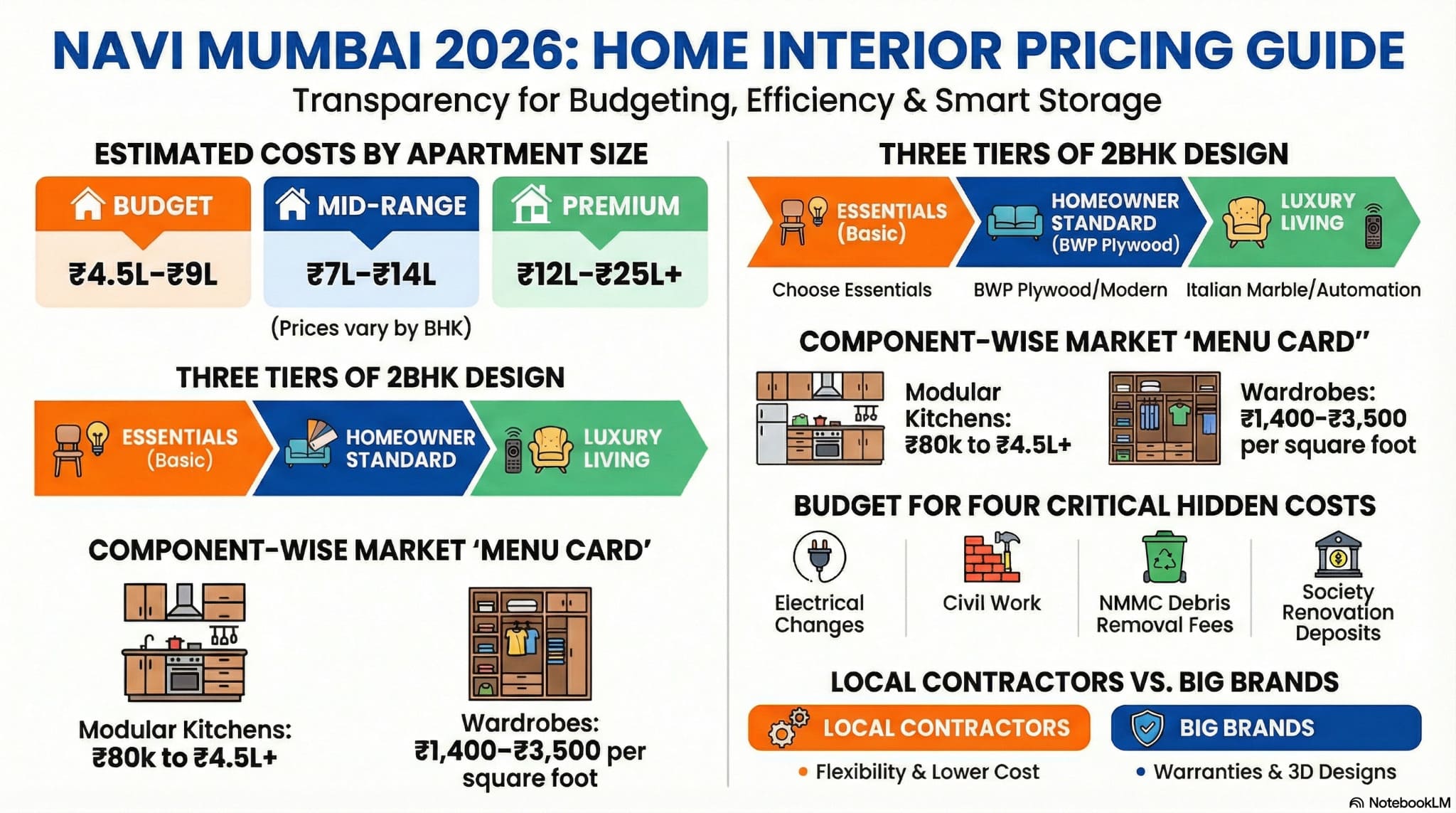
Use the Essentials/Standard/Extended framing to tell a vendor which tier you want priced, rather than asking for “a 2BHK interior quote,” which leaves too much room for the vendor to guess your expectations.
4. Modular Kitchen Costs
Kitchen pricing is usually quoted per running foot of shutter area, and the finish is what moves the number most:
- Laminate finish: generally the most economical option, suited to a straightforward L-shaped or straight-line kitchen layout.
- Acrylic or high-gloss finish: mid to upper range, chosen mainly for the glossy look, at a meaningfully higher per foot cost than laminate.
- Duco or PU paint finish: the most premium option, priced highest due to the spray-paint process and finish quality.
On top of the shutter finish, hardware (hinges, drawer channels, basket systems) is a separate line item. A basic domestic hardware set costs meaningfully less than a branded soft-close system, and this difference alone can shift a full kitchen quote by tens of thousands of rupees. Always ask which hardware brand is included by name, not just “branded hardware,” since that phrase covers a wide price range.
5. Wardrobes & Storage
Wardrobe pricing is where measurement basis confusion causes the most disputes. Vendors quote either:
- Per sq. ft. of shutter area (the visible front face of the wardrobe), or
- Per running foot (a flat rate per foot of width, regardless of height).
These two methods are not interchangeable, and a rate that looks lower under one method can work out more expensive under the other once height and internal fittings are factored in. Always ask which basis a quote uses, and ask for the total wardrobe cost in rupees, not just the rate, before comparing across vendors.
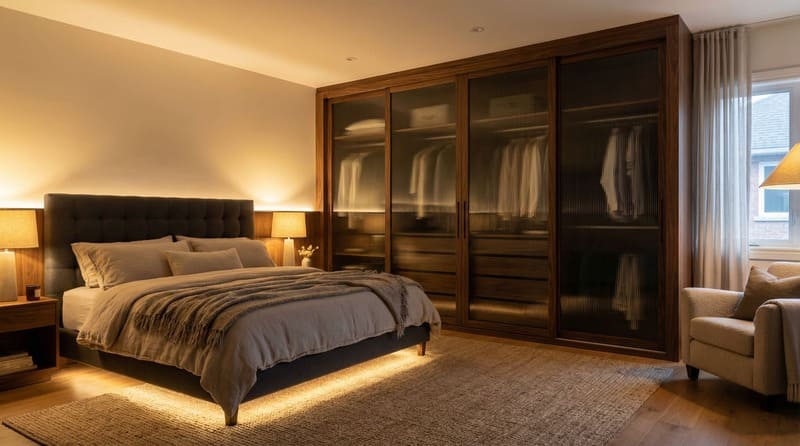
On material, BIS-certified BWP (Boiling Water Proof) grade plywood is a genuinely relevant specification for a coastal, humid city like Navi Mumbai, since it resists moisture better than lower grades. That said, plywood grade is one factor among several (edge banding quality, hardware, installation) that determine how a wardrobe performs over time, not a standalone guarantee of durability. Ask which grade of ply is used and request the BIS certification mark rather than accepting “marine ply” as a description on its own, since the term gets used loosely in the market.
6. Furniture, False Ceiling & Lighting
False ceilings in Navi Mumbai apartments are optional, not mandatory, but many homeowners choose one for the living room to conceal wiring for fans and lights, and for some cosmetic and thermal benefit on top floor units. A basic peripheral false ceiling is priced by running foot of gypsum board and framing; a full-room or multi-tier designer ceiling costs more due to the additional material and labor. Loose furniture (sofas, dining tables, beds) and light fixtures are typically outside the interior contractor’s scope and purchased separately, which is worth confirming upfront so it does not come as a surprise later.
7. Civil, Electrical & Plumbing Work
Any work that touches the building’s structure or utility lines sits outside standard furniture and finishing quotes, and is priced separately:
- Electrical changes: adding or relocating switch points and wiring for new fixtures is charged per point.
- Civil work: breaking or altering a wall, such as to open up a kitchen into a living area, involves structural considerations. This guide does not provide structural engineering advice. Any wall alteration should be reviewed by a qualified structural engineer or the society’s appointed civil consultant before work begins, particularly in older buildings.
- Plumbing relocation: moving a sink or fixture point is priced by the plumber separately from the furniture contractor.
If your project involves any of the above, get a separate written estimate for this portion specifically, since it is easy for a general “interior quote” to either omit it entirely or bundle it in a way that is hard to audit later.
8. Contractor vs. Designer vs. Turnkey Brand
None of these three routes is universally better. Each suits a different kind of homeowner and project:
| Independent Contractor | Freelance Interior Designer | Turnkey Brand | |
|---|---|---|---|
| Design input | Minimal, usually executes what you specify | Full design service, often for a separate fee | In-house 3D design included in the package |
| Customisation | High, negotiated directly | High, designer coordinates with contractors | Lower, modules are often standardised |
| Price structure | Usually the most negotiable | Design fee plus execution cost | Package pricing, often with less room to negotiate |
| Accountability | Depends entirely on the individual’s reputation and your own oversight | Designer is accountable for coordination and quality checks | Company processes and formal warranty documentation |
| Timeline predictability | Varies by contractor | Varies, designer manages multiple vendors | Generally more standardised, but confirm what the timeline actually covers (see Section 11) |
GST treatment also differs by vendor type and depends on how the specific business is registered and how it structures the bill (materials versus labour, for instance), not on whether it is a “local contractor” or a “big brand.” Ask any vendor, regardless of type, for a bill that clearly states whether GST applies and at what rate, and treat a vendor’s claim about GST with the same scrutiny as any other line item, rather than assuming a blanket rule applies to their category.
9. Costs That May Sit Outside the Quote
Overruns happen most often not because a vendor lied, but because a scope item was never priced in the first place. Before you sign, check whether your quote actually covers each of these, since they are commonly left out:
- Electrical changes beyond the original plan: if you add a switch point or move one after work has started, this is billed separately.
- Civil work: breaking a wall or altering layout, priced by the civil contractor, not the furniture vendor.
- Debris removal: Navi Mumbai has NMMC rules around construction debris disposal, and hauling it away is often a separate cost that some quotes omit.
- Society charges: many societies levy a refundable renovation deposit and sometimes a separate lift usage or entry charge, which is between you and the society, not the interior vendor.
- Soft furnishings and appliances: curtains, sofas, and kitchen appliances are almost always outside a modular interior quote unless explicitly listed.
There is no reliable universal percentage to budget for these as a buffer, since how many of them apply depends entirely on your specific project and building. The safer approach is to explicitly ask which of the five items above are included in your quote and get written confirmation either way, rather than assuming a fixed markup will cover whatever is missing.
10. Check Your Society’s Renovation Rules First
Before finalising any scope that involves civil or electrical changes, check with your housing society. Renovation deposit amounts, permitted working hours, debris disposal procedures, and whether structural changes need society or NMMC approval vary by building and by society bylaws. There is no single rule that applies across all of Navi Mumbai. Get your society’s process in writing before your contractor starts work, so timelines and costs are not disrupted midway by a permission you did not know you needed.
11. How Long Can Interior Work Take?
Timelines depend on scope, not on which type of vendor you hire. Broadly, the factors that extend a project are:
- Whether civil or plumbing work is involved (this typically adds the most time, since other trades often wait on it to finish).
- How much is custom fabricated on-site versus factory pre-made and simply installed.
- How quickly you finalise design decisions and material selections, since delays in approvals are a common cause of schedule slippage on both ends, contractor and homeowner.
- Site access restrictions from your society (permitted working hours, material delivery windows).
Rather than relying on a universal day count, ask your vendor for a scope-linked timeline: which milestones happen in which order, and what specifically could extend each one. A brand’s marketing claim about delivery speed often refers only to one portion of the work (such as woodwork installation) and not the full project including any civil work, so ask exactly what the quoted timeline covers before treating it as the total project duration.
12. Before You Sign a Turnkey Interior Contract
Whichever vendor type you choose, do not sign until the contract or quote covers each of these in writing:
- Scope: every room and every deliverable listed by name, not a general description like “full interior.”
- Materials and specifications: exact brand and grade for plywood, laminate or finish type, and hardware brand, not generic terms like “branded” or “premium.”
- Quantities and measurement basis: running feet or sq. ft. for every furniture item, clearly stated, so you can verify the final bill against the quote.
- Total price and what it excludes: a single bottom-line figure plus an explicit list of what is not included (civil work, appliances, soft furnishings).
- Payment schedule: a schedule tied to specific, verifiable milestones (material delivery, carcass installation, final handover), not a fixed industry-standard split. There is no single payment percentage split that applies as a rule across vendors, so review whatever schedule your specific vendor proposes on its own merits rather than assuming any particular split is the norm.
- Timeline: a start date, an estimated completion date, and what happens (in terms of compensation or otherwise) if the vendor misses it.
- Changes and variations: how a mid-project change request gets priced and documented, in writing, before the change is made.
- Warranty and defects: what exactly is covered (hardware, against manufacturing defect, against installation fault), for how long, and the process for raising a defect after handover. Warranty terms and lengths vary genuinely by vendor and by component, so get the specific terms in writing rather than accepting a verbal promise of a standard length.
- Handover: a documented handover checklist and a joint walkthrough before you make the final payment.
13. Interior Quote Comparison Worksheet
When you have quotes from more than one vendor, put them side by side using the same categories, since vendors rarely format quotes the same way:
| Item | Vendor A | Vendor B | Vendor C |
|---|---|---|---|
| Kitchen: material, finish, running feet, hardware brand | |||
| Wardrobes: measurement basis, finish, loft included? | |||
| False ceiling: rooms covered, design type | |||
| Painting: brand, coats, putty/primer included? | |||
| Electrical: number of points, wiring included? | |||
| Civil/plumbing work: included or separate? | |||
| Design/project management fee | |||
| Total price | |||
| Payment schedule (milestones) | |||
| Timeline (start to handover) | |||
| Warranty (component and duration) | |||
| GST treatment on the bill |
Fill this in with each vendor’s actual quote before you decide. A vendor that will not answer one of these rows in writing has told you something useful about how the rest of the project is likely to go.
Interior Design Navi Mumbai: FAQs
What is the average interior design cost per sq. ft. in Navi Mumbai?
A: There is no single reliable per sq. ft. figure that applies across specification levels. A basic laminate-finish fit-out and a premium acrylic or Duco fit-out can differ by two to three times per sq. ft. Treat any flat per sq. ft. number you see, including ranges in this guide, as an indicative planning range, not a quotation, and get a written quote against your specific scope (see Section 2).
How much does a modular kitchen cost in Navi Mumbai?
A: It depends on shutter finish and hardware brand, priced per running foot. A laminate finish with standard hardware is at the lower end; acrylic or Duco finishes with branded soft-close hardware sit meaningfully higher. Get a per running foot rate broken down by material and hardware, not a single flat “kitchen price.”
Is local carpentry or factory-made modular furniture better for my home?
A: Neither is universally better. Factory-made modular units use machine-pressed edge banding, which can offer more consistent moisture resistance, relevant in a humid coastal climate. Local carpentry can offer more customisation and sometimes lower cost for simple pieces. Compare the specific material grade, edge treatment, hardware, and warranty offered in each case rather than assuming one method wins by default.
How long does a typical interior project take?
A: It depends heavily on whether civil or plumbing work is involved and how much is custom fabricated versus factory pre-made. Ask your vendor for a scope-linked timeline rather than relying on a generic day count. See Section 11 for what to ask.
Is a false ceiling necessary?
A: No, it is optional. Many homeowners add one in the living room to conceal wiring for fans and lights and for some cosmetic benefit, particularly on top floor units, but it is not a mandatory part of an interior fit-out.
Does GST apply on my interior quote?
A: GST treatment depends on how the specific vendor is registered and how the bill is structured, and there is no single rule that applies to every vendor or every quote. Ask your vendor directly whether and at what rate GST applies to your bill, and get this confirmed in writing rather than assuming a flat rate.
What is the standard payment schedule for an interior project?
A: There is no single industry-standard payment split. Payment schedules vary by vendor and should be tied to verifiable project milestones (material delivery, installation stages, handover) rather than a fixed calendar or a percentage split assumed to be standard. Review whatever schedule your vendor proposes on its own terms.
Do I need society permission for interior work?
A: Possibly, depending on your specific society’s bylaws and the scope of work, particularly for civil or electrical changes. Renovation deposits, working hour restrictions, and approval requirements vary by building. Check with your society before finalising your scope and timeline.
What is BWP grade plywood and does it matter in Navi Mumbai?
A: BWP (Boiling Water Proof) is a plywood grade with high moisture resistance, which is a genuinely relevant specification for a humid, coastal city. It is one factor among several, alongside edge banding quality, hardware, and installation, that determine how furniture performs over time. Ask for the BIS certification mark rather than accepting “marine ply” as a description on its own.
Bottom Line
Interior design cost in Navi Mumbai is driven by scope, specification, and vendor type, not by a single per sq. ft. or per BHK number. The figures in this guide are indicative planning ranges meant to help you sanity-check a quote, not a substitute for one. Before you commit to any vendor, get a written, itemised quote against a defined scope (Section 2), understand the measurement basis for wardrobes and kitchen (Sections 4 and 5), and work through the pre-signing checklist (Section 12) and the comparison worksheet (Section 13) with every quote you receive. That process, more than any number in this article, is what protects your budget.
Sources and Methodology
The cost ranges in this guide are indicative planning ranges compiled from current, publicly available pricing information from modular furniture and hardware brands and published contractor rate structures as of September 2026. They are not the result of a proprietary survey of local contractors, and they should not be read as a quotation for any specific project. Material specifications referenced (including BWP grade plywood and BIS certification) are based on published Bureau of Indian Standards guidance, available at bis.gov.in. GST treatment for goods and services is governed by the Central Board of Indirect Taxes and Customs and depends on vendor registration and billing structure; this guide does not state a single applicable rate. Debris disposal and civil work approvals are subject to Navi Mumbai Municipal Corporation rules, available at nmmc.gov.in. This guide does not provide structural engineering advice; any structural or load-bearing wall alteration should be reviewed by a qualified structural engineer.
Last verified: 13 September 2026. If you have a documented, dated pricing dataset from local Navi Mumbai contractors that you would like reflected here instead of published brand and hardware pricing, let us know and this guide can be rebuilt around it.