
If you buy a flat in a co-operative housing society in Maharashtra, someone will ask for the share certificate. A lender asks for it, the society asks for it, and the seller hands over an old one in a plastic folder. It matters, but it does not mean what many buyers think. A share certificate records a member’s share in the society. It is not a title deed, and holding it does not by itself establish your rights in the flat. This guide explains what to check on the certificate, when it is issued, how a resale transfer works under the housing society provisions of the Maharashtra Co-operative Societies Act, what the society can and cannot charge, and what to do about a lost, damaged or wrong certificate.
It is general information, not legal advice. Housing societies have their own chapter in the Act and their own registered bye-laws, so have a property lawyer read the documents for your own flat.
Last verified: 18 October 2026. Base texts: the housing society chapter inserted into the Maharashtra Co-operative Societies Act, 1960 by the 2019 amendment, the 1961 Rules, and the 2014 model bye-laws for flat owner societies. The model bye-laws predate the 2019 amendment, so a society’s registered bye-laws control. Later notifications and orders must be checked.
Meaning and limits
- What it is: a certificate that records the shares a member holds in the society, in the name or names printed on it.
- What it is not: proof that you own the flat. Section 154B-12 of the Act says a member transfers share, right, title and interest in the society property by a registered document, following the procedure in the rules or bye-laws.
- Not the certificate of allotment either: section 154B-10(2) separately requires a housing society to issue a certificate of allotment, under its seal and signature, to a member to whom a flat has been allotted. Ask which of the two you are being shown.
- What matters in a resale: the seller’s dues to the society are paid and the transferee applies for and acquires membership (section 154B-7). Both are conditions for the transfer of shares and interest to be effective.
A share certificate is not a substitute for the documents establishing your rights in the flat. For a purchase, examine the registered transaction documents and the title history. Inheritance requires separate consideration of succession and testamentary documents. In Suraj Lamp and Industries v State of Haryana the Supreme Court dealt with sales carried out through agreements, powers of attorney and wills in place of a registered conveyance, and held that a sale of immovable property needs a registered deed of conveyance. Our agreement for sale vs sale deed guide explains the documents in a purchase.
Lenders ask for the certificate too. SBI’s NRI home loan page, read on 17 October 2026, lists a share certificate among the property papers, marked as applying in Maharashtra only.
What to check on the certificate
The model bye-laws (bye-law 9(a)) say the certificate shows a distinctive number, the name of the member, the number of shares issued and the value paid. Bye-law 10 says it bears the society’s seal and is signed by the chairman, the secretary and one committee member authorised by the committee. Check these against what you were told, and check the reverse side and any earlier transfer entries as well as the front.
- Do the names match the registered agreement and the seller’s identity papers?
- Are the number of shares and the value paid shown, and do they match the society’s register?
- Are the seal and the signatures there?
- Does the certificate say it is a duplicate? A duplicate should be identified as one.
- Do the earlier transfer entries, if any, run in order up to the seller?
When the certificate is issued
Under bye-law 9(a) of the 2014 model bye-laws, the society issues a share certificate to every member for the shares subscribed, within six months of the allotment of the shares. That period runs from the allotment of the shares, not automatically from the day you buy a resale flat or the day the society is registered. The model puts the face value of a share at Rs 50, with the authorised share capital and number of shares left blank for each society to fill, and Rule 23(2) of the 1961 Rules says the payment required for a share on allotment cannot exceed its face value. Check your society’s registered bye-laws for its own figures.
How a resale transfer works
| Step | What the law and model bye-laws say | What to do |
|---|---|---|
| The conditions for effectiveness | Section 154B-7 of the Act: subject to the Act, no transfer of the share or interest of a member or of the occupancy right, other than to an heir or a nominee, is effective unless the society’s dues are paid and the transferee applies and acquires membership of the society in due course of time | Get a dues statement from the society in writing and make your application for membership at the same time as the transfer |
| How the transfer is made | Section 154B-12: a member may transfer share, right, title and interest in the society property by a registered document, following the due procedure in the rules or bye-laws | Make sure the registered agreement and the society’s transfer papers match |
| Notice and documents | Model bye-law 37: 15 days’ notice to the secretary in the prescribed form with the transferee’s consent, and documents including the share certificate, the transferee’s membership application, the transferor’s resignation, the registered agreement with stamp duty paid and an undertaking to discharge liabilities. Rule 24 of the 1961 Rules also speaks of a clear fifteen days’ written notice | Ask the society for its bye-laws, the prescribed forms and the checklist it uses, and ask which notice period it applies |
| Dues and the society’s charge | Section 154B-14: the society has a charge on the share and interest of a member, a past member or a deceased member to the extent of dues payable to the society | Dues can follow the flat if they are not cleared. Pay nothing in the final instalment until the society has confirmed clearance in writing |
| Leasehold land | Section 154B-7, proviso: a transfer of share or interest in respect of leasehold property is governed by the terms of the lease that are not inconsistent with the lease of the land to the society or the society’s lease to its members | Read the lease. For flats on CIDCO land, see our CIDCO transfer charges guide |
| If the society does not decide | Model bye-law 38: the society should not refuse an application except for non-compliance with the Act, the Rules or the bye-laws, and if its decision is not communicated within three months of receipt the application is deemed accepted and the transferee deemed admitted. Section 154B-9: the Registrar decides a question about a person’s membership within three months of an application | Apply in writing, keep proof of receipt and note the dates |
What about the one-year holding rule? Many guides say a member cannot transfer a share until it has been held for a year, citing section 29(2) of the Act. Section 154B(2), which lists the provisions of the Act that do not apply to housing societies, includes section 29. The 2014 model bye-laws predate the 2019 amendment and still refer to section 29(2), so do not rely on either text without checking the society’s registered bye-laws. Do not assume that every immediate resale is allowed, either. A lease, a lender’s terms, a builder’s agreement or an order may set its own conditions, so have a lawyer check the transaction.
Fees, premium and permissions
Societies often charge more than one amount when a flat changes hands, and the amounts are different payments. The model bye-laws (bye-law 37(e)) are a reference, not an invoice. Ask the society which of its registered bye-laws and which government order each demand rests on.
| Payment | How to treat it |
|---|---|
| Share capital | The value of the shares, separate from every transfer charge. Model bye-law 8 puts a share at Rs 50, and Rule 23(3) of the 1961 Rules says a transferee admitted as a member is not required to pay more than the value of the share worked out under Rule 23(1) |
| Transfer fee | Model bye-law 37(e)(vii) lists a transfer fee of Rs 500. Check the amount in your society’s registered bye-laws |
| Entrance fee | Model bye-law 37(e)(viii) lists an entrance fee of Rs 100, payable by the proposed transferee. Check your society’s bye-laws |
| Transfer premium | Model bye-law 37(e)(ix) says the premium is fixed by the general body within the limits in the circular issued from time to time by the Department of Co-operation, and that no additional donation or contribution to any other fund can be recovered from the transferor or transferee. It does not apply to transfers to a family member, a nominee or an heir, or to an exchange of flats. The limit changes with the circular in force, so this page gives no figure. Ask the society which order it relies on and read that order |
| Duplicate share certificate | Model bye-law 170 lists Rs 100 for a duplicate share certificate in its schedule of copying charges. Check your society’s bye-laws |
| CIDCO charges | Separate from anything the society charges. See our CIDCO transfer charges guide |
| Other demands | Ask for an itemised written basis in the bye-laws or an order, and a receipt for every amount |
Society NOC and other permissions are different things. Model bye-law 37(d) says the society’s no objection certificate is not required to transfer the shares and interest, though if the transferor or transferee asks for one, the committee considers the request on merit within one month. Separately, bye-law 37(e)(x) lists any no objection certificate required under any law or by the government, a financing agency or another authority. Keep these apart in your own checklist: the society’s membership and transfer formalities, your lender’s documents, any CIDCO or other lease permission, and the confirmation of dues.
Lost, damaged or incorrect certificates
- Lost: under model bye-law 9(b) the committee issues a duplicate certificate, marked as a duplicate, on application with a copy of the police complaint and an affidavit.
- Soiled, burnt, torn or disfigured: the same bye-law asks for an affidavit.
- A duplicate is identified as one. Do not accept one that is not, and do not rely on a photocopy as the certificate.
- Wrong spelling or a mismatch with the register: make a written request to the society with supporting documents, ask for a corrected or endorsed certificate and for the register entry, and keep the receipt. Do not alter the certificate by hand yourself.
The model bye-laws ask for a police complaint copy and an affidavit for a lost certificate, and do not list a newspaper notice or an indemnity bond for it. Ask the society whether its registered bye-laws add either, and what it charges for the duplicate.
Joint, associate and provisional members, nomination and succession
The names on the certificate affect who can vote, but they do not settle ownership shares. Section 154B-4 lets a housing society admit an associate, joint or provisional member, and section 154B-11 sets out the voting rules:
- Joint members: the person whose name stands first in the share certificate has the right to vote. In that person’s absence the person whose name stands second does, and so on, among those present who are not minors (section 154B-11(4)).
- Associate members: an associate member has the right to vote with the prior written consent of a member (section 154B-11(2)), and the right to contest the committee election with the prior written consent of a member (section 154B-10(6)).
- Provisional members: a provisional member has the right to vote (section 154B-11(3)).
- Defaulters: a member who is a defaulter of the society is not eligible for a committee seat (section 154B-10(4)).
Section 154B-13 deals with a member’s death. The society transfers the share, right, title and interest to a person or persons on the basis of testamentary documents, a succession certificate, a legal heirship certificate or a family arrangement document executed by those entitled to inherit, or to a duly nominated person. A nominee is admitted as a provisional member until the legal heir or the person entitled under the succession law or a will is admitted, and if there is no nomination the society admits the apparent heir or legal representative as a provisional member in the manner prescribed. Section 154B-13 speaks of a person nominated in accordance with the rules, and Rule 25 of the 1961 Rules describes how a nomination is made and revoked. Check the form your society uses.
| Situation | What to understand |
|---|---|
| The member has made a nomination | The society records it and, on the member’s death, admits the nominee as a provisional member. Make the nomination in the form and manner the society’s rules and bye-laws require |
| The member dies | Provisional membership is different from final entitlement. The society then admits the person entitled under the succession law or a will in place of the deceased member |
| Several people claim the flat | The society’s records do not settle a dispute between heirs. That needs the succession documents and, if the claims conflict, legal advice |
| You are buying from an heir | Examine the succession documents independently. A share certificate in the heir’s name, or a provisional membership, is not enough on its own |
If the society delays or refuses
- Apply in writing, with the documents the bye-laws list, and keep a receipt with the date.
- Ask for any refusal or objection in writing with its legal or bye-law basis. Model bye-law 38 says a society should refuse only for non-compliance with the Act, the Rules, the bye-laws or a government order.
- A member can ask in writing to inspect records free of cost, and to receive copies on payment of the fee decided by the Registrar, within 45 days of the payment (section 154B-8).
- A question about whether someone has been duly admitted as a member goes to the Registrar, who decides it within three months of the application (section 154B-9).
Buyer checklist
- See the original certificate and compare the names, the share details and the seal and signatures with the registered agreement, the seller’s papers and the society’s register.
- Read the reverse side and any earlier transfer entries.
- Ask the society to confirm in writing who is recorded as the member and what dues are outstanding.
- Obtain confirmation that membership and the transfer have been recorded, and collect the appropriately updated or endorsed share certificate. Where a replacement is issued, confirm how the earlier certificate has been accounted for.
- Ask for the society’s registered bye-laws, its prescribed forms and an itemised list of what it will charge, with the basis of each item.
- If the flat is on CIDCO land, ask which lease, transfer and mortgage documents apply. See our CIDCO transfer charges guide.
- Check that the society itself is registered and its records are kept up to date. See our housing society registration guide.
- Read the rest of our flat buying checklist and our stamp duty guide for the other documents and costs, and our Index II guide and encumbrance certificate guide for the record searches.
Frequently Asked Questions
Is a society share certificate proof that I own the flat?
No. It records a member’s share in the society. Section 154B-12 of the Act says a member transfers share, right, title and interest in the society property by a registered document, and a purchase needs the registered transaction documents and the title history examined. Treat the certificate as one document in the set.
Does a one-year holding rule apply to the resale of a housing society flat?
Do not assume so. The one-year rule is in section 29(2) of the Act, and section 154B(2) lists section 29 among the provisions that do not apply to housing societies. The 2014 model bye-laws still mention section 29(2), so check the society’s registered bye-laws, and have a lawyer check any lease, lender or builder conditions on the transfer.
What must happen for the transfer to be effective in a resale?
Under section 154B-7, the society’s dues must be paid and the transferee must apply for and acquire membership of the society. The transfer is made by a registered document, following the procedure in the rules or bye-laws (section 154B-12). Where the land is leasehold, the terms of the lease also govern.
How do joint members vote?
Under section 154B-11(4), the person whose name stands first in the share certificate has the right to vote. If that person is absent, the person whose name stands second does, and so on, among those present who are not minors. The order of names does not decide ownership shares.
Can an associate member vote or contest a committee election?
With the prior written consent of a member. Section 154B-11(2) gives an associate member the right to vote with that consent, and section 154B-10(6) gives the right to contest the committee election with prior written consent.
What if my share certificate is lost or damaged?
Under model bye-law 9(b) the committee issues a duplicate, marked as a duplicate, on application with a copy of the police complaint and an affidavit for a lost certificate, or an affidavit for one that is soiled, burnt, torn or disfigured. The model lists Rs 100 for the duplicate. Ask the society which requirements and charge its registered bye-laws apply.
Is there a government cap on the society transfer fee and premium?
The model bye-laws list a transfer fee of Rs 500 and an entrance fee of Rs 100, and say the transfer premium is fixed by the general body within the limits in a circular of the Department of Co-operation. That limit changes with the circular in force, so this page gives no figure. Ask the society for the bye-law and the order it relies on.
Should I nominate someone for my share and flat?
Yes. Section 154B-13 provides for a nominee to be admitted as a provisional member after a member’s death, and Rule 25 of the 1961 Rules describes how to make a nomination. A nomination does not settle entitlement between heirs, so take legal advice on a will as well.
Sources and verification date
| Source | Purpose |
|---|---|
| Housing society chapter, section 154B onwards, inserted by the Maharashtra Co-operative Societies (Amendment) Act, 2019 | Which sections apply to housing societies, membership, transfers, voting and succession (sections 154B(2), 154B-4, 154B-7 to 154B-14) |
| Maharashtra Co-operative Societies Rules, 1961 as hosted by the Cooperation Department | Procedure: Rules 23, 24 and 25 |
| The society’s own registered bye-laws | What your society actually requires. These control over a model |
| 2014 model bye-laws for flat owner housing societies on the Registrar’s website | Reference provisions, clearly labelled as a model that predates the 2019 amendment: bye-laws 8, 9, 10, 37 and 38 |
| Government orders and circulars of the Department of Co-operation | Limits on the transfer premium. Read the order the society cites |
Draft documents are not law. The Cooperation Department’s Acts and Rules page lists, among other items, a 2026 draft of revised model bye-laws for tenant co-partnership housing societies and a January 2026 notice inviting objections to proposed draft amendments to the Act under the Maharashtra Jan Vishwas Bill. Neither replaces a society’s registered bye-laws unless and until it is adopted. Check whether any change has been enacted before relying on this page. Section references above follow the English text of the 2019 amendment Act as hosted by the Cooperation Department. The Act’s consolidated PDF on that site is in Marathi, so check it, or ask a lawyer, for any later amendment to the housing chapter. A review by a Maharashtra co-operative housing practitioner would strengthen this page.
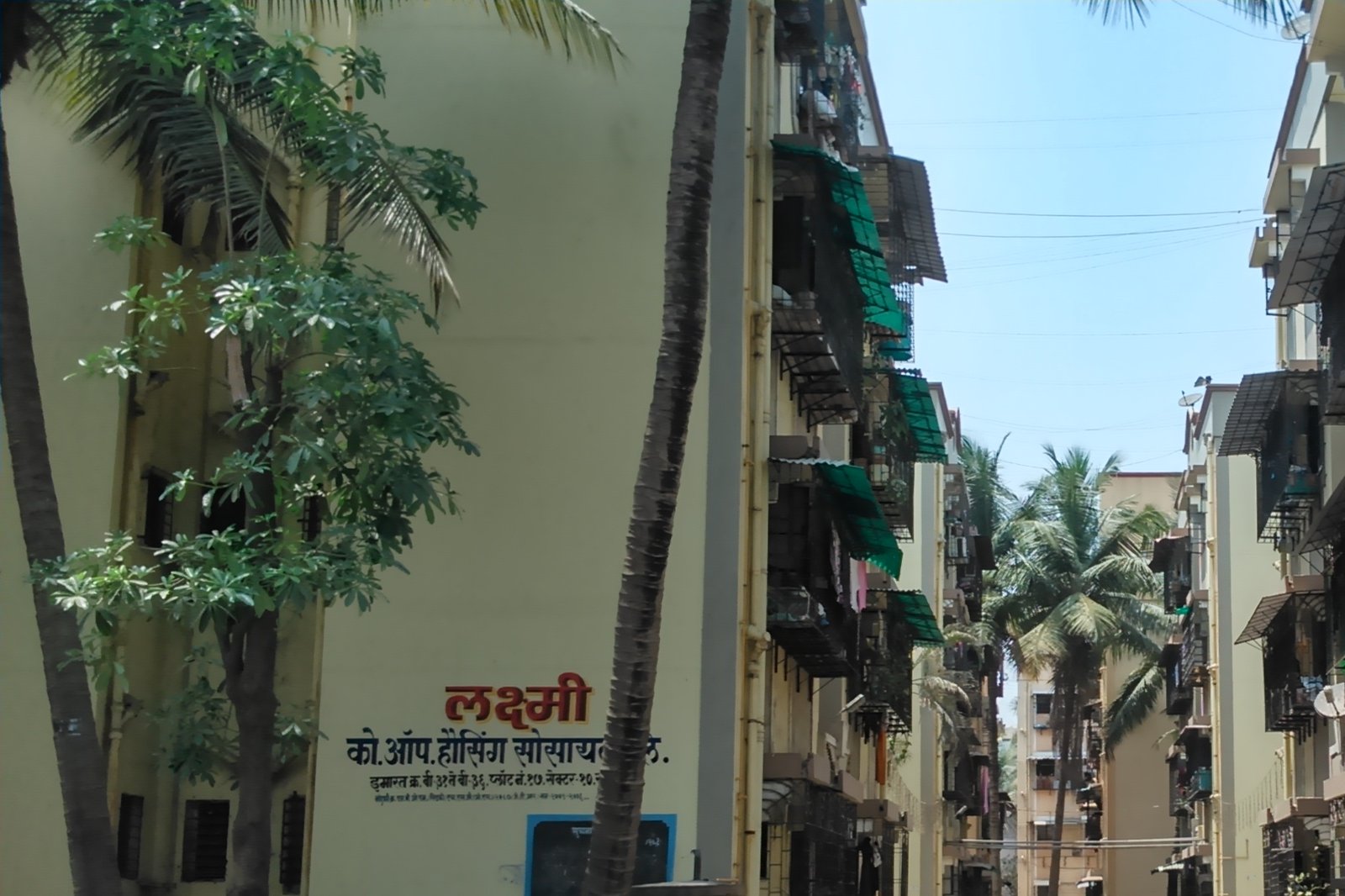
Featured photo: housing society building and name board in Sector 10, Sanpada by Prashant Gaikwad, licensed CC BY-SA 3.0 via Wikimedia Commons, cropped and resized. It is an illustration and does not relate to any transaction described here.
NaviMumbai.com is an independent information site and is not a law firm or a co-operative department.