The Unified Development Control and Promotion Regulations, called the UDCPR, are the state rulebook that decides what can be built on a plot in most of Maharashtra. In Navi Mumbai they sit behind almost every question a buyer, a landowner or a housing society asks about floor space, setbacks, parking, height, zones and redevelopment. The compilation runs to about 570 pages, and the rulebook does not apply the same way across the whole city. This page explains where it applies, how its chapters map to the questions people ask, and what to gather before you check a claim about one particular plot. Each topic links to our detailed guide.
It is general information, not planning or legal advice. It does not tell you the permitted FSI, setbacks or use of any particular plot. That comes from the plot’s planning authority and its records.
Base text reviewed: UDCPR compilation updated to 30 January 2025. Article reviewed: 17 October 2026. Later notifications, directions and relevant court orders must be checked for the specific provision and jurisdiction.
Does UDCPR apply in Navi Mumbai?
- What it is: the state government sanctioned the UDCPR under Section 37(1AA)(c) and Section 20(4) of the Maharashtra Regional and Town Planning Act, 1966, by a notification of 2 December 2020.
- Where it applies: to building activities and development works on lands within all planning authorities and regional plan areas, except the listed exceptions. NAINA is one of the exceptions.
- Navi Mumbai: Chapter 10 has its own sections for the Navi Mumbai Municipal Corporation area, for the CIDCO area excluding NAINA, and for CIDCO and Panvel Municipal Corporation areas.
- Which version: the rules have been amended many times since 2020. Check which provisions apply to your plot before relying on a number from a brochure, a website or a guide, including ours.
These points come from the regulations themselves, in the official compilation (PDF, about 40 MB) hosted by Panvel Municipal Corporation. See Regulation 1.1 on extent and jurisdiction.
Where the UDCPR applies in and around Navi Mumbai
Regulation 1.1(i) says the regulations apply to all planning authorities and regional plan areas in Maharashtra except the Municipal Corporation of Greater Mumbai, other authorities within its limits, MIDC, NAINA, the Jawaharlal Nehru Port Trust, hill station municipal councils, notified eco-sensitive regions and Lonavala. Regulation 1.1(ii) adds that the regulations also apply to a town planning scheme area, without barring development permission under the scheme’s own regulations.
| Area or situation | What the UDCPR says | What to do |
|---|---|---|
| Navi Mumbai Municipal Corporation area | Chapter 10 has a section for the Navi Mumbai Municipal Corporation, Regulation 10.10 (printed page 192) | Read it with the general chapters below |
| CIDCO area, excluding NAINA | Regulation 10.14 (printed page 202). Regulation 10.14.1 makes Regulations 10.10.1 to 10.10.6 applicable to the CIDCO area | Read 10.10 as it applies to the CIDCO area, with the general chapters |
| CIDCO area within Panvel Municipal Corporation | Regulation 10.14A.1 (printed page 204) makes Regulations 10.10.1, 10.10.2, 10.10.3, 10.10.5 and 10.10.6 applicable | Read those provisions with the other rules for the plot |
| Panvel Municipal Corporation, TDR provision | Regulation 10.16 (printed page 204) is a specific provision. It allows 75% of the permissible TDR component to be used on payment of a premium at 60% of the land rate in the Annual Statement of Rates, with the balance 25% used as TDR. It applies only until the Development Plan of Panvel Municipal Corporation is sanctioned. It does not replace the general regulations | Read its conditions alongside the other provisions for the plot. See our TDR guide |
| A town planning scheme in an area governed by the UDCPR | Regulation 1.1(ii) applies the UDCPR to the scheme area while allowing permission under the scheme’s own regulations | Read it alongside the scheme regulations and permissions |
| A town planning scheme within NAINA | NAINA is listed among the exceptions in Regulation 1.1(i). CIDCO acts as the planning authority for NAINA and publishes the sanctioned NAINA regulations separately | Check NAINA’s sanctioned regulations and the scheme documents. See our NAINA guide, NAINA town planning scheme guide and the CIDCO page for the NAINA regulations |
| MIDC, port and other excluded areas | Named in the exceptions in Regulation 1.1(i) | Check the rules of the authority that governs the land |
Regulation 10.16 is narrow. Reports of a Bombay High Court judgment say the court rejected a challenge to the notification that introduced it, in February 2026, so read the report and the judgment itself, and check whether any appeal is pending. For a plot inside NAINA, the UDCPR is not the rulebook. Our NAINA land buying checks explains what to check there.
Which chapter answers which question
| Your question | UDCPR chapter | Our guide |
|---|---|---|
| Can I build here, and what permits are needed? | Chapter 2, development permission and commencement certificate, including completion and occupancy certificates (2.9 to 2.11, printed page 37) | Our occupancy certificate guide |
| What can this land be used for? | Chapter 4, land use classification and permissible uses (printed page 59) | Our land use zones guide |
| How far must the building stay from the boundary? | Chapter 6, general building requirements: setbacks, marginal distances, height and permissible FSI (printed page 105) | Our setbacks and margins guide |
| How tall can it be? | Chapter 6, Regulation 6.10 on height of building and 6.11 on exemptions (printed page 122) | Our building height limits guide |
| How much can I build? | Chapter 6, Regulation 6.3 on permissible FSI (printed page 115), and Regulation 3.9 on net plot area and computation of FSI (printed page 56) | Our FSI limits guide |
| Which redevelopment provisions apply to my building? | Check the applicable city specific provisions, including Regulation 10.10.2, which deals with reconstruction or redevelopment of buildings previously constructed by CIDCO in CIDCO and NMMC areas in the cases it lists, and the cross references in 10.14.1 and 10.14A.1. Read them alongside the relevant general provisions, such as Regulation 7.6 (printed page 134) | Our society redevelopment guide |
| How many parking spaces? | Chapter 8, parking, loading and unloading spaces (printed page 145) | Our parking requirements guide |
| How does TDR work? | Chapter 11, Regulation 11.2 on transferable development rights (printed page 219) | Our TDR guide |
| Rules specific to my city | Chapter 10, city specific regulations (printed page 171) | The table above |
Chapter 3 covers general land development requirements, including layouts, recreational open space and amenity space. Chapter 9 sets the requirements of parts of a building, such as plinth, balcony, podium, lift and exits. Chapter 12 covers structural safety, water supply and drainage, and Chapter 13 covers special provisions for certain buildings.
Documents to gather before checking a development claim
| What to establish | Record to request or inspect |
|---|---|
| Exact parcel identity | Survey, Gat or CTS number or plot number, village and the relevant layout details |
| Planning jurisdiction | The planning authority’s records or a written jurisdiction confirmation |
| Permissible land use | The applicable plan extract and a zone confirmation |
| Existing approved construction | Sanctioned plans and permission documents |
| Completion or occupation status | The relevant completion and occupancy records |
| Road and plot constraints | Official road and layout records, and any reservations that apply |
| Proposed development potential | An assessment by the appointed architect or town planner that names the provisions relied on |
For a CIDCO planned plot, ask the authority for its zone confirmation. For NAINA, CIDCO publishes a zone confirmation statement process.
How to check which rules apply to one plot
- Identify the planning authority for the specific parcel from its official records. A Navi Mumbai postal address, a municipal boundary or a CIDCO lease does not by itself settle which authority processes the development proposal. For land within NAINA, check CIDCO’s NAINA planning records. Land in MIDC or port authority areas follows its own rules, because the UDCPR names them as exceptions.
- Do not assign a plot to an authority by neighbourhood. Ask for parcel level evidence.
- Find the zone. The land use zone in the sanctioned development plan decides what is permitted.
- Record the inputs. Note the plot area, the recognised road width, the proposed use, the building height and any congested area classification. Different provisions use different inputs. For parking, check the relevant use category and the parking schedule rather than relying on road width alone.
- Check the version. Ask which notifications, directions and court orders apply to the provision you need.
- Get the answer in writing. For a purchase, a redevelopment or a loan, ask for the authority’s sanctioned plan or written confirmation. A guide, a brochure or an agent’s figure is not a permission.
Existing approval versus proposed development
The sanctioned plan records the development approved for an existing building. Any additional construction or redevelopment proposal must be assessed separately against the applicable regulations, plot conditions and permissions. An existing approval is not automatic permission to use further development potential.
Any relaxation or discretionary approval must have a lawful basis and meet the conditions attached to that power. Where the regulations allow a relaxation, they attach conditions to it, for example a floor below which a margin cannot be reduced. Obtain the written approval and its conditions rather than assuming a rule can be waived.
- The UDCPR does not say whether a seller has good title or whether land can be bought. See our guide to buying land in Navi Mumbai and flat buying checklist.
- It does not apply to NAINA. See the table above.
The official PDF, amendments and verification dates
The compilation is a PDF of about 40 MB, so download it on a good connection. It is updated as on 30 January 2025. Its front pages list 53 numbered notifications, orders, directives and corrigenda, running from the original notification of 2 December 2020 to one dated 27 November 2024. Footnotes in the text show that provisions have been introduced, brought into force and stayed since. For example, a footnote in Chapter 10 records a modification proposed in January 2024 that was brought into force under Section 154 and then stayed by the Urban Development Department on 3 April 2024.
That is why the compilation date and current applicability are different questions. Later notifications may exist that are not in this compilation. Ask the planning authority which provisions it applies, and look for the Urban Development Department’s and Town Planning Department’s later notifications for the specific provision you need. We have not recorded a full amendment review beyond the compilation date.
Frequently Asked Questions
What does UDCPR stand for?
Unified Development Control and Promotion Regulations for Maharashtra State. The state government sanctioned them by a notification of 2 December 2020 under Section 37(1AA)(c) and Section 20(4) of the Maharashtra Regional and Town Planning Act, 1966.
Does UDCPR apply in NMMC, CIDCO and Panvel areas?
In large part, yes. The regulations apply to all planning authorities except the listed exceptions, and Chapter 10 has provisions for the Navi Mumbai Municipal Corporation area, the CIDCO area excluding NAINA, CIDCO areas within Panvel Municipal Corporation, and a specific TDR provision for Panvel Municipal Corporation. Confirm which authority governs your parcel.
Does UDCPR apply to NAINA town planning schemes?
No. NAINA is listed among the exceptions in Regulation 1.1(i), and CIDCO publishes sanctioned NAINA regulations separately. Regulation 1.1(ii), which applies the UDCPR to town planning scheme areas, concerns areas the UDCPR governs. For a scheme in NAINA, check the sanctioned NAINA regulations and the scheme documents.
Where can I download the official UDCPR PDF?
A copy of the compilation updated as on 30 January 2025 is hosted by Panvel Municipal Corporation and linked on this page. The file is about 40 MB. It is the version we reviewed, not necessarily the latest, so check later notifications.
How do I check amendments after the compilation date?
Ask the planning authority which provisions it applies. Then look for later notifications, directions and court orders on the specific provision. The compilation lists 53 numbered entries to 27 November 2024, and later material can exist.
Does my sanctioned plan show all future development potential?
No. The sanctioned plan records the development approved for an existing building. Any additional construction or redevelopment must be assessed separately against the applicable regulations, plot conditions and permissions. An existing approval is not automatic permission to use further development potential.
Which regulations should a Navi Mumbai society check for redevelopment?
Check the applicable city specific provisions, including Regulation 10.10.2 and the cross references in 10.14.1 and 10.14A.1, alongside relevant general provisions such as Regulation 7.6. Which apply depends on who built the building, which authority governs the land and the building’s condition. See our society redevelopment guide.
Does compliance with UDCPR establish clear property title?
No. The UDCPR governs how land can be developed and used. Title, tenure and who may buy are separate questions. See our guide to buying land in Navi Mumbai.
What to read next
- FSI limits in Navi Mumbai: how much floor area a plot can carry.
- Setbacks and margins in Navi Mumbai: how far a building must stay from the boundary.
- Land use zones in Navi Mumbai: what each zone permits.
- TDR in Navi Mumbai: how transferable development rights work.
Sources and method
The regulations: Unified Development Control and Promotion Regulations for Maharashtra State, updated as on 30 January 2025, as hosted by Panvel Municipal Corporation. Sections cited: 1.1, 2.9 to 2.11, 3.9, 6.3, 6.10, 6.11, 7.6, 8.2, 10.10, 10.10.2, 10.14, 10.14.1, 10.14A.1, 10.16 and 11.2, the notification list on the front pages and the footnotes to Chapter 10. NAINA: CIDCO’s page for the NAINA regulations and its zone confirmation page. Printed page numbers are those of the compilation. The state may have amended the regulations since the compilation date, so confirm current provisions with the planning authority.
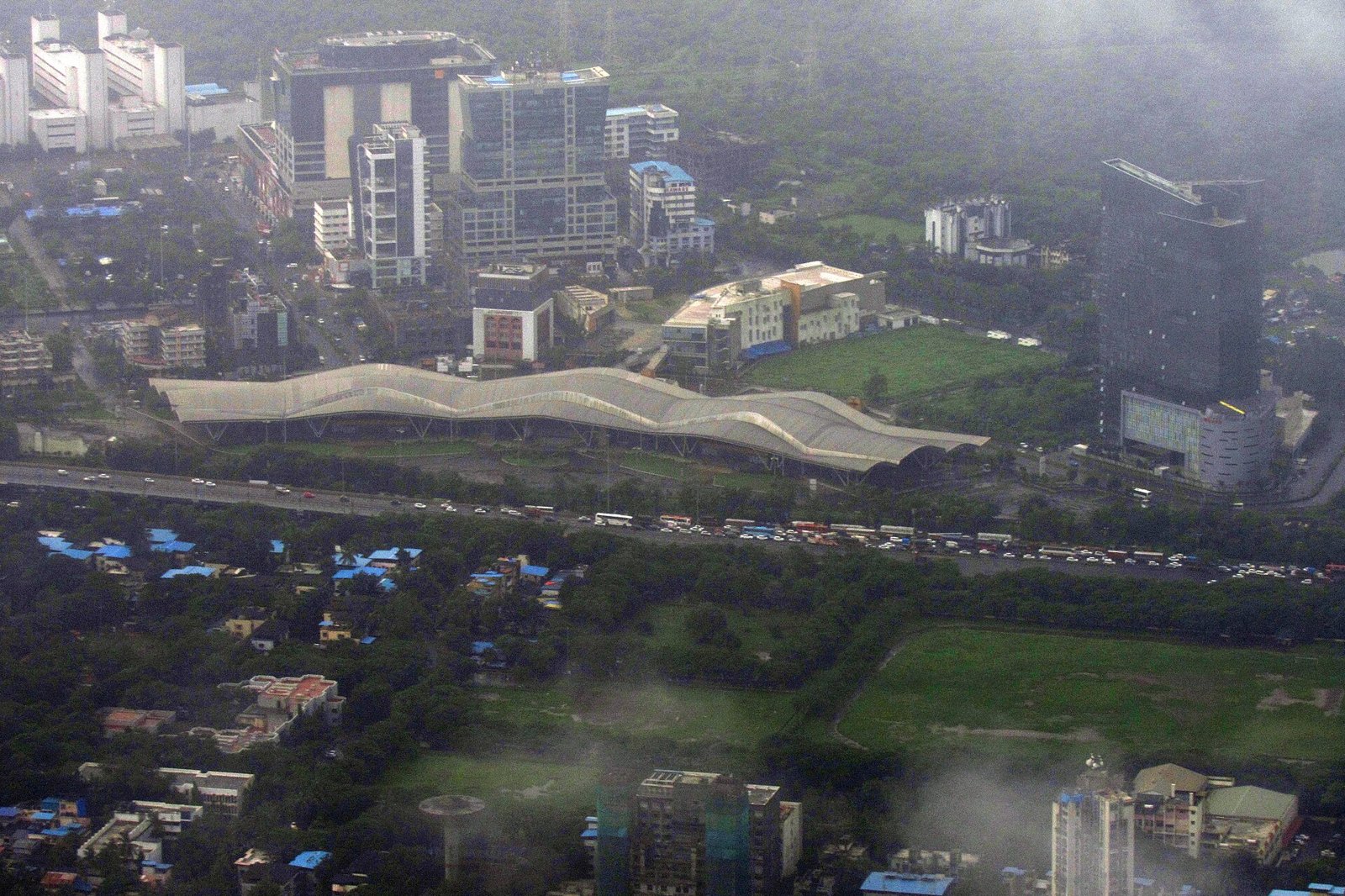
Featured photo: aerial view of the CIDCO Exhibition Centre, Navi Mumbai by Rehman Abubakr, taken on 4 August 2016, licensed CC BY-SA 4.0 via Wikimedia Commons, cropped and resized. It is an illustration and does not show any plot’s approved development.
NaviMumbai.com is an independent information site and is not a planning authority or a law firm.