Wondering what it actually costs to live in Navi Mumbai versus Mumbai? The short answer is: it depends heavily on where in each city you’re comparing. This guide breaks the comparison down by rent, groceries, transport, utilities, dining, schooling and healthcare, with sourced ranges instead of a single headline number.
Quick Answer
Navi Mumbai can be materially cheaper than Mumbai, primarily because of housing. The actual difference depends heavily on which locations you’re comparing — Taloja or Panvel versus Bandra is a very different comparison from Vashi versus a suburban Mumbai locality like Mulund or Chembur. Independent cost-of-living data (Numbeo, July–August 2026) puts overall living costs in Mumbai 25–50% higher than Navi Mumbai depending on whether rent is included, but your own number will come down to where you live, where you work, and how you commute between them.
Navi Mumbai vs Mumbai: Cost of Living at a Glance
| Category | Navi Mumbai | Mumbai |
|---|---|---|
| 1 BHK rent, outside centre | ₹20,000–45,000 (area-dependent) | ₹30,000–1,10,000 in outer suburbs; ₹33,769 city-wide average |
| Groceries, per person/month | ≈₹11,900 | Consistently higher; no single reliable city-wide figure |
| Monthly public transport pass | ≈₹500 | ≈₹525 |
| Basic utilities, ~900 sq ft flat | ≈₹4,600 | ≈₹5,750 |
| Mid-range dinner for two | ≈₹1,400 | ≈₹2,000 |
Source: Numbeo and Wise cost-of-living data, June–August 2026; see Sources & Methodology below. These are city-wide averages, not predictions for any one household. Housing is where the gap is largest and most consistent — everything else narrows the comparison.
Rent — Biggest Cost Difference
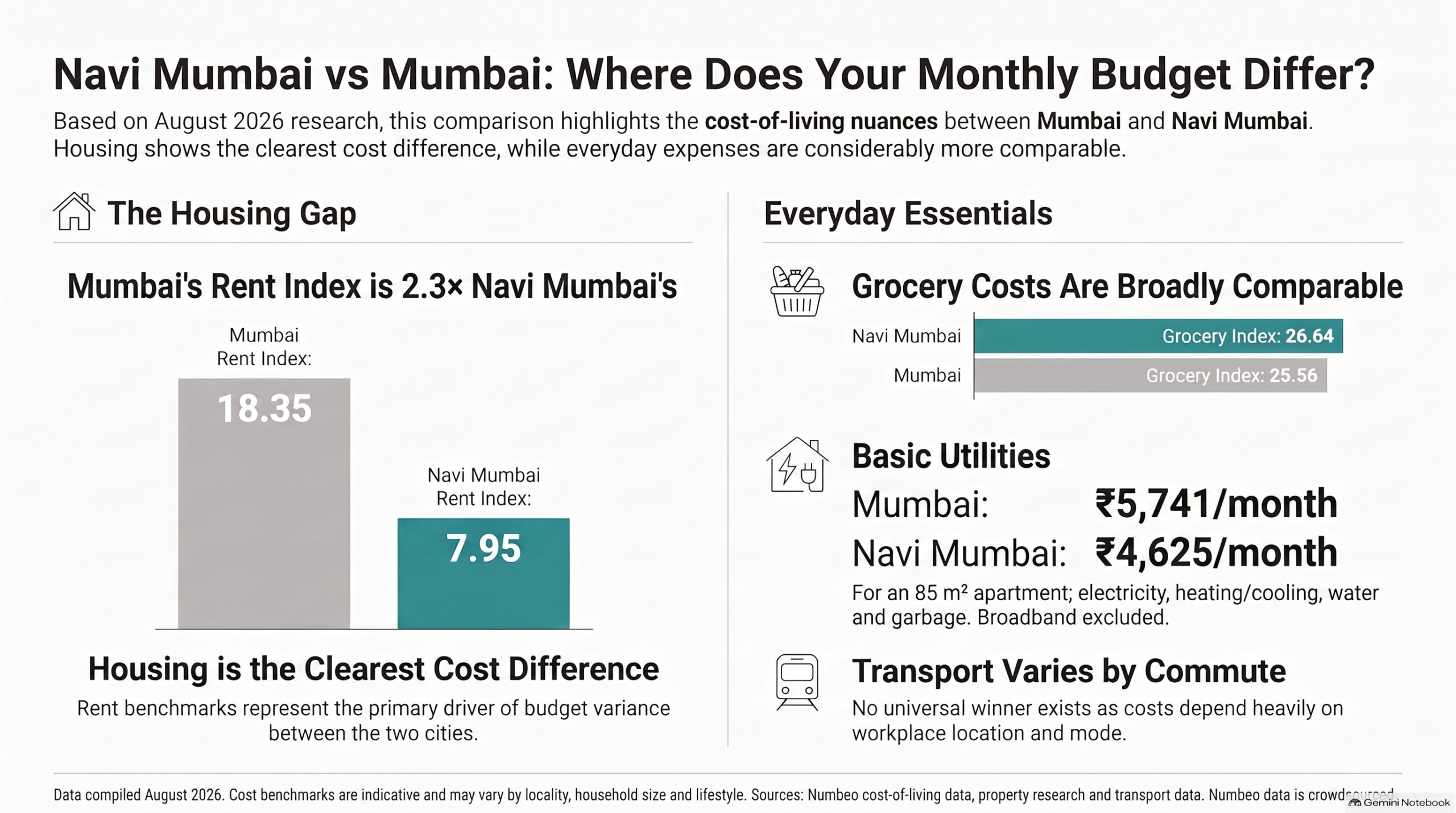
This is where Navi Mumbai’s cost advantage is real and consistent. Citywide, Numbeo’s July 2026 data puts a one-bedroom apartment in Navi Mumbai at roughly ₹27,300 in the centre and ₹20,000 outside the centre, against ₹61,700 and ₹33,800 respectively for Mumbai — but citywide averages hide enormous variation by locality, which is why the area-by-area comparison below matters more than any single number.
Two honest caveats before the table: first, this is contributor-submitted listing data, not an official housing index, so treat it as a benchmark rather than a guarantee. Second, comparing a peripheral Navi Mumbai locality to a premium central Mumbai one (like Bandra) compares two different kinds of markets, not a “saving” — so the table below compares Navi Mumbai localities against Mumbai’s outer suburbs, which are closer in commute profile and building stock.
Area-wise Rent Comparison
Ranges below are current listing ranges (August 2026), not averages — actual rent depends heavily on furnishing, floor, building age, and proximity to the station.
| Navi Mumbai | 1 BHK | 2 BHK |
|---|---|---|
| Vashi | ₹20,000–45,000 | ₹45,000–1,00,000 |
| Nerul | ₹30,000–45,000 | ₹45,000–1,00,000 |
| Kharghar | ₹15,000–40,000 | ₹35,000–1,20,000 |
| Panvel | ₹10,000–28,000 | ₹24,000–35,000 |
| Taloja | ₹10,000–15,000 | ₹15,000–35,000 |
| Mumbai (comparable outer suburbs) | 1 BHK | 2 BHK |
|---|---|---|
| Mulund | ₹30,000–65,000 | ₹35,000–1,10,000 |
| Vikhroli | ₹40,000–65,000 | ₹50,000–1,80,000 |
| Chembur | ₹45,000–65,000 | ₹70,000–1,20,000 |
| Powai | ₹40,000–1,10,000 | ₹70,000–1,60,000 |
Illustrative location comparison — these are not equivalent neighbourhoods in terms of connectivity, social infrastructure, or market positioning; the comparison is directional, not a like-for-like match.
What this actually shows: even against Mumbai’s more affordable outer suburbs, Navi Mumbai’s Panvel and Taloja corridor runs noticeably cheaper, while Vashi, Nerul and Kharghar sit closer to Mumbai’s outer-suburb range than a “30-50% cheaper” framing suggests. The saving is real but concentrated in specific corridors, not a citywide constant.
Groceries & Household Essentials
Rather than claiming category-by-category percentage savings (rice X% cheaper, dal Y% cheaper), it’s worth being direct: grocery prices vary by store, brand, local market, and whether you buy online or offline, in both cities. A same-day basket comparison would be needed to state a reliable percentage difference, and we haven’t run one — so we won’t publish one.
What’s more useful is a realistic monthly grocery budget:
| Household | Indicative monthly range |
|---|---|
| Single | ₹6,000–9,000 |
| Couple | ₹10,000–15,000 |
| Family of four | ₹18,000–25,000 |
Built from Numbeo/Wise’s Navi Mumbai per-person grocery estimate of ≈₹11,900/month, adjusted for household size and shopping habits.
The more important insight: grocery costs matter far less to your total budget than housing or commuting. Even a generous 20% grocery saving in Navi Mumbai is a few thousand rupees a month — a cheaper 1 BHK can be worth ten times that.
Transport & Commuting
Commuting cost depends entirely on your actual pattern, not a single monthly figure that mixes a bus pass, occasional autos, and a full-time cab habit. Here’s a more honest breakdown by commuter type.
Public transport commuter (local train + bus/metro within Navi Mumbai or into Mumbai): NMMT ordinary bus fares run roughly ₹10–25 for intra-city trips; AC Volvo/premium express services cost more — for example, Nerul–Mantralaya runs around ₹230, Kharghar–Mantralaya around ₹270 one-way. See our NMMT Bus Fare Guide for the full route-by-route breakdown. Numbeo puts a generic monthly transport pass at ≈₹500 citywide, though NMMT’s own monthly pass pricing should be confirmed directly at the depot, as it isn’t published in a single consolidated fare card.
Navi Mumbai internal commuter (NMMT + Metro + auto): For trips along the Belapur–Pendhar corridor, current fares and the full station list are covered in our Navi Mumbai Metro Fare Guide — use that for current fares rather than a number repeated here, since metro fares are revised periodically.
Navi Mumbai → Mumbai commuter (train / bus / car / Atal Setu): If you drive across the harbour, the Atal Setu (Mumbai Trans Harbour Link) currently charges ₹250 one-way / ₹375 return for cars, with a 50% concessional discount in effect through 31 December 2026 (rates are due for review after that). Full detail in our Atal Setu Toll Guide. Local trains and buses remain considerably cheaper for this commute but add meaningfully more time.
The honest takeaway: if you work in Navi Mumbai, your commute cost is genuinely lower and simpler than Mumbai’s. If you commute daily into central or western Mumbai, the commute can erase a meaningful share of what you saved on rent — in time as much as money.
Utilities
Utility costs vary substantially with apartment size, electricity provider, AC usage, and season — summer AC load alone can meaningfully move the number either way. Current benchmark data (Numbeo, July–August 2026) puts basic utilities — electricity, cooling/heating, water, garbage — for an ~85 m² (915 sq ft) Navi Mumbai apartment at roughly ₹4,600/month, plus around ₹700 for broadband internet. Mumbai’s equivalent runs somewhat higher, around ₹5,750 plus ₹900 for internet.
Treat ₹4,500–7,000/month as a realistic combined range for electricity, water, internet and mobile for a small family, adjusting up for larger homes or heavy AC use.
Eating Out
Rather than another generic buffet-vs-fine-dining table, here’s what independent data actually shows for Navi Mumbai (Numbeo, July 2026):
| Occasion | Indicative cost |
|---|---|
| Budget/street meal | ₹150–250 |
| Inexpensive sit-down meal | ≈₹200–225 |
| Casual meal for two | ₹800–1,200 |
| Mid-range three-course meal for two | ≈₹1,400 |
Mumbai’s equivalents run higher across the board — Numbeo’s Mumbai data shows an inexpensive meal at ≈₹500 and a mid-range two-person meal at ≈₹2,000 — but the gap narrows sharply at the premium end, where mall and hotel dining in both cities converge on similar pricing.
School & Education Costs
This is where broad percentage claims (“Navi Mumbai schools are 25–40% cheaper”) fall apart on contact with reality — school fees vary enormously by board, school tier, and specific institution, far more than by city.
Schooling in both cities ranges from relatively affordable CBSE/state-board options to premium international schools charging several lakh rupees a year, and the choice of school can move your monthly cost of living more than the choice of city does. Families should budget for education separately from general living costs.
For actual current fee figures by named school, see our dedicated guides: Best Schools in Navi Mumbai: Fees & Admission and International Schools in Navi Mumbai: Real 2026-27 Fees.
Healthcare
Healthcare costs vary considerably by hospital, speciality, procedure, and insurance coverage — more than they vary by city. Navi Mumbai has major private and institutional healthcare providers, with multi-speciality hospitals across Vashi, Nerul, Kharghar, and Panvel, but readers should compare actual consultation and procedure charges directly rather than assume a fixed percentage saving versus Mumbai. For current hospital options and what they offer, see our Best Hospitals in Navi Mumbai 2026 guide.
Entertainment
Kept brief on purpose — this category doesn’t move the needle on total cost of living the way housing does.
- Gym/fitness membership: ≈₹1,000–2,500/month (Numbeo, Navi Mumbai)
- Cinema ticket: ≈₹350–500
- OTT subscriptions: effectively the same nationally, regardless of city
Monthly Budgets
These are illustrative scenarios built from the rent, grocery, transport, and utility ranges above — not a claim that any specific person can “comfortably” live on a fixed number. Actual spending depends on lifestyle, location choice within Navi Mumbai, and how much of your budget goes to eating out versus cooking at home.
Single Professional
| Expense | Budget (Taloja/Panvel, 1 BHK) | Mid-range (Vashi/Nerul/Kharghar, 1 BHK) |
|---|---|---|
| Rent | ₹12,000 | ₹28,000 |
| Food & groceries | ₹6,000 | ₹9,000 |
| Transport | ₹1,500 | ₹2,500 |
| Utilities | ₹3,000 | ₹4,500 |
| Personal/leisure | ₹4,000 | ₹7,000 |
| Total | ≈₹26,500 | ≈₹51,000 |
Couple
| Expense | Budget (Taloja/Panvel, 1 BHK) | Mid-range (Vashi/Nerul/Kharghar, 2 BHK) |
|---|---|---|
| Rent | ₹15,000 | ₹55,000 |
| Food & groceries | ₹12,000 | ₹18,000 |
| Transport | ₹3,000 | ₹5,000 |
| Utilities | ₹4,500 | ₹6,000 |
| Personal/leisure | ₹6,000 | ₹12,000 |
| Total | ≈₹40,500 | ≈₹96,000 |
Family of Four
| Expense | Budget (Panvel/Kharghar, 2 BHK) | Mid-range (Vashi/Nerul, 3 BHK) |
|---|---|---|
| Rent | ₹30,000 | ₹75,000 |
| Food & groceries | ₹20,000 | ₹30,000 |
| Transport | ₹4,000 | ₹7,000 |
| Utilities | ₹6,000 | ₹8,000 |
| Education | ₹8,000 (budget school) | ₹20,000 (mid-tier private) |
| Personal/leisure | ₹8,000 | ₹15,000 |
| Total | ≈₹76,000 | ≈₹1,55,000 |
Where Navi Mumbai Actually Saves You Money
- Housing — usually the biggest and most consistent difference, especially in Panvel and Taloja.
- Daily commute — can be cheaper or more expensive than Mumbai, depending entirely on where you work. If you work in Navi Mumbai, this is a clear saving.
- Food — a smaller difference than housing; grocery costs are broadly comparable once you account for shopping habits.
- Utilities — broadly comparable between the two cities; not a meaningful lever either way.
- Education — depends far more on which school you choose than which city you live in.
When Navi Mumbai May NOT Be Cheaper
- If you commute daily to South, Central, or Western Mumbai. The time and transport cost can offset a large share of what you save on rent — sometimes all of it, once you value your time.
- If you choose premium developments in Vashi, Nerul, or Kharghar. Rents there sit close to Mumbai’s outer-suburb range, not the “30-50% cheaper” framing implies.
- If your children attend a premium international school. Fees at the top end are comparable across both cities.
- If you need specialist medical care. Top-tier procedures and specialists are priced similarly wherever you live in the metro region.
- If your lifestyle centres on premium dining, malls, or entertainment. These converge in price at the upper end in both cities.
Navi Mumbai vs Mumbai: Which Makes Sense for You?
For most households, housing is the biggest reason Navi Mumbai can cost less than Mumbai. But the actual saving depends on where you live, where you work, how you commute, your school choice, and your lifestyle. Someone working in Navi Mumbai may see substantial, durable savings. Someone commuting daily to western or south Mumbai may trade lower rent for higher travel time and transport costs — a trade that doesn’t show up in a simple rent comparison.
Sources & Verification
Updated & verified: August 2026.
Rental ranges were reviewed using current property listings (Square Yards, Rentu.in, and comparable portals) across selected Navi Mumbai and Mumbai localities in August 2026. Transport fares were checked against the relevant operators (NMMT, Navi Mumbai Metro, MSRDC/Atal Setu) and our own dedicated fare guides. Other living-cost ranges — groceries, dining, utilities, entertainment — use Numbeo’s contributor-submitted cost-of-living data for Navi Mumbai and Mumbai (June–August 2026) and Wise’s published cost-of-living breakdown, cross-checked against each other. All figures are indicative: actual household expenditure varies by locality, building, and lifestyle, and none of the ranges here should be read as a guarantee.
Primary Sources
- Numbeo — Cost of Living in Navi Mumbai (accessed August 2026)
- Numbeo — Cost of Living in Mumbai (accessed August 2026)
- Numbeo — Navi Mumbai vs Mumbai comparison (accessed August 2026)
- Wise — Cost of Living in Navi Mumbai (accessed August 2026)
Supporting Sources
- Square Yards — 1 BHK rent listings, Panvel and Panvel property listings (August 2026)
- Rentu.in — Mumbai Rental Rates by Location & BHK (May 2026)
- Free Press Journal — Atal Setu 50% toll concession extended through end of 2026
- Navi Mumbai Blog’s own NMMT Bus Fare Guide, Navi Mumbai Metro Fare Guide, and Atal Setu Toll Guide
Frequently Asked Questions
Is Navi Mumbai really 30–50% cheaper than Mumbai?
Not as a flat rule — that range comes from a single Numbeo city-to-city comparison that shifts as contributor data updates, and it depends heavily on whether rent is included and which specific localities you compare. Housing is where the gap is real and consistent; other categories narrow the difference considerably.
What’s the cheapest area in Navi Mumbai to rent?
Based on current listings, Taloja and Panvel run noticeably cheaper than Vashi, Nerul, or Kharghar — often by half or more for a comparable 1 BHK. See the area-wise table above.
How much should a single person earn to live comfortably in Navi Mumbai?
This depends entirely on lifestyle and location choice rather than a fixed salary figure. Use the monthly budget table above (₹26,500–51,000 depending on area and lifestyle) as a starting point and work backward from your own rent and spending habits.
Is public transport in Navi Mumbai reliable and affordable?
Yes — NMMT buses and Navi Mumbai Metro Line 1 cover most of the city affordably. See our NMMT Bus Fare Guide and Navi Mumbai Metro Fare Guide for current routes and fares.
What’s the monthly budget for a family of four in Navi Mumbai?
Roughly ₹76,000 on a budget scenario in Panvel/Kharghar up to ₹1,55,000 for a mid-range 3 BHK lifestyle in Vashi/Nerul with private schooling — see the family budget table above for the full breakdown.
How does the cost of living in Navi Mumbai compare to Thane?
The two are broadly comparable rather than one being clearly cheaper — some published comparisons suggest Navi Mumbai can run slightly higher on certain measures. We’d rather say that honestly than repeat an unsourced percentage.
How much does healthcare cost in Navi Mumbai?
It varies far more by hospital, specialist, and procedure than by city. Navi Mumbai has established multi-speciality hospitals in Vashi, Nerul, Kharghar, and Panvel — compare actual consultation and procedure charges rather than assuming a fixed saving. See our Best Hospitals in Navi Mumbai guide.
What are the monthly expenses for a couple in Navi Mumbai in 2026?
Roughly ₹40,500 on a budget scenario (1 BHK in Panvel/Taloja) up to ₹96,000 for a mid-range 2 BHK lifestyle in Vashi/Nerul/Kharghar. See the couple budget table above.