
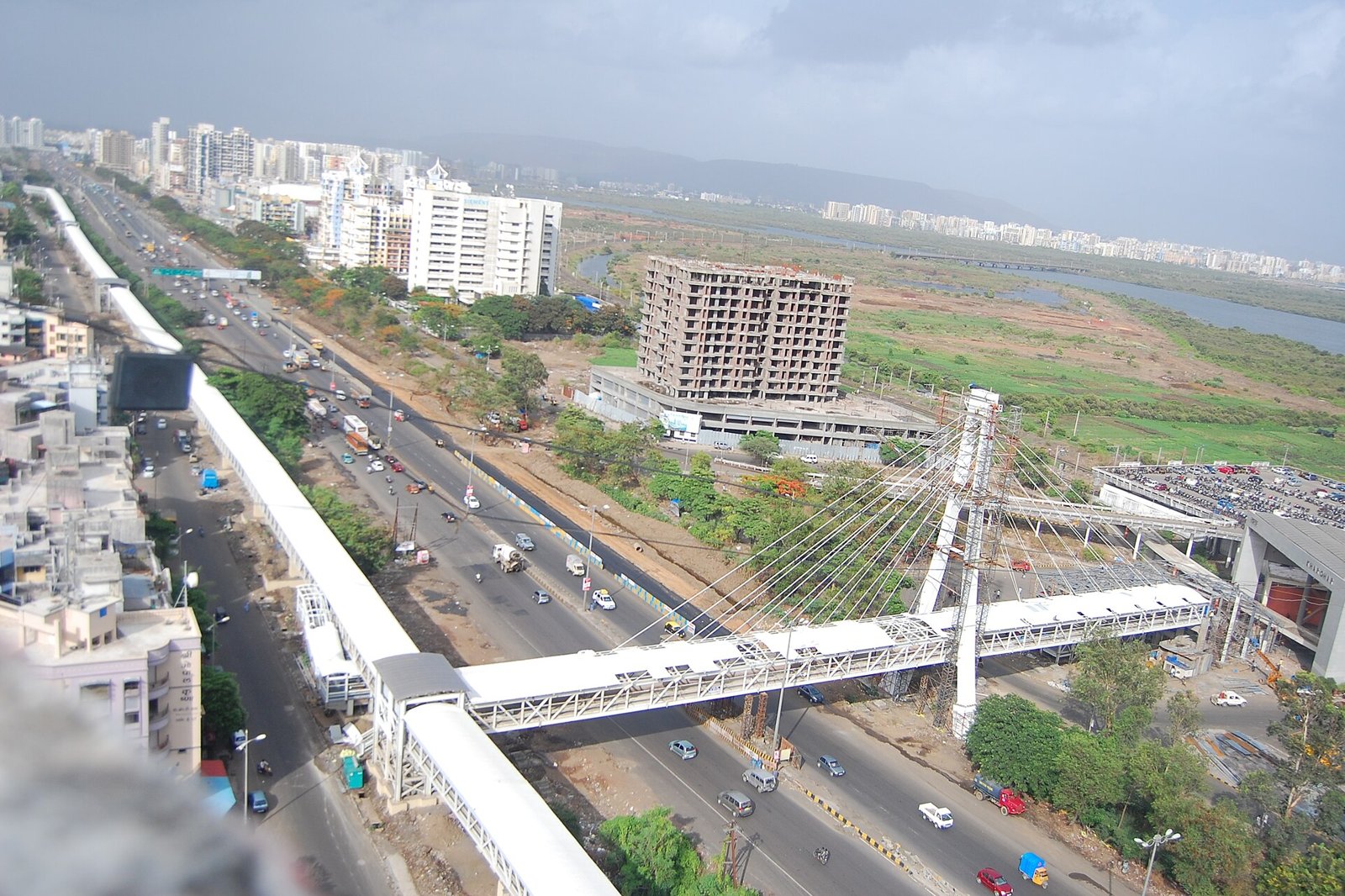
Roads and open land in the Kharghar area, seen from above. Illustrative photograph, not a NAINA scheme area.
A NAINA town planning scheme reorganises land into final plots while providing land for roads, infrastructure and public facilities. Owners need to verify their plot entitlement, compensation option, financial contribution and the scheme’s legal stage. This guide explains those checks using CIDCO documents and the final report for NAINA Town Planning Scheme No. 5 (TPS No. 5) as an example. It does not say what any owner will receive, and it is general information, not legal advice.
Quick answer: a NAINA town planning scheme is a statutory land pooling process under the Maharashtra Regional and Town Planning Act, 1966. CIDCO, as Special Planning Authority, declares the scheme, an arbitrator appointed by the State Government deals with the owners’ entries, and CIDCO’s FAQ says owners get about 40 per cent of their original land back as freehold final plots. The rest goes to roads, reservations, common open space and amenities, and housing for EWS and LIG. The Act allows FSI or TDR in place of cash compensation. The figures differ from scheme to scheme, so check the sanctioned documents of the scheme that covers the land. Allotment of a plot, possession, completion of infrastructure and permission to build are separate matters, and each needs checking.
Town planning scheme or NAINA Scheme
| Town planning scheme | NAINA Scheme | |
|---|---|---|
| Basis | Chapter V of the Maharashtra Regional and Town Planning Act, 1966 | Voluntary land pooling under regulations 12.6 and 13 of the 2017 NAINA development control regulations |
| Who starts it | The planning authority, CIDCO, for a defined area | Landowners who come together, with a minimum area |
| Who builds infrastructure | CIDCO builds the roads and public infrastructure | The participating owners build the internal layout roads, open spaces and amenities |
| Return to the owner | About 40 per cent of the original land as final plots, according to CIDCO’s FAQ, and the sanctioned scheme documents decide the actual entry | The applicable regulation and the approved layout decide the retained and developable area |
| Tenure | Freehold final plots, according to CIDCO’s FAQ | Freehold land with a new property card, according to CIDCO’s FAQ |
| Which route applies to my land? | Match the property to the relevant notified scheme, approved proposal and applicable regulations | The same check. Do not assume an owner can freely choose between the routes today |
CIDCO’s FAQ calls them “two sides of the same coin”, since both pool and reconstitute land, and says owners get relatively more net developable land in a town planning scheme. Do not mix the figures from one route with the other. Our NAINA guide covers the wider NAINA area, and CIDCO publishes the sanctioned NAINA development control regulations and a NAINA FAQ.
The stages, with a real example
The stages below follow the section numbers of the Maharashtra Regional and Town Planning Act. The examples are from CIDCO’s report for TPS No. 5, which covers part of seven villages in Panvel taluka: Bonshet, Bhokarpada (Chipale), Devad, Moho, Shivkar, Vichumbe and Vihighar, about 241 hectares. The report is the arbitrator’s final report, drawn up on 12 September 2024.
| Stage | What happens | In TPS No. 5 |
|---|---|---|
| 1. Intention declared, section 60(1) | CIDCO declares its intention to make a scheme and publishes a notice in the Government Gazette. The original plots are the holdings on this date, and their values are taken as at this date | Board resolution of 7 June 2019, gazette notice of 26 June 2019 |
| 2. Draft scheme | The draft is prepared after consulting the Director of Town Planning and meeting the owners. It is published for suggestions and objections (30 days, according to CIDCO’s FAQ) and then sanctioned by CIDCO’s Vice Chairman and Managing Director under section 68(2), a power the State Government delegated in 2017 | Sanctioned on 21 October 2022 |
| 3. Arbitrator appointed, section 72(1) | The State Government appoints an arbitrator. The process provides for special notices (Form 4) to the owners and an opportunity for affected owners to be heard | Arbitrator appointed on 2 December 2022, started work on 5 April 2023, hearings in July and August 2023 |
| 4. Preliminary scheme | The arbitrator divides the scheme into a preliminary scheme, which fixes the physical layout and the final plots, and a final scheme, which deals with the money. The State Government sanctions the preliminary scheme by a Gazette notification. Check the commencement date that notification specifies. Section 86(2) requires it to be no earlier than one month after publication, and it can be extended | Split on 20 October 2023, drawn up on 30 November 2023, sent for sanction on 13 December 2023, sanctioned by the State Government on 28 February 2024 |
| 5. Final scheme | The arbitrator draws up the financial part: values, compensation, increment, contribution and the net demand for each owner. The final scheme then needs State Government sanction under section 86 | Arbitrator’s final report drawn up on 12 September 2024 |
Check the exact status of any document. A document called a “final scheme report” is the arbitrator’s report. It is not, by itself, evidence that the State Government has sanctioned the final scheme. Where both dates exist, treat the sanction date and the commencement date as separate.
CIDCO’s FAQ also describes target timelines, from the declaration of intention to final sanction in about 37 months without extension and 40 months with it. TPS No. 5 took longer than that from the declaration to the arbitrator’s final report, so treat the timeline as a plan, not a promise. The FAQ adds that once the draft scheme is sanctioned, the lands for roads and similar infrastructure are deemed transferred to the authority, which can then start building the roads.
What the owner receives
- About 40 per cent of the original land as net final plots, according to CIDCO’s FAQ. The beneficiary is the holder of the 7/12 extract, and the area on the 7/12 is the basis for the 40 per cent. Verify the area of your holding that is actually included in the scheme and the matching final plot entry, especially where a holding falls only partly within the scheme boundary.
- Freehold. The FAQ says final plots are freehold, do not attract transfer charges of the kind that apply to Navi Mumbai lease plots, and carry no CIDCO deadline for development. Freehold tenure does not replace checks on ownership, encumbrances, applicable restrictions, scheme dues or building permission.
- Location and shape. The principles say final plots are anchored to the original location as far as possible, are regular and buildable, and are placed around existing structures with valid permissions. Forest land and water bodies are kept intact, and tribal land and land with restricted tenure are not amalgamated with other land.
- Common spaces. About 10 per cent open space and 5 per cent amenity space are provided in the scheme layout for common use, so the owner does not have to provide open space, amenity space or EWS housing again on the final plot, whatever its size, according to the FAQ.
- FSI on the final plot. CIDCO’s FAQ describes the permissible FSI as the original plot area divided by the final plot area, and gives 2.5 as the figure when the final plot is exactly 40 per cent of the original. The TPS No. 5 report uses the same ratio and calls 2.5 the maximum. The ratio alone does not establish the entitlement of a particular plot. Check the sanctioned scheme regulations, the plot entries and your compensation option before stating the permissible FSI. Our FSI limits guide explains FSI.
Illustrative arithmetic only. An owner with an original plot of 1,000 sq.m. who receives a final plot of 400 sq.m. has a ratio of 2.5. At an FSI of 2.5, the FSI accounted built-up area on a 400 sq.m. plot would be 1,000 sq.m., the same as the original plot area. That is the idea behind CIDCO’s notional FSI of 1.00 on the original holding. This illustrates FSI accounted built-up area. It is not a statement of carpet area, saleable area or an approved building design.
The money: a TPS No. 5 case study
The final scheme settles the financial side under sections 97 to 100 of the Act. For each owner the report (Form No. 1) records:
These figures illustrate how the TPS No. 5 arbitrator’s report calculated scheme values. They are historical statutory valuations as at June 2019, not current asking prices, transaction prices or forecasts of investment returns.
| Item | What it means |
|---|---|
| Original plot value | The value of the original plot on the date of the declaration of intention, as if there were no scheme. In TPS No. 5 the arbitrator revised the draft values, using the 2019 ready reckoner rates and the plot’s access, flood line, utility lines and distance from the gaothan |
| Semi-final value | The value of the final plot on that date, without the scheme’s improvements except for its better shape and location. In TPS No. 5 the arbitrator fixed it at Rs 11,000 per sq.m. |
| Final value | A statutory valuation of the final plot on the assumption that the scheme is complete. It is not a resale forecast. In TPS No. 5 it was Rs 22,000 per sq.m. for plots on scheme roads and Rs 23,000 for plots on the 45 m wide road |
| Compensation | The original plot value minus the semi-final value of the final plot (section 100). The Act lets an owner opt for FSI or TDR instead of this cash compensation |
| Increment | The final value minus the semi-final value of the final plot (section 98) |
| Contribution | What the owner pays towards the cost of the scheme, in proportion to the increment, with a ceiling of 50 per cent of the increment (section 99). The percentages in this guide are percentages of the increment, not of any sale price |
| Net demand | Compensation and contribution set against each other. It is either payable by the owner to the authority or by the authority to the owner |
Cash or FSI and TDR in TPS No. 5. In that scheme the draft showed zero compensation on the assumption that owners would take FSI. The arbitrator decided that owners who took FSI or TDR in lieu of cash would pay contribution at a nominal 0.05 per cent of the incremental value. For an owner who demanded cash, the arbitrator decided contribution at 50 per cent of the incremental value, an FSI of 1.00 on the final plot and no eligibility for TDR in future. A reduced rate also applied to very small final plots where the FSI or TDR could not be used. If every owner had taken cash, the compensation payable by CIDCO would have been about Rs 81.91 crore. These are that arbitrator’s decisions on that scheme, and other schemes can differ.
CIDCO’s FAQ, which is older, says the contribution, which it calls the betterment charge, is payable at the time of seeking development permission. Check the operative demand and the scheme documents for the actual amounts and timing. Development charges are separate statutory charges on development of the final plot. Our TDR guide explains how TDR works.
What owners objected to
The TPS No. 5 report records the objections owners raised, and they show what to check early. They said the original plot values were too low, that trees, wells and fencing were not valued, that final values were too high, that they had not been told they would pay a contribution after giving up 60 per cent of their land, that they had not understood that FSI of 2.5 was offered in place of cash and not in addition to it, and that compensation was lower than under the land acquisition law. The arbitrator told them that compensation at multiples of the market value is not part of this Act and that project affected person status is outside the arbitrator’s role.
If you disagree with a decision
If you disagree with an allotment, a valuation or a financial entry, identify the decision, the statutory provision it was made under and the date it was communicated to you. Preserve the notice, your plot records and your written submissions, and get advice promptly on the applicable objection or appeal route.
Section 74 of the Act lets a party aggrieved by an arbitrator’s decision under the clauses it lists apply to the arbitrator, within two months from the date the decision is communicated, to refer the matter to the Tribunal of Appeal. It is not a general right of appeal against every decision, and the Act’s wording and any later amendments decide what applies to a particular decision.
- Keep the Form 4 notice and proof of when you received it.
- Keep your objections, acknowledgements and hearing records.
- Keep the arbitrator’s decisions and the plot table extracts for your original and final plots.
- Keep receipts for anything you pay and any demand you receive.
What to check if you own land in a scheme
- Whether the land is in a declared scheme, and its stage: intention, draft, preliminary or final, and whether each stage is a sanction, an award or only a published draft. CIDCO lists the schemes on its town planning schemes page.
- Your original plot number and the entries for it in Form No. 1, Table A and Table B, including the area, tenure and the final plot allotted.
- The Form 4 notice, the hearing dates and your chance to be heard.
- Whether the final plot is close to 40 per cent of your original area, and what the sanctioned scheme regulations say about its FSI.
- Your choice between cash compensation and FSI or TDR, and its effect on the contribution and the development rights of the final plot. Do not assume you receive both benefits for the same entitlement, and check the scheme documents for the rights that remain under the option you choose.
- The values, the contribution and the net demand, and when they are payable.
- Your 7/12 and land records. CIDCO says it cannot correct land records, and the owner must have errors corrected by the land records department, with the measurement done by the taluka inspector of land records.
- Whether a development permission or structure of yours was sanctioned before the scheme, since valid permissions are protected as far as possible.
| Check | Evidence to request |
|---|---|
| Final plot identification | The relevant scheme plan and plot schedule |
| Boundaries | Official demarcation and measurement |
| Possession | The applicable possession or handover record |
| Access | The approved access and the actual condition on site |
| Services | Written status of water, drainage and electricity provision |
| Construction readiness | The applicable development permission requirements |
What to check if you are buying land in or near a scheme
- Ask which scheme, if any, covers the land and its stage, and read the sanctioned preliminary or final scheme documents on CIDCO’s website.
- Check that the seller’s documents match the correct original or final plot entry, and whether the interest is held individually or shared.
- Ask whether there are pending objections, disputes or changes that affect the entry.
- Ask which compensation option has already been exercised, which scheme payments remain outstanding, and who bears them under the transaction.
- Check that the access shown on the plan is usable on the ground and that the plot boundaries have been officially demarcated.
- Check the zone, road access and FSI of the final plot. Our land use zones guide and FSI limits guide explain zones and FSI.
- Check the title and the land records. Our guide to buying land covers the transaction checks, and our property card guide explains how to read the property card.
- Treat marketing claims about FSI, rates or timelines with caution until they are matched to the scheme documents.
- For land outside a scheme, or to check zone, access and physical limits as well, see our guide to buying land in NAINA.
Common misunderstandings
- How land pooling differs from conventional acquisition. CIDCO’s FAQ says no land is acquired and the freehold stays with the owners, with the land for roads and public sites redistributed through the scheme. Owners do not keep every part of their original holding, so check the entry for yours.
- 40 per cent is not the whole story. The FAQ points to the common open space, amenity space and EWS relaxations as part of what the owner effectively gets back, but that is a different thing from a larger plot.
- The ratio is not a guaranteed FSI. A ratio such as 2.5 illustrates the calculation. The sanctioned scheme regulations and your entry decide the entitlement.
- The FSI or TDR option replaces the relevant cash. Do not assume an owner receives both for the same entitlement. Check the scheme documents for the development rights that remain under the option chosen.
- One scheme’s numbers are not another’s. The rates, the contribution and the decisions are recorded in each scheme’s own report.
Frequently Asked Questions
What is a NAINA town planning scheme?
It is a statutory land pooling scheme under the Maharashtra Regional and Town Planning Act, 1966. CIDCO as Special Planning Authority pools the land of many owners in a defined area, provides for roads and public sites, and reconstitutes the land into final plots. CIDCO’s FAQ says owners get about 40 per cent of the original land back as freehold final plots.
How does land pooling differ from acquisition?
CIDCO’s FAQ says no land is acquired and the freehold stays with the owners, while the land needed for roads and public purposes is redistributed through the scheme. Owners do not keep every part of their original holding, so check the plot entry for your land.
What FSI does a final plot get?
CIDCO’s FAQ describes the FSI as the original plot area divided by the final plot area, with 2.5 when the final plot is exactly 40 per cent of the original. The ratio alone does not establish the entitlement of a particular plot, so check the sanctioned scheme regulations, the plot entries and your compensation option.
Do owners pay anything?
The final scheme works out a contribution towards the cost of the scheme, which cannot exceed 50 per cent of the increment, and compensation, which the Act lets an owner take as FSI or TDR instead of cash. In TPS No. 5 the arbitrator set the contribution at 0.05 per cent of the increment for owners who took FSI or TDR and 50 per cent for those who demanded cash. Check the operative documents for your scheme.
What is the difference between the NAINA Scheme and a town planning scheme?
The NAINA Scheme is a voluntary land pooling route under the 2017 NAINA regulations, started by the owners. A town planning scheme is started by CIDCO under the Act for a defined area. CIDCO’s FAQ says owners get relatively more net developable land in a town planning scheme. Match your land to the scheme and regulations that apply to it.
Does a “final scheme report” mean the scheme is sanctioned?
No. CIDCO publishes scheme notices, reports, plans and valuation statements on its website. Check each document’s exact status: draft, arbitrator’s preliminary or final award, or government sanctioned preliminary or final scheme. A document titled “Final Scheme Report” is not, by itself, evidence of government sanction.
What to read next
- Buying land in NAINA: the zone, access and title checks to make first.
- NAINA Navi Mumbai guide: the map, the development plan and the town planning schemes.
- FSI limits in Navi Mumbai: how much floor area a plot can carry.
- UDCPR in Navi Mumbai: where the rules apply and which chapter answers which question.
Sources and a note on accuracy
Sources reviewed on 17 October 2026. Process and principles: CIDCO’s NAINA town planning schemes FAQ, which is an older document, so check CIDCO’s current pages. A worked example: CIDCO’s report for NAINA Town Planning Scheme No. 5, the arbitrator’s final report drawn up on 12 September 2024. Statute: sections 74 and 86 as printed in the Maharashtra Regional and Town Planning Act, 1966, modified up to 2015, and the Act may have been amended since. Voluntary scheme and background: CIDCO’s NAINA FAQ and its NAINA page. The report pages used are pages 1 to 15 (the background, the arbitration, the preliminary scheme, the valuation, compensation, contribution and the arbitrator’s decision).
Each scheme’s numbers, values and decisions are recorded in its own report, and the examples here are from TPS No. 5 only. Schemes can be amended, and the NAINA area and CIDCO’s documents change, so confirm the current position with CIDCO. This guide leaves out the scheme finance forms and the details of the cost of the scheme. Featured photo: Cable Stayed Bridge at Kharghar by Nil.bhadane 1984, licensed CC BY-SA 3.0 via Wikimedia Commons, cropped and resized. NaviMumbai.com is an independent information site and is not affiliated with CIDCO or any other authority named here.