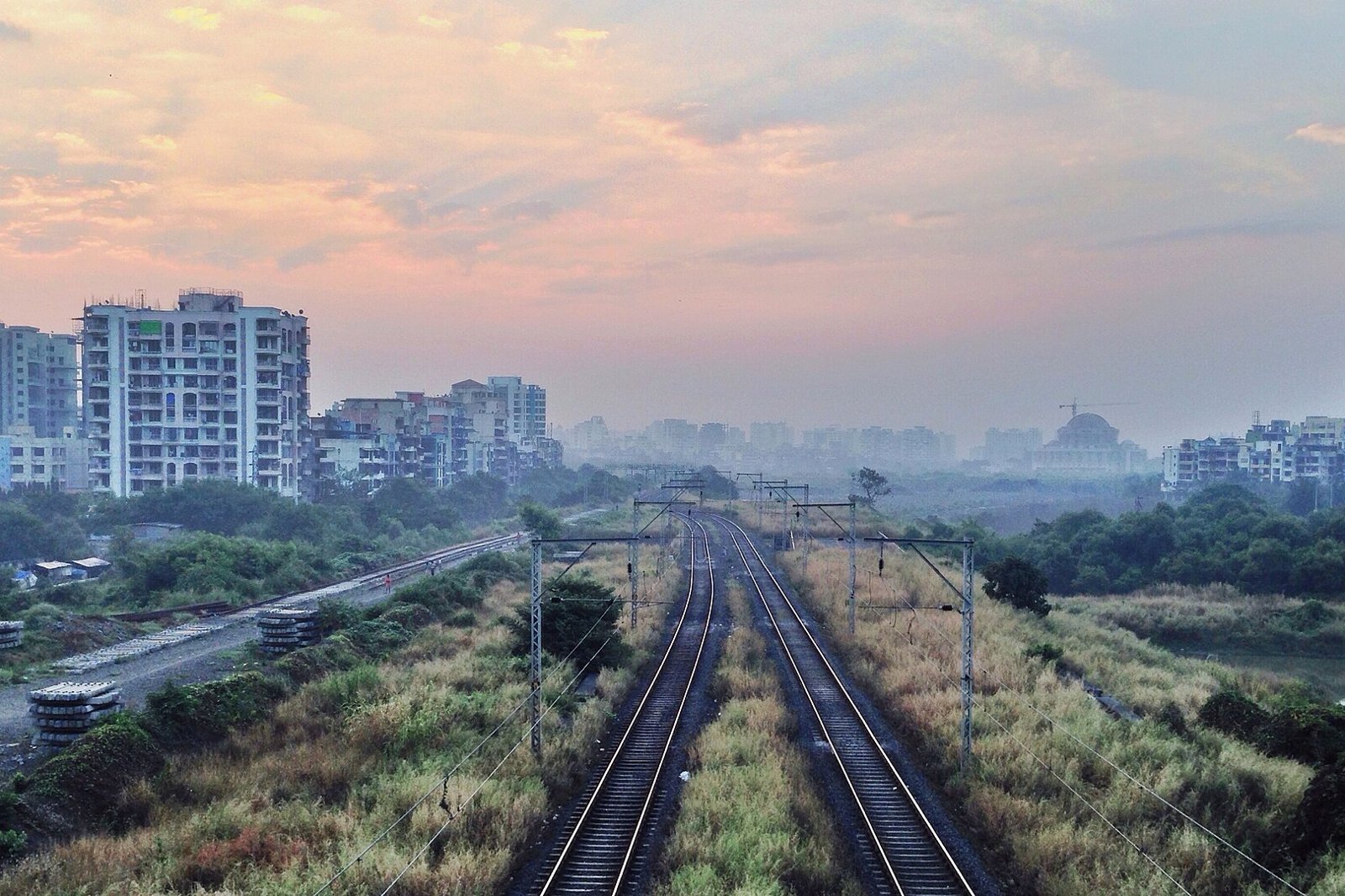
Hazy dawn near Seawoods. Haze in a photograph is not evidence of pollution at any site.
Pollution in Navi Mumbai can come from a factory, a building site, a generator, a loudspeaker, a vehicle or a fire of burning waste, and more than one agency may be able to act. This guide uses the Maharashtra Pollution Control Board’s own routing and the State’s noise resolutions to suggest where to report first, what to record and how to follow up. You do not need to identify who is responsible before you report. It does not promise that a complaint will be acted on, and it gives no pollution limits.
Quick answer: report what you observed, with the exact location, time and how long it lasted. Industrial pollution goes to the Maharashtra Pollution Control Board through its Maha Paryavaran app or its Navi Mumbai regional office. Non-industrial noise goes to the police. Burning waste, municipal nuisance and many dust and drainage problems go to the municipal authority. In an emergency, such as a fire, a gas leak or a chemical release, call 112 or 101 first.
Emergencies first
A pollution complaint is not an emergency service. For a fire, an explosion, a gas leak, a chemical spill or anyone in danger, call 112, or 101 for fire. Move away from immediate danger and follow emergency service instructions. Do not remain near a release or a fire to photograph it. Our emergency services guide lists the numbers and the fire stations.
Where to report first
This table is a starting point, not a rule that only one body can act. Some incidents involve more than one authority. A municipal body may deal with a local nuisance while the pollution control board looks into emissions, discharge or waste compliance. That is common with burning waste, sewage pollution, construction dust and generator emissions.
| Concern | Appropriate first reporting route | Notes |
|---|---|---|
| Industrial air, water or noise pollution | The Maharashtra Pollution Control Board | Use the Maha Paryavaran app or the Navi Mumbai regional office, both below |
| Smoke, dust, an unusual odour or suspected discharge, source unknown | The Board if you suspect an industrial source, or the municipal authority for a local nuisance | You can report without knowing the source. Describe what you saw and ask the authority to investigate |
| Non-industrial noise, such as loud music or loudspeakers | The police | See the police contacts below |
| Construction noise or generator noise | The municipal authority, and the police for night time loudspeakers | Under the State’s 2009 noise resolution the municipal commissioner is named for construction and building equipment noise at source |
| Dust from construction, demolition or material handling | The municipal authority or the project’s own authority, and the Board where environmental compliance is involved | Record the project name only if it is visible from a safe public place. Do not enter a site |
| Generator smoke or fumes | The municipal authority, and the Board where it is an emissions issue | Report emissions separately from noise, and note the premises and the operating times if you know them |
| Burning waste | The municipal authority | Call 112 or 101 if there is immediate danger. See our civic problems guide |
| Unusual discharge into a drain, creek or water body, or a suspected sewage overflow | The municipal authority for drains and sewers, and the Board if you suspect an industrial discharge | See the guidance on water and odours below |
| Suspected dumping of waste | The municipal authority | Give the location and what you saw |
| Vehicle smoke or vehicle noise | The transport department and the traffic police | See our RTO Navi Mumbai guide |
Coastal construction, mangrove damage and polluted discharge are different complaints. This guide covers pollution reports only. The routing in the table follows the Board’s FAQ, which also says that complaints against a polluting unit can go to a regional office, the head office in Mumbai or the State Government, and that some matters lie with the municipal corporation or the district authority.
The Maharashtra Pollution Control Board in Navi Mumbai
- Maha Paryavaran app: the Board’s official app for reporting industrial pollution, with a location, photographs or video and complaint tracking, according to its store listing. Get it for Android or iPhone.
- Regional office: Maharashtra Pollution Control Board, Raigad Bhavan, 7th floor, Sector 11, CBD Belapur, Navi Mumbai. The Board’s Navi Mumbai offices page lists the regional office emails ronavimumbai@mpcb.gov.in and mpcbnavimumbai@mpcb.gov.in, and sub-regional offices for Navi Mumbai and Taloja. The Board’s pages list different telephone numbers for these offices, so we do not print one. Use the official page.
- Which sub-regional office: the Board’s pages list the areas of the two Navi Mumbai sub-regional offices differently, so ask which office covers your address. Do not assume one office covers every address called Navi Mumbai.
- If you cannot use the app: contact the relevant office through its published email or telephone channels and ask how to register a written complaint. Keep the acknowledgement or correspondence.
Noise
For non-industrial noise, contact the police through their published local or control room channels. Record the location, the source if known, the start time and whether the disturbance is continuing. Include the organiser or venue name if you already know it, and ask the authority to verify the permissions and the applicable conditions. You do not need to approach an organiser before you report.
- In an emergency, call 112.
- The Navi Mumbai Police publish the control room numbers on their contact page: 112, 022 2757 2298 and 022 2757 4928, with a complaints page.
- A 2015 State resolution says that, in cities with a police commissioner, the commissioner, deputy commissioner or assistant commissioner is the noise authority under the Noise Rules, and that noise complaints can be received through the police emergency number. Its text is on the Board’s noise pollution page as a PDF.
Under the Noise Rules, a person can complain to the authority if the noise exceeds the ambient standard by 10 dB(A) or more, or if a night time restriction is broken. You do not have to measure anything. Ask the authority to assess whether the rules are being followed. The Rules do not allow loudspeakers or public address systems outside closed premises at night, between 10 pm and 6 am, apart from limited exceptions. A 2016 State resolution allows the exceptions for up to 15 days a year and lists the festival days, which included Christmas Day and 31 December, so ask the police which days apply this year. See our Christmas and New Year guide. A Bombay High Court order of 22 September 2026 gave directions to authorities on loudspeakers, firecrackers and processions during festivities, so read the order before you rely on older summaries.
- A recording or an app reading can help describe the disturbance, but it is not a certified noise measurement.
- Record the time, the location, how long it lasted and any pattern, such as every evening.
- Ask the relevant authority for the applicable silence zone notification and boundary. Do not assume that being near a hospital, a school or a court alone sets the current boundary.
- Our wedding planning guide explains the permissions that weddings and similar events can need.
Smoke, dust, odours and water
You can report smoke, dust, unusual odours or suspected discharge even if you cannot identify the source. Give the exact location, time, duration and what you observed. If you suspect a source, describe it as unconfirmed and ask the authority to investigate. A high reading on an air quality monitor does not by itself identify a particular polluter. Our air quality guide explains how to read a reading and the monitoring stations.
- Water and drains: describe what you observed, including colour, visible flow, odour, location and timing. Do not name a chemical or declare water toxic without evidence. Do not touch, collect or enter suspected contaminated material to strengthen a complaint.
- Odours: the time and the pattern, such as every night around ten, may help more than a photograph.
- Construction: note the location and the project name if it is visible from a safe public place. Do not enter a site to find the operator.
Write a complaint that can be acted on
Keep it factual and specific. You can copy this format:
Subject: [noise, smoke, dust, odour or discharge] near [road, sector or landmark]
Location: [exact location and map pin]
Observed on: [date, start time, how long it lasted and whether it continues]
Pattern: [how often, or the time of day it recurs]
What you observed: [brief factual description]
Suspected source: [unconfirmed, if you have one, or not known]
Effect: [who or what is affected]
Requested action: Please investigate and take appropriate action.
Evidence: [photograph or video taken from a safe public place]
Earlier response: [complaint number and any response]
- Take photographs and recordings only from a safe public place. Do not enter a factory, a site or private land, and do not confront the people responsible.
- In public posts, avoid unsupported allegations and remove unrelated personal information.
- Keep the reference number and a record of each follow up.
If you get no response
- Keep the original complaint and the acknowledgement.
- Follow up with the assigned office, quoting the same reference.
- Add new observations if the problem continues.
- Ask for the action taken and any closure explanation.
- Use the department’s own grievance route if it is still unresolved. Our civic problems guide explains the state and national portals.
- Seek legal advice where appropriate.
If a complaint is marked resolved but the problem continues, keep the closure response and submit fresh observations through the available feedback or follow up route, quoting the earlier reference. The Board publishes action taken reports on some complaints, but not every complaint appears there.
Legal remedies
Legal remedies depend on the issue, the applicable law and the forum, and notice requirements and filing deadlines differ. The National Green Tribunal has its own procedures. Seek advice promptly from a lawyer familiar with environmental matters, and keep your complaints, acknowledgements, evidence and official responses. Do not wait for an official reply before you get advice or seek urgent relief.
Frequently Asked Questions
Who do I complain to about loud music or loudspeakers in Navi Mumbai?
Non-industrial noise goes to the police. Contact them through their published local or control room channels, record the location, the start time and whether it is continuing, and call 112 in an emergency. A 2015 State resolution names the police commissioner, deputy commissioner or assistant commissioner as the noise authority in cities with a police commissioner.
Do I have to know who is causing the pollution before I report it?
No. You can report smoke, dust, unusual odours or suspected discharge without identifying the source. Give the exact location, time, duration and what you saw. If you suspect a source, describe it as unconfirmed and ask the authority to investigate.
Who handles industrial pollution?
The Maharashtra Pollution Control Board. Its Maha Paryavaran app is meant for industrial pollution complaints, and its Navi Mumbai regional office is at Raigad Bhavan, 7th floor, Sector 11, CBD Belapur. If you cannot use the app, contact the office through its published email or telephone channels.
Who handles dust, generator smoke or burning waste?
Start with the municipal authority for a local nuisance such as burning waste, and report dust or fumes to the municipal or project authority. The Board is also relevant where environmental compliance is involved. Some incidents involve more than one authority.
Can loudspeakers be used at night?
The Noise Rules do not allow loudspeakers or public address systems outside closed premises between 10 pm and 6 am, apart from limited exceptions. A 2016 State resolution allows exceptions for up to 15 days a year. Ask the police which days apply this year.
Can I take legal action over pollution?
Legal remedies depend on the issue, the applicable law and the forum, and notice requirements and deadlines differ. Seek advice promptly from a lawyer familiar with environmental matters, and keep your complaints, evidence and responses.
Sources and a note on accuracy
Sources checked on 15 October 2026. Complaint routing: the Maharashtra Pollution Control Board’s FAQ. Noise: the Board’s noise pollution page and the State resolutions it publishes, of 21 April 2009, 28 July 2015 and 5 September 2016, which are scanned Marathi documents, and the Bombay High Court’s order of 22 September 2026. Industrial pollution app: the Google Play listing and App Store listing. Regional office: the Board’s offices page. Police contacts: the Navi Mumbai Police contact page. We did not file complaints or test any app, email or number, and the routing may change, so confirm it with the Board or the authority concerned. This is general information and not legal advice. Featured photo: Vanishing point, Seawoods, Mumbai by Arun Muralidhar, licensed CC BY-SA 3.0 via Wikimedia Commons, cropped and resized. NaviMumbai.com is an independent information site and is not affiliated with the Maharashtra Pollution Control Board, the police, NMMC, Panvel Municipal Corporation or any agency named here.