Belapur Fort is the only old fort inside Navi Mumbai, and it is not set up for visitors. It is a ruined hill fort in CBD Belapur, looked after by CIDCO, with a long restoration that has stalled more than once. This guide explains who built it, who held it, what CIDCO planned for it, what has happened since, and what is known about getting in. It is a history and status guide, not an opening-hours guide, because no visiting hours have been published.
Access arrangements can change. If you want to go, ask CIDCO first and do not enter barricaded areas or climb the walls. This is an independent guide and is not run by CIDCO.
Belapur Fort at a glance
| Question | Answer |
|---|---|
| Where is it? | On a hillock near the mouth of Panvel Creek in CBD Belapur, close to the Amruteshwar temple. Wikipedia gives the coordinates as 19°00′20″N 73°01′42″E, and Citizen Matters places one bastion opposite the NMMC headquarters. |
| Who looks after it? | CIDCO, according to Wikipedia and CIDCO’s own conservation page. |
| Is it open to visitors? | Wikipedia lists it as not open to the public. CIDCO’s page gives no opening hours, entry fee or access instructions, and a 2021 report described it as mostly closed behind barricades. |
| What survives? | Ruins. CIDCO says it once had five bastions and strong ramparts, and only remains survive. |
| How old is it? | Built in the 16th century by the Siddis of Janjira, according to CIDCO and Wikipedia. |
| Site size | CIDCO describes a 5 acre site under its control. |
Who built Belapur Fort, and who held it
CIDCO’s page calls it the only historic monument in Navi Mumbai and traces it to the 16th century. The Siddis of Janjira built it, and Wikipedia gives 1570 for the construction, while Citizen Matters, quoting Wikipedia, says 1560 to 1570. The sources do not agree on every later date, so the table gives each as the source states it.
| Period | What happened | Source |
|---|---|---|
| 16th century | Built by the Siddis of Janjira | CIDCO and Wikipedia |
| 1582 or 1682 | The Portuguese took the fort. CIDCO’s page says 1582. Wikipedia says 1682, after the Portuguese put down a revolt by the Patkar family | CIDCO and Wikipedia |
| 1730s | Chimaji Appa’s Marathas took the fort from the Portuguese. Wikipedia says 1737 and Citizen Matters says 1733 | Wikipedia and Citizen Matters |
| 23 June 1817 | Captain Charles Gray of the East India Company captured it, and the British partly destroyed it | Wikipedia |
Wikipedia also records that Chimaji Appa vowed to offer a garland of beli leaves at the Amruteshwar temple if he won the fort, and that the fort was then named Belapur. Local belief speaks of a tunnel from the fort to Gharapuri Island, where the Elephanta Caves are. Wikipedia describes that as something supposed to exist and traces it to a 2004 newspaper article, so treat it as a story, not a fact.
What CIDCO planned
CIDCO’s conservation and beautification page, in Marathi, describes a project to preserve the ruins, restore the fort’s former standing and develop it as a tourist site and a cultural and educational centre. The page lists the facilities as plans:
- An entrance plaza with a ticket counter, rest area and shops.
- Spiral stone steps and gentle ramps inside the fort, and battery operated vehicles.
- Parking, restaurants, toilets, a pavilion and watch towers.
- An amphitheatre and open stage near the bastions, and a sound and light show about the fort.
- A proposed museum and exhibition centre on Mumbai’s naval and maritime history.
- A small garden and fountain around the fort.
The page says new structures would use materials and styles from the fort’s era. It gives no completion date and no opening date.
What has happened since
| Date | What was reported | Source |
|---|---|---|
| 2009 | CIDCO drew up its first plans, which were not carried out | Citizen Matters, July 2021 |
| June 2019 | Restoration work reportedly started, with Kimaya Architects and Savani Heritage Conservation as CIDCO’s partners | Citizen Matters, July 2021 |
| 12 June 2021 | A square bastion tower on the edge of the fort collapsed in heavy rain and wind. Residents said it had been newly repaired and blamed poor work | Citizen Matters, July 2021 |
| July 2022 | The Hindustan Times reported that the state archaeology directorate was in the process of taking the fort over from CIDCO, and that CIDCO had asked the state to declare it a protected monument. It said earlier conservation had stalled for lack of technical supervision | Hindustan Times, 1 July 2022 |
| July 2026 | Wikipedia, last edited on 19 July 2026, still lists the fort as administered by CIDCO and not open to the public | Wikipedia |
The Citizen Matters report from July 2021 describes the site as mostly closed, with barricades carrying project information. It quotes a resident saying little was happening at the fort, and another arguing that the Archaeological Survey of India should have been given the project. It gives no cost and no completion date. The Hindustan Times report describes the handover as under way in July 2022. Whether the state has since declared the fort a protected monument or taken it over, ask CIDCO before you rely on either.
Can you visit Belapur Fort?
Not as a regular visitor stop. CIDCO publishes no hours or entry rules, and the 2021 report found the site barricaded. A resident quoted in that report said he had walked into the premises and climbed a tower, but that is one person’s account from 2021, not a sign that visits are allowed. If you want to see it:
- Ask CIDCO whether access is possible. Its contact page lists its head office at CIDCO Bhavan, CBD Belapur.
- Do not enter barricaded or fenced areas, and do not climb the walls or bastions. The ramparts are old and partly collapsed.
- Respect any notice on site and any instruction from guards.
The fort is about 2.5 km from Belapur CBD station on a map estimate (route on foot, about 33 minutes), checked on 21 October 2026. The Belapur CBD railway station guide covers the trains and the Navi Mumbai Metro route map covers Metro Line 1. For the area around it, see the CBD Belapur area guide.
Where to go instead
For places in this part of the city that are set up for visitors, see the places to visit in Nerul, Seawoods and Belapur and the parks and gardens guide. The first of these explains why Belapur Fort and Parsik Hill are left out of its suggested plans.
Frequently Asked Questions
Is Belapur Fort open to visitors?
Wikipedia lists it as not open to the public, and CIDCO’s page gives no opening hours or entry rules. A 2021 report described it as mostly closed behind barricades. Ask CIDCO before you go.
Who owns and looks after Belapur Fort?
CIDCO administers it, according to Wikipedia and CIDCO’s conservation page. A 2022 Hindustan Times report said the state archaeology directorate was taking it over. Ask CIDCO whether that has happened.
Who built Belapur Fort?
The Siddis of Janjira built it in the 16th century. The Portuguese, the Marathas and then the British held it later.
Is there an entry fee for Belapur Fort?
CIDCO’s page gives no entry fee. It describes a ticket counter only as a planned facility.
Is there a tunnel from Belapur Fort to Elephanta?
It is a local story. Wikipedia describes it as supposed to exist and traces it to a 2004 newspaper article, so it is not an established fact.
When will the restoration be finished?
No completion date appears in CIDCO’s page or in the reports cited here. A July 2021 report described little happening at the site, and a July 2022 report described the handover as under way.
Sources and a note on accuracy
Checked on 21 October 2026: Wikipedia’s Belapur Fort entry (last edited 19 July 2026), CIDCO’s Belapur Fort page, Citizen Matters (12 July 2021) and the Hindustan Times (1 July 2022). Wikipedia’s dates rest on older newspaper pieces, and the sources disagree on some dates, which the table shows. Distances are an OpenStreetMap estimate. Access arrangements may have changed since these reports, so confirm with CIDCO.
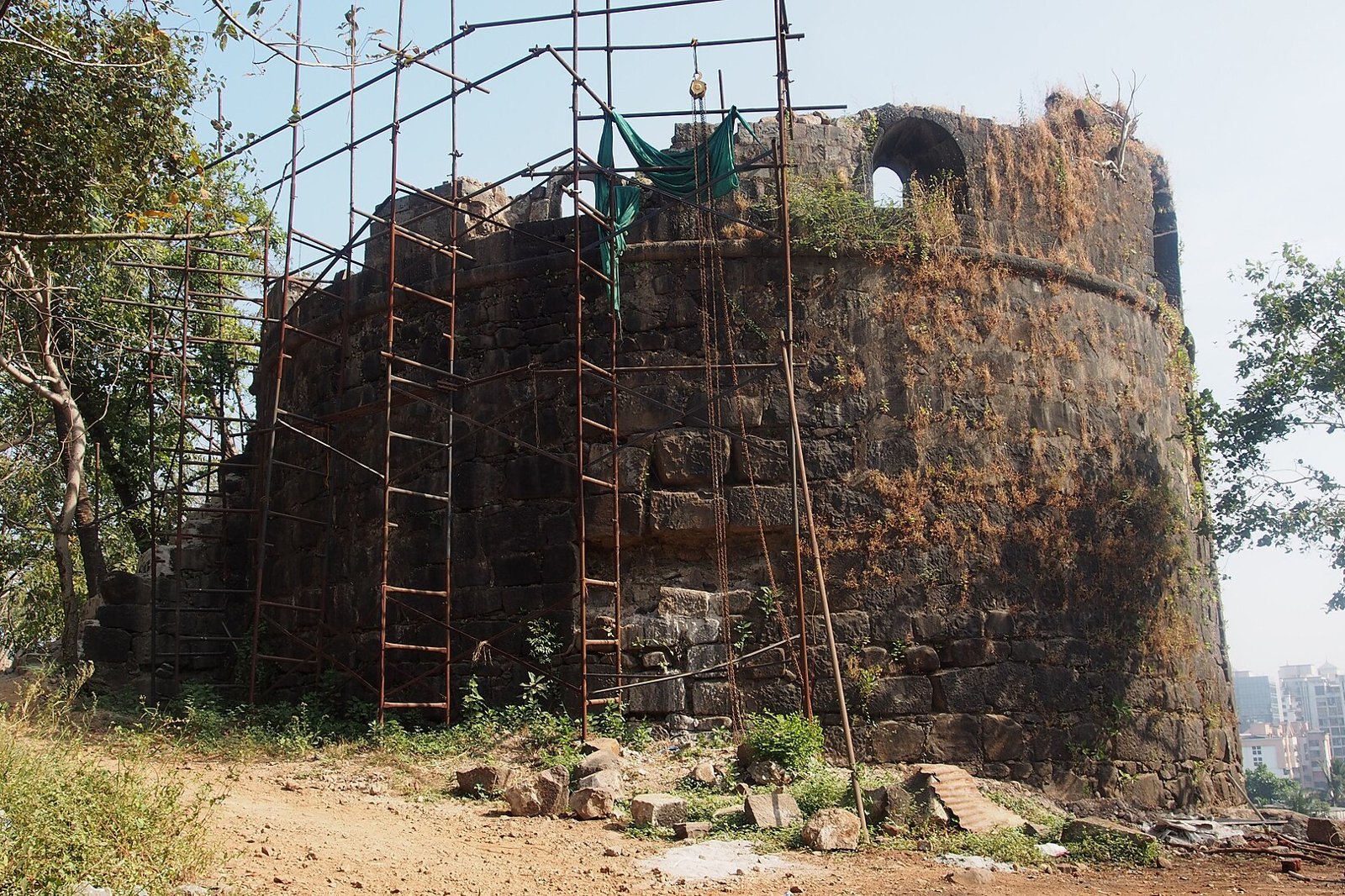
Featured photo: Belapur Fort Restoration 01 by Pradeep717, licensed CC BY-SA 4.0 via Wikimedia Commons, cropped and resized. It shows a bastion with scaffolding and Navi Mumbai buildings behind.
NaviMumbai.com is an independent information site and is not affiliated with CIDCO, NMMC or any government body.