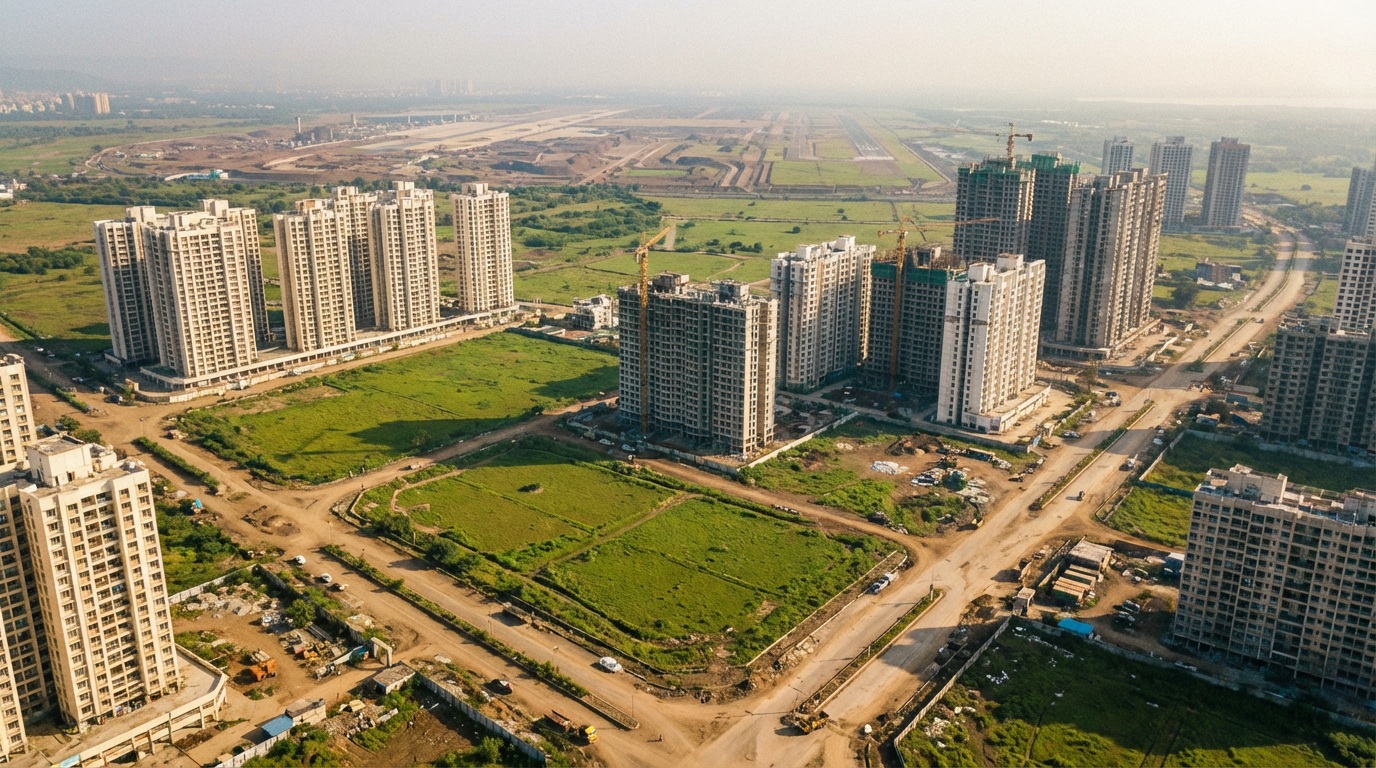
The image above is an illustration made for this guide.
A loan against property (LAP) lets you borrow money by mortgaging a property you own, such as a flat, a shop, an office or a plot, without selling it. In Navi Mumbai the questions people ask are practical: which property a lender will accept, what papers are needed, what it costs beyond the interest, and what happens if the property is on CIDCO land or in a housing society. This guide explains how the loan works, the checks lenders run, the costs to ask about, and what to confirm before you sign. It gives no interest rates, because rates and lending limits change and differ by lender and by borrower.
This is general information and not financial or legal advice. Rates, loan limits and charges are set by each lender and can change, so use the lender’s Key Facts Statement and sanction letter as the final word. This guide is independent and is not run by any bank.
How a loan against property works
- You keep the property and pledge it to the lender as security. The lender registers its charge, and releases it when the loan is repaid.
- The amount and the tenure are lender specific limits, not entitlements. They depend on the value the lender puts on the property, your income and your credit record. As one example, ICICI Bank advertises up to 75% of the property value and up to 15 years, subject to eligibility and its assessment of the property. Other lenders advertise different limits, so ask for yours in writing.
- The tenure and the interest rate are set by the lender. Ask whether the rate is floating or fixed, because that affects what you pay if you repay early.
- You can use the money for many purposes, but lenders ask for the purpose, and some uses are not allowed. Say honestly what it is for.
A loan against property is a different product from a home loan, where the loan buys the home. The home loans guide and the home loan EMI calculator guide cover home loans, and the NRI home loan guide covers borrowers abroad.
Property eligibility and your eligibility are different tests
A lender checks two things separately. The property must be acceptable: clear title, a usable zone and use, and documents in order. You must also qualify as a borrower, through your income, your existing loans and your credit record. A good property does not make up for weak repayment capacity, and a high income does not fix a property with a title problem.
LAP, top-up, balance transfer and overdraft
| Product | What it is |
|---|---|
| Loan against property | A new loan secured on a property you own, for a purpose you state. |
| Home loan top-up | An extra amount on an existing home loan with the same lender, usually on the same property. |
| Balance transfer | Moving an existing loan to another lender, sometimes with a top-up. The costs and the effect on the rate differ. |
| Overdraft against property | A limit you draw on and repay as needed, with interest on the amount used. Terms differ from a term loan. |
Which properties lenders usually look at
| Property | What lenders check in Navi Mumbai |
|---|---|
| Flat in a housing society | Clear title, the society’s no objection, the share certificate, and that maintenance dues are paid. See the society share certificate guide. |
| Flat or shop on CIDCO land | Leasehold documents are different from ordinary ownership papers: the allotment or lease papers, the lease terms and any transfer or mortgage permission the landlord authority requires, with any charge. Ask the lender what it needs and obtain the permission before you apply. |
| Plot | Zone, layout approval and clear title. See the land use zones guide and the NAINA town planning scheme guide. |
| Commercial property | Usage permission, ownership papers and, where relevant, rental income. |
| Under construction property | Many lenders prefer completed property, so ask whether yours qualifies. |
A property with an unclear title, a dispute, an unauthorised structure or an unpaid dues problem may be refused or valued low. Check these first. The flat buying checklist and the MahaRERA check guide show what to verify.
Documents to keep ready
Bank of Maharashtra’s loan against property page lists identity proof, address proof, income proof, property documents and any other documents the bank specifies. Other lenders ask for similar groups. Expect to be asked for:
- Identity and address proof, and your PAN.
- Income proof for a salaried or self-employed borrower, such as salary slips, bank statements and tax returns.
- Property documents: the title chain, the agreement for sale or sale deed, the society documents and the latest tax receipts. See the agreement for sale versus sale deed guide for what the main documents mean.
- Any other document the lender names in writing.
Costs to ask about
| Cost | What to ask |
|---|---|
| Interest | The rate, whether it is floating or fixed, and how it can change. |
| Processing fee | The amount or percentage, whether it is refundable if the loan is declined, and the taxes on it. |
| Valuation and legal fees | Who charges them, how much, and whether you pay if the loan is declined. |
| Stamp duty on the mortgage | The amount for your loan under the Maharashtra Stamp Act, which the lender and the registration office can confirm. See the stamp duty and registration guide. |
| Insurance | Whether a policy is required and whether it is optional. |
| Prepayment or foreclosure charges | See the next section. |
Compare the total cost, not only the rate
For applicable retail and MSME term loans, lenders must give you a Key Facts Statement that includes the annual percentage rate (APR). The APR brings the interest and the applicable charges into one figure, so two loans with the same advertised rate can cost different amounts. Compare the APR and the Key Facts Statement, not only the interest rate. Check with the lender whether your loan is covered.
Treat any EMI figure from a calculator as an illustration. Your actual EMI depends on the lender’s offer, the rate, the tenure and the charges, so use the figure in your sanction letter. The home loan EMI calculator guide explains how EMIs work.
Prepayment and foreclosure
The Reserve Bank of India’s Pre-payment Charges on Loans Directions, 2025 bar prepayment and foreclosure charges on most floating-rate loans to individuals taken for non-business purposes, for loans sanctioned or renewed on or after 1 January 2026, according to reports on the directions. Fixed-rate loans are not covered. For loans taken for business purposes, the conditions depend on the lender and the borrower, so do not assume either that charges apply or that they do not. Whether your loan against property counts depends on its stated purpose and your lender’s category, so read the directions on the RBI website and check your Key Facts Statement and sanction letter before you assume it applies.
What you can use the money for, and tax
Lenders ask for the purpose and may not allow some uses, such as speculative investment. Tax treatment depends on how you use the money and on your own situation, so do not assume the interest is deductible. Ask a chartered accountant before you rely on a tax claim.
If you cannot repay
The property you mortgage is your security. If you miss payments, the lender can take action under the law to recover the dues, which can include selling the mortgaged property. Mortgaging a home puts it at risk, so borrow only what your regular income can repay, and talk to the lender early if you expect trouble.
Before you sign
- Read the Key Facts Statement and the sanction letter, and compare the total cost, not only the rate.
- Check what happens if you miss payments. The lender can take action on the mortgaged property.
- Borrow only what you can repay from your regular income, since the property is at risk.
- Keep copies of every document and the receipt for each fee.
- Do not pay an agent anything beyond the lender’s published fees, and be wary of anyone who promises approval.
If your goal is investing rather than borrowing, see the investment options guide.
Frequently Asked Questions
What is a loan against property?
A loan you take by mortgaging a property you own, such as a flat, shop or plot, without selling it. You keep the property and the lender holds a charge on it until you repay.
How much can I borrow against my property?
It depends on the value the lender assigns, your income and your credit record. Lenders lend only a share of the property value, and the share differs by lender, so ask for it in writing.
Which documents are needed for a loan against property?
Identity and address proof, income proof and the property documents, plus anything else the lender names. Bank of Maharashtra lists these groups on its loan against property page.
Can I get a loan against a CIDCO or society flat in Navi Mumbai?
Often yes, but lenders check the title, the society’s no objection, the share certificate and any lease conditions on CIDCO land. Ask the lender what it needs for your property.
Are there prepayment charges on a loan against property?
RBI’s 2025 directions bar them on most floating-rate loans to individuals for non-business purposes, for loans sanctioned or renewed from 1 January 2026. Fixed-rate and business loans differ, so check your sanction letter.
What costs apply besides interest?
Commonly a processing fee, valuation and legal fees, stamp duty on the mortgage and insurance, if required. Ask for each in writing.
Sources and a note on accuracy
Reviewed on 22 October 2026: the Bank of Maharashtra loan against property page for the document groups, and reports on the Reserve Bank of India Pre-payment Charges on Loans Directions, 2025. The example limits from ICICI Bank come from its product information, and the Key Facts Statement and APR points follow RBI requirements. Rates, other loan limits and stamp duty amounts are not given because they vary by lender and change, and the aggregator sites that quote them disagree. Confirm every figure with your lender and with the registration department (igrmaharashtra.gov.in).
NaviMumbai.com is an independent information site and is not affiliated with any bank or lender.