
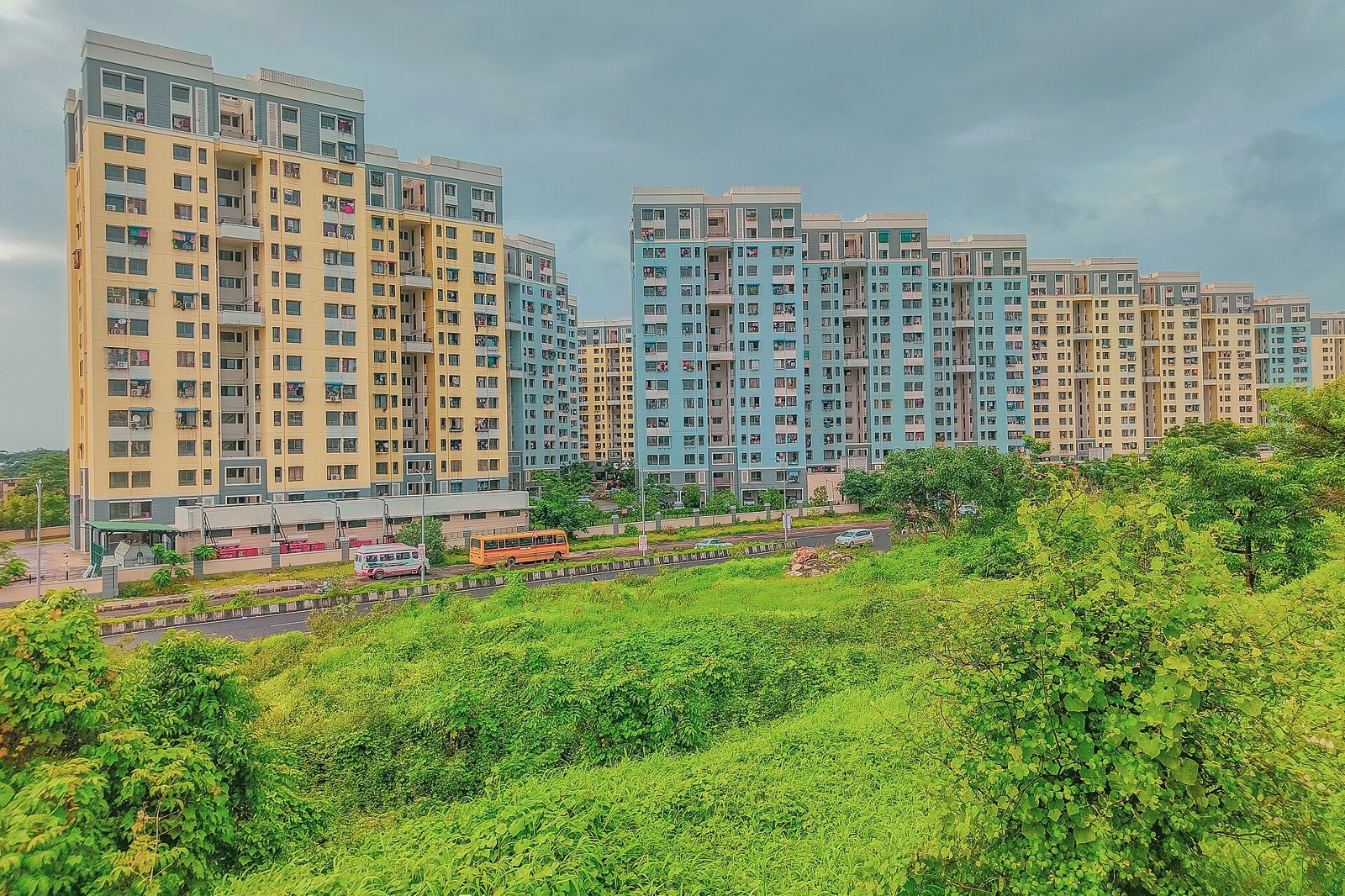
The photo above is a licensed Wikimedia Commons image of open land beside a residential township in Ulwe, Navi Mumbai.
A plot loan, also called a land loan, finances the purchase of a residential plot. Lenders look closely at the land itself: who holds it, how it can be used and what approvals it has. In Navi Mumbai that matters because land can be CIDCO leasehold, fall under a planning scheme such as NAINA, or be agricultural. This guide explains the three kinds of financing, an example of one lender’s published conditions, how lenders assess you and the plot separately, what you need in cash, and the checks to make before you pay a token.
This is general information and not financial or legal advice. Lender terms differ and change, so use each lender’s current product page and your Key Facts Statement. This guide is independent and is not run by any bank.
Three kinds of financing
| Product | What to establish |
|---|---|
| Plot-purchase loan | Whether it finances only the land, and what construction obligation applies after you buy. |
| Construction loan | What approvals, cost estimates and disbursement conditions apply when you already own the land. |
| Plot-plus-construction loan | How the purchase and the later construction are funded under one facility, and in what stages. |
Approval for a plot-purchase loan does not guarantee a construction loan later. Ask whether construction funding is part of the offer, and on what terms. Also distinguish two approvals that are often confused: layout approval, which concerns the plot and its subdivision, and approval of your proposed house plans, which you need before you build. An “approved plot” is not permission to begin construction.
An example of published lender conditions
One example is ICICI Bank’s land loan page, checked on 22 October 2026. These are one lender’s published conditions, not rules for every lender and not confirmation that a particular plot qualifies.
| Item | What ICICI Bank’s page says |
|---|---|
| Maximum tenure | Up to 20 years. |
| Construction condition | Residential construction must be completed within four years of disbursement. |
| Building plan | An approved building plan is not required for the initial plot purchase, according to its FAQ. |
| Who it is for | People building an individual residential unit for their own use. Builders are excluded. |
Some third-party websites quote a shorter construction deadline for the same bank, which may be out of date, so rely on the lender’s current page and your sanction letter. Other lenders set different conditions, so compare more than one.
How lenders assess you and the plot
| Borrower assessment | Property assessment |
|---|---|
| Income and repayment capacity | Title and the ownership chain |
| Existing loan obligations | Permitted use and approvals |
| Credit history | Valuation and the lender’s acceptance of that plot |
| Age and the tenure you ask for | Lease and mortgage conditions, where they apply |
A first eligibility estimate is not the same as final approval of the plot or the disbursement, which come after the lender has checked the documents. Lenders set their own thresholds, so this guide does not give a minimum income or credit score.
Navi Mumbai checks, kept separate
These four checks answer different questions, and a plot has to pass each of them. They are not alternative types of plot.
| Check | What it establishes |
|---|---|
| Ownership or leasehold tenure | What interest the seller holds and can transfer, for example freehold or CIDCO leasehold, and any transfer or mortgage permission the landlord authority requires. |
| Planning jurisdiction | Which authority’s planning framework applies, for example CIDCO or the NAINA scheme. |
| Land use and permissions | What use and development are allowed. See the land use zones guide. |
| Lender acceptance | Whether that lender will finance that particular plot. |
Ask the lender to assess the specific plot documents and the applicable approvals. Do not treat a developer’s statement that a plot falls within an approved layout or planning scheme as confirmation of loan eligibility. For plot-specific planning checks in the NAINA area, see the NAINA town planning scheme guide and the NAINA Navi Mumbai guide. Agricultural land has restrictions on who can buy it, so see the guide to buying land in Navi Mumbai.
What you need in cash: a hypothetical example
This is an illustration only, and the percentage is assumed. It is not a published offer. The approved amount may be lower because of the lender’s valuation, your eligibility or the product’s limits.
| Illustration only | Amount |
|---|---|
| Plot purchase price | ₹50 lakh |
| Assumed loan approval | ₹35 lakh |
| Your contribution towards the price | ₹15 lakh |
| Other costs | Additional amounts, as applicable |
If the lender values the plot below the price you agreed, the loan is worked from the lower value, and you cover the difference. Budget for these on top of your contribution:
- Stamp duty and registration. See the stamp duty and registration guide.
- Processing, legal scrutiny and valuation charges.
- Mortgage related costs, where they apply.
- Transfer or permission charges, where they apply.
- The construction funding you will need later.
Compare offers by the annual percentage rate (APR), not only the interest rate. RBI’s Key Facts Statement framework for applicable loans requires the APR and the relevant charges to be disclosed, which makes offers comparable. The home loan EMI calculator guide explains EMIs, and the home loans guide covers loans for flats.
Documents to keep ready
- Identity and address proof, and your PAN.
- Income proof, such as salary slips or business records, with bank statements and tax returns.
- The property papers: the title chain, the draft agreement, layout approvals and a current tax receipt. See the agreement for sale versus sale deed guide.
- A construction plan or estimate, if the lender asks for one.
- Anything else the lender names in writing.
Plot checks before you commit
| Check | What to do |
|---|---|
| Title | Get a lawyer’s title report. It reviews the ownership documents. It does not replace the planning permissions or the lender’s full loan documentation, and your Key Facts Statement is a disclosure of the loan terms, not an approval of the plot. |
| Access | Verify documented legal access to the plot as well as a usable physical road. |
| Existing mortgage or dues | An existing charge needs investigation and an agreed release process. It does not automatically make a resale plot unfinanceable, but do not pay until it is dealt with. |
| Disputes | Check for court cases and unpaid dues. |
If you plan to build
Check what the plot allows before you buy, so that the house you want is permitted. See the FSI limits guide, the setbacks and margins guide and the building height limits guide. You will need approval of your house plans before construction, and the lender may ask for an estimate and release money in stages. If you buy now and build years later, check the lender’s construction deadline, since some set a fixed period from disbursement.
Prepayment
For loans sanctioned or renewed on or after 1 January 2026, lenders covered by RBI’s 2025 directions cannot charge prepayment fees on floating-rate loans granted to individuals for non-business purposes. This applies to partial and full prepayment, whatever the source of funds, and with no minimum lock-in period. Fixed-rate loans and other circumstances need separate checking. For dual-rate loans, the treatment depends on whether the loan is floating-rate when it is prepaid. Older loans do not all attract a charge, so read your own terms. The directions are listed in the RBI circular index (Pre-payment Charges on Loans Directions, 2025, RBI/2025-26/64, issued 2 July 2025).
Tax
Buying a vacant plot does not by itself establish eligibility for home-loan tax deductions. Any later claim relating to house construction depends on the applicable tax rules, the tax regime you are under and your individual circumstances, so ask a chartered accountant.
Frequently Asked Questions
What is a plot loan?
A loan that finances the purchase of a residential plot. Lenders assess you and the plot separately, and many set a deadline to build after disbursement.
Can I buy a plot now and build several years later?
Possibly, but lenders often set a deadline. For example, ICICI Bank’s page says residential construction must be completed within four years of disbursement. Check your lender’s terms.
What happens if the lender values the plot below the price?
The loan is worked from the lender’s valuation, and you pay the difference. Budget for a lower approved amount than you expect.
Does loan eligibility mean the plot has been approved?
No. A first eligibility estimate is not final approval of the plot. Layout approval is also different from approval of your house plans.
Does a plot loan cover construction too?
Not necessarily. A plot-purchase loan may fund only the land. A construction loan or a combined facility funds building, so ask which you are being offered.
Are there prepayment charges on a plot loan?
For floating-rate loans to individuals for non-business purposes, sanctioned or renewed from 1 January 2026, covered lenders cannot charge them under RBI’s 2025 directions. Fixed-rate loans and other cases need separate checking.
Which documents are needed for a plot loan?
Identity, address and income proof, plus the title papers, layout approvals and a tax receipt. Some lenders also ask for a construction plan.
Sources checked on 22 October 2026
- ICICI Bank land loan page for the example of tenure, the construction condition and the building plan point.
- RBI circular index for the Pre-payment Charges on Loans Directions, 2025.
- Reserve Bank of India for the Key Facts Statement and annual percentage rate framework for applicable loans.
- The linked guides on this site, for the local land and planning checks.
Reviewing a source does not mean a lender confirmed its terms for your plot. Confirm every figure with your lender, and get a lawyer’s title report for the plot.
Featured photo: Ulwe skyline by This Now, licensed CC BY-SA 4.0 via Wikimedia Commons, cropped and resized.
NaviMumbai.com is an independent information site and is not affiliated with any bank or lender.