This guide covers selected engineering colleges in Navi Mumbai and the Panvel area that take part in Maharashtra’s centralised admission process (CAP). It lists 12 of them, in Nerul, Vashi, Ghansoli, Airoli, Kharghar, Kopar Khairane, Kamothe and Panvel, and it is not a verified count of every engineering college in the region. Instead of ranking them, the guide uses the State Common Entrance Test Cell’s own published data: the list of institutes with their intake, and the cut-off list for the last allotment round of the 2026-27 cycle. It explains what those numbers mean, how admission works, and where to check fees.
Details read on 18 October 2026 from the Maharashtra CET Cell FE 2026 admission site, its list of institutes and its CAP Round IV cut-off list, with fee and address details from the college pages named below. The 2026-27 cycle is closed, and the latest completed cycle’s figures do not predict next year’s. Institutions that admit outside this CAP list, such as private or deemed universities, are not covered. This guide does not rank colleges or quote placements.
Engineering colleges in Navi Mumbai and Panvel: quick comparison
| College | Location | Status in the CAP list | Total intake | Institute code |
|---|---|---|---|---|
| Terna Engineering College | Nerul | Un-aided, autonomous | 780 | 03190 |
| S.I.E.S. Graduate School of Technology | Nerul | Un-aided, autonomous, Tamil linguistic minority | 660 | 03211 |
| Agnel Charities’ Fr. C. Rodrigues Institute of Technology | Sector 9A, Vashi | Un-aided, autonomous, Christian religious minority | 480 | 03197 |
| N.Y.S.S.’s Datta Meghe College of Engineering | Airoli | Un-aided | 960 | 03187 |
| Lokmanya Tilak College of Engineering | Kopar Khairane | Un-aided, autonomous, Hindi linguistic minority | 780 | 03196 |
| Bharati Vidyapeeth College of Engineering | Navi Mumbai (check the college for the exact address) | Un-aided | 540 | 03189 |
| Smt. Indira Gandhi College of Engineering | Sector 8, Ghansoli | Un-aided, autonomous | 420 | 03192 |
| Saraswati College of Engineering | Kharghar | Un-aided, autonomous | 600 | 03154 |
| Jawahar Education Society’s Annasaheb Chudaman Patil College of Engineering | Kharghar | Un-aided | 600 | 03146 |
| M.G.M.’s College of Engineering and Technology | Kamothe | Un-aided | 870 | 03175 |
| Chhatrapati Shivaji Maharaj Institute of Technology | Shedung, Panvel | Un-aided | 300 | 03477 |
| Anjuman-I-Islam’s Kalsekar Technical Campus, School of Engineering & Technology | Panvel | Un-aided, autonomous, Muslim religious minority | 510 | 03439 |
The locality for Vashi comes from the college’s own page and for Ghansoli from the college’s contact page. Other localities are as printed in the CAP list. Some colleges list their address under another locality, such as Panvel taluka or Mumbai, so search the CAP list by name if a college you know is missing. The intake is the total sanctioned for the first year in the CAP list and is shared across branches. For AIKTC the list shows regular branch intakes, with TFWS entries shown separately.
What the cut-off figures mean
The cut-off list for CAP Round IV shows, for each branch, the merit number and the merit percentile of the last candidate allotted a seat in a category in that round. Category codes start with G for general or L for ladies. A code ending in H means home university candidates, here Mumbai University, S means state level seats, and O means candidates from other universities. So GOPENH is the general open category for home university candidates, and GOPENS is the general open category at state level. These are different applicant pools, so a GOPENH figure and a GOPENS figure are not a like for like comparison.
- A cut-off is the last allotment in one category and one stage of one round, not an admission guarantee for any year.
- Round IV is a single snapshot. It does not show the trend across the earlier rounds.
- A branch with no entry in the Round IV list does not mean the course is unavailable. It means no allotment was recorded for that category in that round.
- Minority, TFWS, EWS and other quotas have their own cut-offs, which the full list shows. Check the category that applies to you separately.
Autonomous, affiliated and home university are different things
Autonomy and university affiliation are separate attributes. An autonomous college can also be affiliated to the University of Mumbai. Fr. C. Rodrigues Institute of Technology, for example, describes itself as an autonomous institute permanently affiliated to the University of Mumbai. Which seats a college offers, whether state level or home university and other university, depends on the official allocation rules and the institute’s seat matrix in the CET Cell’s documents. Your home university is set by the candidature rules in the CET Cell brochure, so do not assume it from where you live now.
Round IV cut-offs for Computer Engineering and Mechanical Engineering
For each branch the table shows the first general open category printed at Stage I of the Round IV list, with its merit number and percentile in separate columns. Lower merit numbers and higher percentiles mean a harder cut-off. Course names are as in the CAP list, so Computer Engineering is not the same entry as Computer Science and Engineering.
| College | Computer Engineering: category, merit no. | Percentile | Mechanical Engineering: category, merit no. | Percentile |
|---|---|---|---|---|
| Fr. C. Rodrigues Institute of Technology, Vashi | GOPENS, 12,980 | 96.96 | GOPENS, 5,120 | 98.82 |
| S.I.E.S. Graduate School of Technology, Nerul | GOPENS, 13,182 | 96.92 | No entry in the list | No entry |
| Bharati Vidyapeeth College of Engineering | GOPENH, 26,386 | 93.76 | GOPENH, 55,074 | 86.86 |
| Datta Meghe College of Engineering, Airoli | GOPENH, 28,563 | 93.23 | No open category in the list | No entry |
| Terna Engineering College, Nerul | GOPENS, 29,071 | 93.13 | GOPENS, 43,143 | 89.69 |
| Lokmanya Tilak College of Engineering | GOPENS, 29,287 | 93.07 | GOPENS, 59,136 | 85.91 |
| A.C. Patil College of Engineering, Kharghar | GOPENH, 46,908 | 88.86 | GOPENH, 78,869 | 80.79 |
| Saraswati College of Engineering, Kharghar | GOPENS, 47,141 | 88.83 | No open category in the list | No entry |
| Smt. Indira Gandhi College of Engineering, Ghansoli | GOPENS, 47,368 | 88.76 | No open category in the list | No entry |
| M.G.M.’s College of Engineering and Technology, Kamothe | GOPENH, 56,155 | 86.60 | GOPENH, 67,567 | 83.77 |
| AIKTC, Panvel | GOPENS, 86,195 | 79.00 | GOPENS, 123,671 | 68.60 |
| C.S.M. Institute of Technology, Shedung, Panvel | GOPENH, 90,260 | 77.94 | No entry in the list | No entry |
These figures relate to the specific branch, seat category, allotment stage and CAP round shown, as printed in the Round IV cut-off list for Maharashtra and minority seats, 2026-27. Because each figure is the last allotment in one round, a branch can show a tighter or looser number than you expect, so use the cut-offs as a range and not as a ranking. Compare your own category separately.
Which branches the colleges offer
Total intake is shared across branches, and students apply to a specific course, so check the course list on each college’s own site and in the CAP list. The Round IV list shows, for example, that AIKTC has separate entries for Computer Engineering, Computer Science and Engineering (Artificial Intelligence and Machine Learning), Computer Science and Engineering (Data Science), Electronics and Computer Science, Electrical and Computer Engineering, Civil Engineering and Mechanical Engineering. FCRIT lists Computer Engineering and Computer Science and Engineering as separate programmes. Similar course names are separate entries with their own cut-offs, so do not treat them as interchangeable.
How admission works
- Entrance exam and merit. Admission to the first year of engineering through the CAP uses a merit list prepared by the CET Cell. The FE 2026 site and its information brochure explain which entrance scores apply to which seats, the qualifying subjects and marks, and the candidature types.
- After results. The process runs through registration, document verification, publication of the merit list, an option form, allotment rounds, acceptance of the seat and reporting to the college.
- Choose by branch and college. You fill an option form that lists college and branch pairs in order of preference. Compare the cut-offs for several colleges before you decide.
- Home university and state level seats. Seat types and home university rules are defined in the brochure. Read them before you decide which cut-off row applies to you.
- Documents. Keep your academic records, entrance scorecard and the candidature and category certificates the brochure asks for. See our EWS certificate guide, non-creamy layer certificate guide and caste validity certificate guide.
- Diploma holders. Direct second year admission has a separate process on the CET Cell site and is not covered here.
- After the CAP rounds. Seats left vacant after the rounds are handled through separate institute level and against CAP vacancy processes, with their own notices, and are not simply another allotment round.
- Scope of this guide. It looks only at Maharashtra and minority seats in the CAP list. It does not cover management quota, institute level or all India seats.
- Next cycle. The FE 2026 site shows the 2026-27 cycle as closed and does not announce 2027 dates. Watch the main CET Cell website for the next cycle and its admission portal.
Fees
Fees are approved by the Fees Regulating Authority for each college and branch, and change each year. The one college whose approved figure this guide has read on its own site is Fr. C. Rodrigues Institute of Technology, which publishes the fee structure approved for 2026-27.
| College | Academic year | Tuition fee | Development fee | Approved total | Source |
|---|---|---|---|---|---|
| Fr. C. Rodrigues Institute of Technology, Vashi | 2026-27 | ₹1,69,565 | ₹25,435 | ₹1,95,000 | College fee page |
The development fee is already part of the approved total, so do not add it again. This is one year’s fee and not a confirmed cost for the whole degree. For every other college, use the Authority’s fee search report for 2026-27 to see the approved fee for your college and branch, and ask the college what else it charges, such as hostel and exam fees.
Getting to the campuses
The CAP list gives locality names, not station distances. Check each campus on a live map and plan the last stretch from the station. Our station guides cover the main nodes: Nerul railway station guide for Nerul, Vashi railway station guide for Vashi, Airoli railway station guide for Airoli, Kharghar railway station guide for Kharghar and Belapur railway station guide for Belapur. For hostels, check with each college.
Questions to ask a college
- Which branches are approved for this year, and what is the intake for each?
- What is the Fees Regulating Authority fee for my branch, and what other charges apply?
- Is the college autonomous, and which university awards the degree?
- What is the hostel arrangement and the cost, if I need one?
- How does the college handle internships and projects?
- Which accreditations does the college hold, and for which branches?
Our NEET and JEE coaching guide and coaching classes guide cover preparing for the entrance exams. For management courses, see our MBA and MMS colleges guide. If you are considering a law degree instead, see our law colleges guide.
Frequently Asked Questions
How many engineering colleges are there in Navi Mumbai?
This guide lists 12 colleges in Navi Mumbai and the Panvel area that take part in the Maharashtra CET Cell’s centralised admission process for 2026-27. That is a selection from the official list and not a verified total, and institutions that admit outside the CAP are not covered. Colleges may list a different locality, so search the list by name.
How are engineering admissions done in Navi Mumbai colleges?
Through the Maharashtra CET Cell’s Centralised Admission Process, which uses a merit list, an option form and allotment rounds, followed by separate processes for seats left vacant. Which entrance scores apply to which seats is set out in the CET Cell brochure.
What was the cut-off for Computer Engineering at these colleges?
In CAP Round IV for 2026-27, the first general open category cut-offs listed at Stage I ranged from a merit number of 12,980 (96.96 percentile) at Fr. C. Rodrigues Institute of Technology to 90,260 (77.94) at C.S.M. Institute of Technology. Each figure is the last allotment for one category in one round, and categories differ between colleges, so check the one that applies to you.
Does a missing Round IV cut-off mean the branch is not offered?
No. It means the list shows no allotment for that category in that round. Check the college and the seat matrix to see whether the branch is offered.
Does autonomous mean a college is not affiliated to a university?
No. An autonomous college can also be affiliated to a university. Fr. C. Rodrigues Institute of Technology, for example, describes itself as autonomous and permanently affiliated to the University of Mumbai.
Where can diploma holders find direct second year admission?
Direct second year admission has its own process on the Maharashtra CET Cell site. This guide covers first year admission only.
Are the 2027 admission dates announced?
Not on the FE 2026 site, which shows the 2026-27 cycle as closed. Watch the CET Cell’s main website for the next cycle.
Where can I find college fees?
On the Fees Regulating Authority’s fee search report for 2026-27, which lists the approved fee by college and branch. Fr. C. Rodrigues Institute of Technology also publishes its approved 2026-27 fee of ₹1,95,000 on its own site, which includes the development fee.
Sources and method
The Maharashtra State Common Entrance Test Cell’s FE 2026 admission site, its list of institutes participating in CAP and the CAP Round IV cut-off list for Maharashtra and minority seats, the Fees Regulating Authority’s fee search report, the Fr. C. Rodrigues Institute of Technology fee page and the Smt. Indira Gandhi College of Engineering contact page. This is desk research from published sources. Cut-offs are 2026-27 figures and are not forecasts, and placements are left out because a highest package alone does not describe a batch. If you represent a college and want details corrected, contact us.
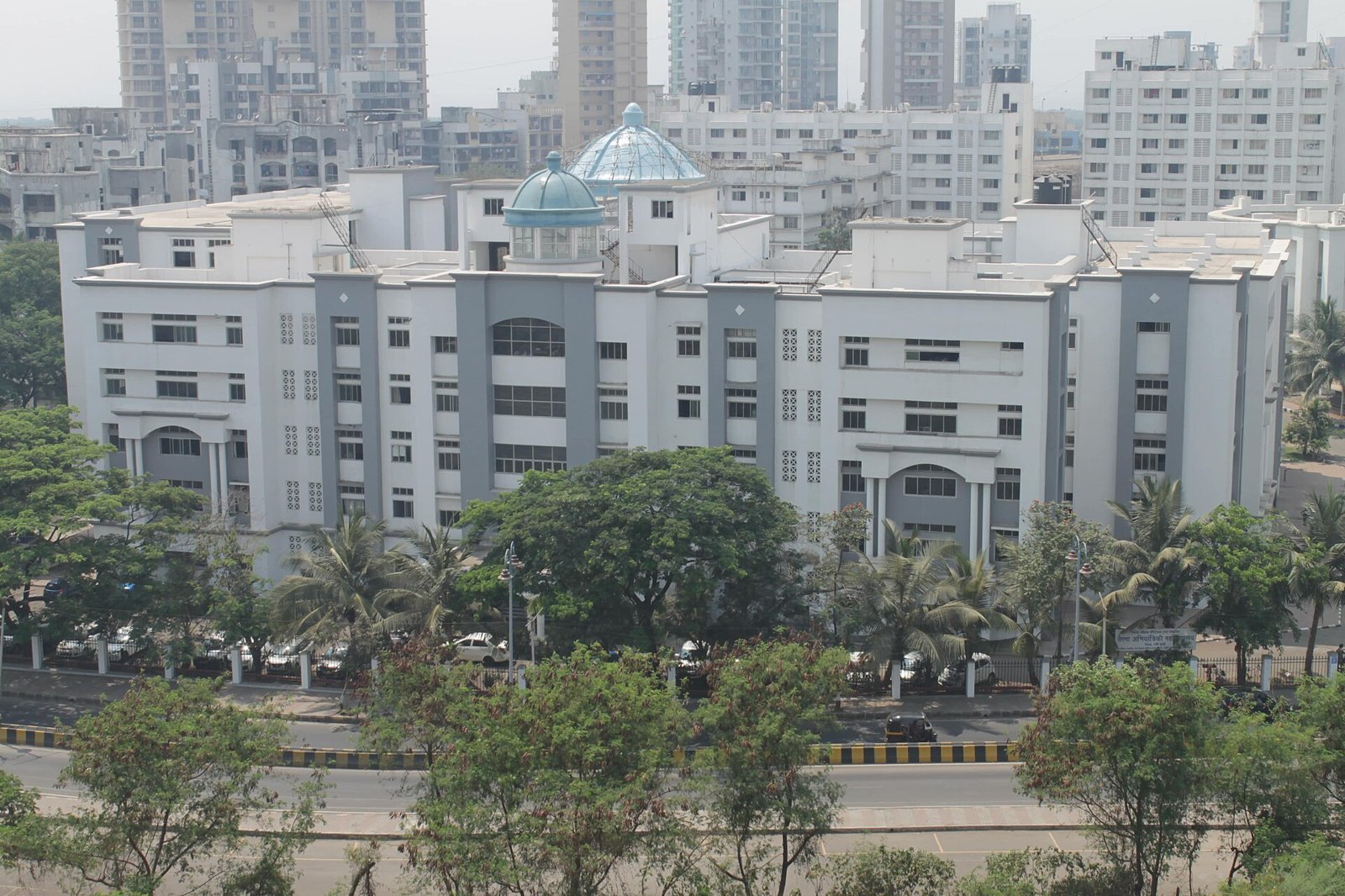
Featured photo: the academic block of Terna Engineering College, Nerul by Alkendra 123, licensed CC BY-SA 4.0 via Wikimedia Commons, cropped and resized. It shows one of the colleges covered and is not a recommendation.
NaviMumbai.com is an independent information site and is not affiliated with any college or the CET Cell.