






Navi Mumbai vs Thane 2026: Property Rates, Commute, Schools, and Lifestyle Compared
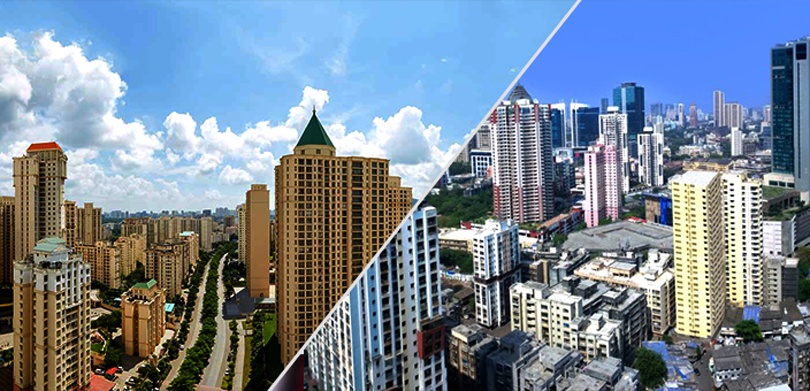
The Navi Mumbai vs Thane debate comes up every time someone decides to move out of Mumbai or invest in property across the harbour. Both cities offer more space, cleaner air, and lower prices than Mumbai proper. But they are very different in character, infrastructure maturity, and investment trajectory. This comparison breaks down property rates, commute options, schools, healthcare, lifestyle, and long-term growth potential so you can make an informed choice in 2026.
Navi Mumbai vs Thane: property rates in 2026
Thane has matured faster. Premium pockets like Pokhran Road, Kolshet, and Ghodbunder Road now command ₹19,000 to ₹25,000 per square foot. Thane East averages around ₹17,500 per square foot. These numbers put parts of Thane on par with established Mumbai suburbs like Andheri East.
Navi Mumbai still offers a wider price band. Affordable options in Taloja and Dronagiri start around ₹6,000 to ₹8,000 per square foot. Mid-range nodes like Kharghar, Ulwe, and Panvel sit at ₹10,000 to ₹15,000. Premium areas like Vashi, Seawoods, and Nerul reach ₹18,000 to ₹22,000. Your money goes further in Navi Mumbai for equivalent carpet area.
On appreciation, Thane has delivered strong returns over the last decade, with values up nearly 46% over three years in some pockets. Navi Mumbai’s growth has been more recent but sharper in specific corridors. Ulwe, Kharghar, and Panvel have seen 35 to 50% appreciation over three years, driven by the airport, Atal Setu, and metro infrastructure coming online.
Commute and connectivity comparison
Thane wins for Mumbai commuters who work in Central or Eastern suburbs. Thane station is a major junction on the Central Line, with direct trains to CSMT, Dadar, Kurla, and beyond. The Eastern Express Highway connects Thane to the Bandra-Kurla Complex in 30 to 50 minutes outside peak hours. If your office is in Powai, Vikhroli, or Mulund, Thane is the more convenient base.
Navi Mumbai wins for South Mumbai, Pune, and airport access. The Harbour Line runs directly to CSMT. The Atal Setu (MTHL) has cut travel time to South Mumbai dramatically. The Mumbai-Pune Expressway is directly accessible from Panvel. And the Navi Mumbai International Airport eliminates the need to cross the harbour for flights.
Internal road quality is where Navi Mumbai pulls ahead clearly. The city was planned from scratch with wide arterial roads, dedicated service roads, and sector-based layouts. Thane’s internal roads, especially in the older parts, suffer from congestion and narrow lanes that were never designed for current traffic volumes.
Schools and education
Thane has a denser network of established schools, including legacy institutions that have been running for decades. If you want a school with a long track record and a large alumni network, Thane has more options.
Navi Mumbai has newer schools in planned education clusters, often with better infrastructure. CBSE, ICSE, IB, and IGCSE boards are all well represented. DAV International, Ryan International, Delhi Public School, and St. Xavier’s all have Navi Mumbai campuses. The schools tend to have more campus space and better facilities because they were built on planned plots rather than squeezed into existing urban fabric.
For higher education, both cities are well served. Thane has Singhad, Jamnalal Bajaj, and K.J. Somaiya campuses. Navi Mumbai has DY Patil University, Pillai College, NMIMS Kharghar, and NIFT.
Healthcare facilities
Thane has Jupiter Hospital, Bethany Hospital, Vedant Hospital, and a cluster of speciality clinics along Ghodbunder Road. The healthcare density is high, and specialist access is mature.
Navi Mumbai has Apollo Hospitals, Fortis Vashi, MGM Hospital, Terna Medical College Hospital, and the recently expanded NMMC-run hospitals. The coverage is excellent across major nodes. Where Navi Mumbai lags slightly is in super-speciality concentration. For rare or complex procedures, some patients still cross to Mumbai or Thane. That gap is closing as new private hospitals set up in Kharghar and Panvel.
Lifestyle and daily living
Thane feels more like a mature city. Viviana Mall, R Mall, and Korum Mall anchor the retail scene. Restaurants, street food, and nightlife are well developed. The lake promenade along Masunda Lake gives Thane a distinctive character that newer cities do not have.
Navi Mumbai feels more spacious and planned. Seawoods Grand Central Mall, Inorbit Vashi, Little World Mall, and Orion Mall handle the retail load. Green spaces like Central Park Kharghar, Parsik Hill, and the palm beach stretch along Vashi-Belapur offer a quality of outdoor life that is hard to match. Air quality is noticeably better in most Navi Mumbai nodes compared to Thane’s denser clusters.
For families with children, Navi Mumbai’s wider roads, planned parks, cycling tracks, and lower traffic density offer a safer and calmer environment. For young professionals who want walkable urban energy, nightlife, and dining variety, Thane has the edge.
Investment outlook: where to put your money in 2026
Thane is a safer, steadier bet. Values are already high, and the appreciation curve is flattening in mature pockets. You are buying stability and rental yield rather than explosive growth.
Navi Mumbai is the higher-upside play. The airport, Atal Setu, metro expansion, and NAINA smart city project are all in active development. Nodes like Ulwe, Dronagiri, and Panvel are still in early stages of their growth curve. If you have a 5 to 10 year horizon, the growth potential per rupee invested is higher in Navi Mumbai.
The bottom line: pick Thane if you want a ready, lived-in city with established infrastructure and strong Mumbai connectivity via the Central Line. Pick Navi Mumbai if you want more space per rupee, a planned city with improving infrastructure, and exposure to the biggest real estate growth drivers in the Mumbai Metropolitan Region.
Frequently asked questions
Is Navi Mumbai cheaper than Thane for property in 2026?
Generally yes. Navi Mumbai’s average rates range from ₹8,000 to ₹18,000 per square foot across most nodes, while Thane’s established areas command ₹17,000 to ₹25,000. Premium pockets in both cities overlap in pricing, but Navi Mumbai offers more options in the affordable and mid-range segments.
Which city has better connectivity to Mumbai?
It depends on where in Mumbai you are going. Thane is better for Central and Eastern suburbs via the Central Line and Eastern Express Highway. Navi Mumbai is better for South Mumbai via the Harbour Line and Atal Setu, and for Pune via the Expressway.
Which city has better schools?
Thane has more long-established schools. Navi Mumbai has newer campuses with better infrastructure and campus space. Both cities cover CBSE, ICSE, IB, and State boards comprehensively. Quality is comparable at the top tier.
Where should I invest for better returns?
Navi Mumbai offers higher growth potential due to the airport, Atal Setu, metro, and NAINA project. Thane offers more stable, mature returns with strong rental yields. Your choice depends on your investment horizon and risk appetite.
Which city is better for families?
Navi Mumbai edges ahead for families with children thanks to wider roads, planned parks, lower traffic density, and better air quality. Thane works better for families who want an established urban feel with walkable markets, dining options, and a denser social fabric.
Written by NaviMumbai Editorial
NaviMumbai.com is a local city guide covering real estate, lifestyle, education, and travel across Navi Mumbai. Our editorial team researches and publishes practical, up-to-date guides for residents, homebuyers, and visitors exploring the planned city.